Okay Signature Service HIPAA Release Form

Eliminate paper and automate digital document processing for higher efficiency and limitless possibilities. eSign anything from your home, quick and professional. Discover a better way of doing business with airSlate SignNow.

Award-winning eSignature solution

Overview of an okay signature service hipaa release form

An okay signature service hipaa release form is a digital authorization that permits a covered entity or business associate to disclose protected health information for a specified purpose, executed using an electronic signature platform. The form must clearly identify the patient, the recipient, the scope of information disclosed, the purpose, and an expiration or revocation instruction. When delivered and stored using a compliant eSignature solution, the release form preserves evidentiary integrity through tamper-evident audit trails, signer authentication, and secure storage, aligning with HIPAA administrative, physical, and technical safeguards.

Legal validity and compliance considerations

Electronic HIPAA release forms executed with compliant eSignature processes are generally enforceable in the U.S. under ESIGN and UETA, provided they meet consent, intent, and record-retention requirements and the platform supports required safeguards.

Legal validity and compliance considerations

Core tools that improve HIPAA release form workflows

Key platform capabilities streamline creation, signing, verification, and storage of HIPAA release forms while providing controls needed for compliant handling and auditability.

Templates

Reusable HIPAA release templates reduce drafting errors by pre-populating required fields and standard clauses, ensuring consistent content and faster processing across repetitive disclosure requests.


Signer authentication

Multiple authentication options such as email OTP, SMS, and identity verification services allow administrators to set the appropriate assurance level for each disclosure case.

Audit trail

Comprehensive, tamper-evident audit records capture timestamps, IP addresses, and signer actions to support chain-of-custody and regulatory inquiries.

Encryption

End-to-end encryption for documents in transit and at rest protects PHI against interception and unauthorized access across storage and delivery lifecycles.

Role permissions

Granular user and role management helps restrict who can create, send, or access release forms, aligning with least-privilege practices in healthcare settings.

Retention controls

Configurable retention and deletion policies enable compliance with institutional document retention schedules and support defensible disposition of PHI when required.

be ready to get more

Choose a better solution

Integrations and template capabilities for HIPAA release forms

Integrations with common document and data platforms reduce manual steps and improve accuracy when populating and storing HIPAA release forms.

Google Workspace

Two-way integration lets users populate forms from Google Docs and store signed copies in Google Drive while preserving metadata for retrieval and audit purposes.

CRM systems

CRM connectors sync patient identifiers and contact details into release templates, reducing rekeying errors and ensuring consistent patient matching across systems.

Dropbox & cloud

Direct save and archival options move final signed releases into regulated cloud storage with configurable folder structures and retention settings.

Document templates

Custom HIPAA release templates support conditional fields, prefilled legal language, and version control so organizations can maintain approved forms centrally.
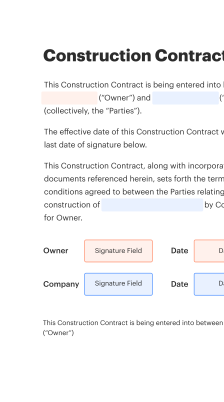
Creating and executing your HIPAA release online

A standard online workflow includes uploading the form, assigning fields, selecting signer authentication, and sending for signature with audit capture enabled.

  • Upload document: Import PDF or template file
  • Place fields: Add signature, date, and initials
  • Select auth: Set email or phone verification
  • Send and track: Notify signers and monitor status
Collect signatures
24x
faster
Reduce costs by
$30
per document
Save up to
40h
per employee / month

Quick setup: Preparing an okay signature service hipaa release form

Follow a few focused steps to prepare a compliant electronic HIPAA release form and configure your eSignature workflow for secure execution.

  • 01
    Draft form: Include patient ID, recipient, scope, purpose, expiry
  • 02
    Select signer auth: Choose email, SMS code, or MFA
  • 03
    Add verification: Attach ID or clinical identifiers if required
  • 04
    Enable audit: Turn on tamper-evident sealing and logs

Managing audit trail details for release form transactions

Capture and review audit elements to prove authenticity and document chain of custody for each signed HIPAA release.

01

Timestamping:

Record event times for each action
02

IP capture:

Log IP addresses for signers
03

Action details:

Record field-level interactions
04

Document hash:

Create tamper-evident hashes
05

Export logs:

Generate CSV or PDF exports
06

Retention of logs:

Store logs with document retention
be ready to get more

Why choose airSlate SignNow

  • Free 7-day trial. Choose the plan you need and try it risk-free.
  • Honest pricing for full-featured plans. airSlate SignNow offers subscription plans with no overages or hidden fees at renewal.
  • Enterprise-grade security. airSlate SignNow helps you comply with global security standards.
illustrations signature

Typical workflow and configuration settings for HIPAA release automation

Common workflow settings define how forms are routed, authenticated, and retained to meet operational and compliance requirements.

Feature Configuration
Reminder Frequency 48 hours
Signer Authentication Method Email OTP
Template Versioning Enabled
Retention Period 7 years
Audit Trail Capture Enabled

Device requirements for signing HIPAA release forms

Most modern mobile, tablet, and desktop platforms support secure electronic signing when using an up-to-date browser or a native app that meets the platform's security expectations.

  • Desktop browsers: Chrome, Edge, Safari, Firefox
  • Mobile support: iOS and Android apps available
  • PDF viewers: In-app rendering for form integrity

Ensure devices run current operating system versions, browsers are updated for TLS support, and users employ corporate-managed devices or strong endpoint protections to reduce risk when executing HIPAA release forms electronically.

Security controls typically used for HIPAA release forms

Encryption at rest: AES-256 level encryption
Encryption in transit: TLS 1.2+ protected channels
Access logging: Comprehensive event logs
Role-based access: Granular access controls
Multi-factor auth: Optional MFA for signers
Data isolation: Tenant separation available

Industry examples: When digital HIPAA release forms are used

Practical scenarios highlight how electronic release forms speed processes while maintaining necessary controls.

Primary care disclosure

A clinic needs timely records transfer for a new specialist appointment, ensuring patient identifiers and scope are correct

  • Form prefill from EHR reduces entry errors
  • Faster authorization cuts scheduling delays and avoids redundant paperwork

Resulting in improved continuity of care and timely specialist access.

Insurance claims coordination

A hospital coordinates with an insurer to verify prior treatments before payment adjudication, requiring documented patient consent

  • Template enforces required legal language and signer fields
  • Automated routing to billing reduces manual follow-up and processing time

Leading to faster claims validation and reduced administrative backlog.

Best practices for accurate and secure HIPAA release forms

Follow these operational and technical practices to reduce risk and ensure valid, auditable releases.

Use standardized, approved templates only
Maintain centrally controlled templates reviewed by legal and compliance teams to ensure required HIPAA elements are present, reduce variation, and simplify audits and training across staff.
Select appropriate signer authentication
Match authentication strength to sensitivity and policy; use multi-factor or identity verification for high-risk disclosures and simpler OTP methods for low-risk scenarios.
Log and retain full audit trails
Ensure every signed release retains an immutable audit trail with timestamps, IP addresses, and document hashes to support investigative or legal needs.
Limit access with roles and permissions
Apply least-privilege principles so only authorized staff can create, send, or retrieve PHI-bearing release forms, and enforce periodic access reviews.

FAQs: common questions about okay signature service hipaa release form

Answers to frequent questions about creating, authenticating, and storing electronic HIPAA release forms.

Feature comparison: signNow versus other major eSignature providers

Compare common technical and compliance features relevant to deploying HIPAA release workflows across leading providers.

Feature signNow (Recommended) DocuSign Adobe Sign
HIPAA-specific offering Available with BAA Available with BAA Available with BAA
API capabilities REST API REST API REST API
Bulk Send / Bulk Send
Native Google Workspace Limited
be ready to get more

Get legally-binding signatures now!

Retention and backup checkpoints for HIPAA release documents

Set clear retention, backup, and review dates to align electronic release storage with policy and legal requirements.

Initial retention review:

At signature plus 1 year

Standard retention period:

Seven years or per state law

Scheduled backups:

Daily encrypted backups

Backup verification checks:

Quarterly restore tests

Records disposal review:

Periodic legal review before deletion

Risks from improper handling of HIPAA releases

Civil penalties: Fines and settlements
Criminal liability: Possible prosecution
Data breaches: Unauthorized exposures
Revoked consent: Invalidated disclosures
Contract breaches: BAA violations
Reputational harm: Trust erosion

Simplify complex workflows

Create, execute, and manage workflows of any complexity, electronically from virtually anywhere. Scalable eSignature capabilities allow you to share documents with the right people in the correct order and define roles for each recipient. Execute document workflows faster and easier than ever before.

Automate document management

Optimize complex signing processes with airSlate SignNow’s powerful features to enhance your business. Control your automated eSignature workflows to ensure they're running at peak performance with instant notifications and reminders.

Optimize in team collaboration

Bring teams together in a secure, shared environment. Manage documents, use form templates and notifications to create more efficient cross-organization collaboration. Free your employees from having to spend time on repetitive activities so that they can focus on valuable, business-critical tasks.

Integrate into your existing systems

Run your projects with industry-leading integration. Collect Salesforce, Microsoft Teams, and SharePoint all in one business flow. Connect your software to a single system for endless possibilities and more productivity.

Stay compliant with best-in-class data protection

Feel safe with the knowledge that your information remains secure by the most recent in encryption security. airSlate SignNow is GDPR and eIDAS compliant and gives you exposure into your eSigning process with court-admissible audit trails. Configure user access permissions and roles to control who has access to what.


walmart logo
exonMobil logo
apple logo
comcast logo
facebook logo
FedEx logo
be ready to get more

Get legally-binding signatures now!