Prove Work Completion Record eSign with SignNow

Eliminate paperwork and optimize document processing for more performance and endless possibilities. eSign any papers from your home, quick and accomplished. Enjoy a greater strategy for doing business with airSlate SignNow.

Award-winning eSignature solution

What proving a work completion record e sign means

Proving a work completion record e sign refers to capturing and retaining a verifiable electronic signature and supporting metadata that demonstrate a specific individual approved or acknowledged that a task, project milestone, or deliverable was completed. This includes the signed document, timestamps, signer identity attributes, IP and device metadata, authentication method, and a tamper-evident audit trail. In many U.S. contexts the record serves as evidence of acceptance or completion for internal controls, client reporting, invoicing, warranty activation, and regulatory compliance where eSignatures are recognized under ESIGN and UETA.

Why an e-signed work completion record matters

A properly captured e-signed work completion record provides reliable proof of acceptance, reduces disputes, and speeds downstream processes by replacing manual acknowledgements with an auditable digital record that meets U.S. legal standards.

Why an e-signed work completion record matters

Common challenges when proving completed work with eSignatures

  • Inconsistent document formatting can obscure required sign-off fields and delay validation of completion.
  • Weak signer authentication raises questions about the signer identity and may undermine evidentiary value.
  • Incomplete audit logs or missing timestamps make it difficult to establish an exact completion moment.
  • Poor retention policies risk loss of records before contractual or regulatory retention periods end.

Representative user profiles for e-signed completion records

Project Manager

Responsible for confirming milestone delivery and approving final acceptance documents. Uses e-signed records to trigger billing, update stakeholder reports, and provide an auditable trail for project closeout and client records.

Field Technician

Performs on-site tasks and captures work completion evidence via mobile devices. Uses eSignature-enabled forms to record completion notes, attach photos, and provide an authenticated signature that links the technician to the completed job.

Typical users who rely on e-signed work completion records

Project managers, contractors, and administrative staff commonly rely on e-signed completion records to confirm task closure and trigger payments or next steps.

  • Construction and trade contractors verifying milestone handoffs and punch-list completion.
  • Professional services teams approving deliverables before invoicing clients.
  • Facilities and inspection teams confirming completed maintenance or safety checks.

Organizations that need clear acceptance evidence—such as facilities teams, professional services, and compliance departments—use these records to reduce disputes and support audits.

Additional functions that strengthen completion records

Beyond core features, these tools help tailor completion records to specific processes and compliance needs.

Template Library

Prebuilt templates preserve consistent structure for completion records, ensuring required fields like scope descriptions, acceptance checkboxes, and signature lines are always present.


Bulk Send

Send identical completion acknowledgement requests to many recipients while tracking individual responses and signatures to streamline multi-site or multi-team confirmations.

Conditional Fields

Show or hide fields based on responses to ensure the recorded data matches the work context, reducing errors and unnecessary data capture.

Role-Based Permissions

Control who can create, send, modify templates, or access signed records to protect the integrity of completion evidence and limit accidental changes.

Retention Policies

Automate document retention and deletion schedules to meet contractual and regulatory requirements for storing completion records.

Integrations

Connect signed completion records to systems like CRM, ERP, or cloud storage to automate acceptance workflows and archival.

be ready to get more

Choose a better solution

Core features that support proving completion with eSignatures

Key capabilities make an e-signed record admissible and operationally useful across teams and audits.

Audit Trail

A timestamped, detailed event log records each action taken on the document, including viewing, field completion, authentication steps, signature application, and final download, supporting chain-of-custody requirements.

Advanced Authentication

Options such as SMS codes, knowledge-based authentication, or multi-factor authentication provide stronger signer identity assurance when provenance is critical for acceptance or compliance.

Tamper-Evident Seal

Cryptographic hashing of the final document ensures any subsequent modification is detectable, maintaining the forensic integrity of the signed completion record.

Mobile Capture

Mobile-friendly signing and the ability to attach photos or forms at point of service let field personnel produce complete evidence of work completion directly from a tablet or phone.
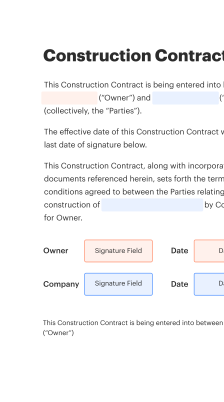
How the e-sign process proves completion in practice

This sequence explains how documents move from draft to an auditable signed completion record.

  • Draft Document: Create a form or upload a PDF.
  • Add Signers: Assign signer roles and order.
  • Signer Authentication: Verify identity before signing.
  • Audit and Archive: Record events and store securely.
Collect signatures
24x
faster
Reduce costs by
$30
per document
Save up to
40h
per employee / month

Quick steps to create a provable e-signed work completion record

Follow these concise steps to assemble, sign, and preserve a legally consistent record for completed work.

  • 01
    Assemble Documents: Collect deliverables, photos, and checklists.
  • 02
    Place Fields: Add signature, date, and acceptance fields.
  • 03
    Authenticate Signer: Choose email, SMS, or MFA authentication.
  • 04
    Finalize and Store: Apply tamper seal and archival retention.

Audit trail steps to maintain for every completion record

Maintain these minimum audit steps in each record so the signed file is verifiable and defensible.

01

Document Created:

Template or upload timestamp
02

Fields Assigned:

Role and field mapping
03

Signer Notified:

Notification event recorded
04

Signer Authenticated:

Auth method and result
05

Signature Applied:

Signature timestamp stored
06

Document Finalized:

Tamper seal applied
be ready to get more

Why choose airSlate SignNow

  • Free 7-day trial. Choose the plan you need and try it risk-free.
  • Honest pricing for full-featured plans. airSlate SignNow offers subscription plans with no overages or hidden fees at renewal.
  • Enterprise-grade security. airSlate SignNow helps you comply with global security standards.
illustrations signature

Recommended workflow settings for reliable completion records

Configure these practical settings to make e-signed records consistent, auditable, and easy to retrieve.

Setting Name Configuration
Reminder Frequency 48 hours
Signing Order Sequential
Authentication Method Email or SMS
Retention Period 7 years
Audit Trail Enabled

Platform and device requirements for capturing e-signed completion records

Make sure signers and administrators use supported platforms and secure network connections to ensure reliable capture and transmission of signed completion records.

  • Desktop: Modern browsers supported
  • Mobile: iOS and Android apps
  • Network: TLS encrypted connections

Confirm browser versions, mobile OS support, and network security policies before rollout; testing on typical field devices and verifying attachments, camera access, and offline behavior helps avoid capture failures in production.

Security controls relevant to proving e-signed completion records

Audit Trail: Comprehensive event log
Tamper Seal: Document integrity hash
Authentication: Email, SMS, MFA options
Access Controls: Role-based permissions
Encryption: Data encrypted at rest
Transport Security: TLS for data in transit

Industry examples showing how e-signed completion records are used

Short examples illustrate how different teams capture signed completion records to reduce risk and speed operations.

Construction Handover

A site superintendent captures completion forms and issue photographs

  • signature confirms final inspection
  • client approval triggers final payment

Resulting in reduced disputes and faster project closeout.

IT Project Acceptance

A technical lead uploads test reports and requires stakeholder eSign-off

  • signature links to authenticated user details
  • acceptance allows production rollout

Ensures auditable acceptance for service-level tracking.

Best practices to produce reliable e-signed proof of completion

Follow these practical controls and process recommendations to maximize evidentiary value and operational consistency.

Standardize completion templates and fields
Create consistent templates that include clear acceptance language, required checkboxes, signature and date fields, and places for supporting attachments so every completion record contains the same essential information for review and audit.
Require appropriate signer authentication
Select authentication strength based on risk; use email for low-risk acknowledgements and SMS or multi-factor checks for approvals that trigger payments, warranties, or regulatory obligations to improve trust in signer identity.
Preserve full audit logs and metadata
Store the final signed document together with the event log, authentication details, and any attachments in a secure, access-controlled archive to support dispute resolution and compliance audits.
Define retention and access policies
Establish retention schedules, backup frequency, and role-based access to signed completion records to meet legal, contractual, and internal governance requirements while minimizing unauthorized exposure.

FAQs and troubleshooting for e-signed work completion records

Answers to common questions about capturing, validating, and storing e-signed proof of completion in U.S. workflows.

Feature availability comparison for proving e-signed completion records

A concise comparison of key capabilities that affect proof and auditability across leading eSignature providers in the U.S.

Criteria signNow (Recommended) DocuSign Adobe Sign
HIPAA Compliance
Bulk Send
Tamper-Evident Audit Trail
SMS Authentication
be ready to get more

Get legally-binding signatures now!

Retention and archival timeframes for completion records

Typical retention windows aligned with common U.S. business and regulatory needs; adjust for your industry and contracts.

Short-term access:

30 to 90 days for operational edits

Standard retention:

7 years for contractual evidence

Financial records:

7 years to satisfy tax audits

Regulated industries:

As required by rule or statute

Permanent archival:

Preserve select records indefinitely

Risks from inadequate work completion records

Dispute Exposure: Increased legal risk
Payment Delays: Billing interruptions
Regulatory Noncompliance: Possible fines
Contractual Breach: Liability issues
Data Loss: Missing evidence
Rework Costs: Operational inefficiency

Pricing snapshot relevant to proof of completion workflows

Brief pricing cues to consider for teams capturing many completion records, focusing on entry tiers and common enterprise features.

Plan signNow (Recommended) DocuSign Adobe Sign Dropbox Sign PandaDoc
Free tier availability Limited free plan No free plan No free plan Free plan Free plan
Starting monthly price $8/user $10/user $14.99/user $8/user $19/user
API access included Available Paid add-on Paid add-on Paid add-on Included
Enterprise features Role controls, SSO Advanced workflows Enterprise admin SSO, admin CRM templates
Bulk sending limits High Variable Enterprise only Variable High

Simplify complex workflows

Create, execute, and manage workflows of any complexity, electronically from virtually anywhere. Scalable eSignature capabilities allow you to share documents with the right people in the correct order and define roles for each recipient. Execute document workflows faster and easier than ever before.

Automate document management

Optimize complex signing processes with airSlate SignNow’s powerful features to enhance your business. Control your automated eSignature workflows to ensure they're running at peak performance with instant notifications and reminders.

Optimize in team collaboration

Bring teams together in a secure, shared environment. Manage documents, use form templates and notifications to create more efficient cross-organization collaboration. Free your employees from having to spend time on repetitive activities so that they can focus on valuable, business-critical tasks.

Integrate into your existing systems

Run your projects with industry-leading integration. Collect Salesforce, Microsoft Teams, and SharePoint all in one business flow. Connect your software to a single system for endless possibilities and more efficiency.

Stay compliant with market-leading data protection

Feel safe understanding that your data remains secure by the most recent in encryption security. airSlate SignNow is GDPR and eIDAS compliant and offers you awareness into your signing process with court-admissible audit trails. Configure user authorization and rights to manage who has access to what.


walmart logo
exonMobil logo
apple logo
comcast logo
facebook logo
FedEx logo
be ready to get more

Get legally-binding signatures now!