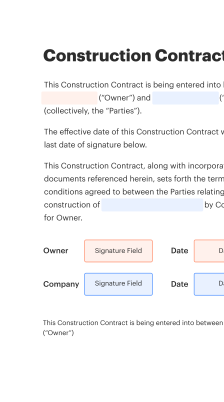
Recover Electronic Signature with SignNow
What recovering an electronic signature means
Why recovering electronic signatures matters
Maintaining access to signature evidence protects contract enforceability, supports regulatory audits, and reduces operational disruption. Effective recovery minimizes legal exposure and preserves business continuity while supporting compliance with ESIGN and UETA requirements in the United States.
Common obstacles to recovering electronic signatures
- Missing audit trails after account closure or administrator changes can complicate verification for legal proceedings or compliance reviews.
- Expired or rotated signing certificates may render signature validation incomplete without preserved certificate chain data or timestamp records.
- Inconsistent document retention policies across departments can lead to accidental deletion of signed records needed for future disputes.
- Lack of standardized export formats and metadata capture prevents straightforward transfer of signature evidence between systems.
Representative user profiles involved in recovery
Records Manager
A records manager coordinates retention schedules, maintains backups, and executes document restores. They reconcile restored artifacts with existing index metadata, ensure integrity checks pass, and deliver preserved records with accompanying audit logs for legal or compliance teams.
Compliance Officer
A compliance officer requests signature retrieval to satisfy audits or investigations. They evaluate recovered evidence against regulatory requirements, confirm chain-of-custody details, and document remediation to prevent recurrence.
Who typically needs to recover electronic signatures
Legal, compliance, and records teams often request recovered signature evidence to support investigations, audits, or litigation.
- Legal departments retrieving signed contracts for dispute resolution and evidentiary needs.
- Compliance officers seeking audit trails to demonstrate regulatory adherence and data retention.
- IT and records managers restoring deleted or archived signed documents from backups.
Recovering signature records also supports HR, finance, and customer service when historical approvals or consent records are required.
Choose a better solution
Platform features that support signature recovery
Audit Trail
Comprehensive, tamper-evident logs record signer IP, timestamps, actions, and document state changes so that each recovered signature can be validated against an immutable event history for legal or compliance review.
Encrypted Backups
Routine encrypted backups preserve full signed documents and metadata offsite. These backups support point-in-time restores and maintain integrity checks so restored records match originals for evidentiary use.
Certificate Management
Integrated certificate and timestamp storage retains signing certificate chains and trusted timestamps, enabling cryptographic validation of signatures even after certificate rotation or expiration.
Evidence Export
Exportable audit reports and PDF/A packages with embedded signatures let organizations produce independent copies for court, regulators, or internal archiving while preserving validation data and metadata.
How recovery processes typically operate
-
Metadata capture: Store signer identity and timestamps
-
Immutable logs: Keep tamper-evident event records
-
Document backup: Periodic encrypted snapshots
-
Evidence export: Produce PDF/A and logs for review
Step-by-step: Recovering an electronic signature
-
01Identify record: Locate contract or signature ID
-
02Check audit trail: Review event timestamps and actions
-
03Restore backup: Recover document from secure backup
-
04Validate signature: Verify certificate chain and timestamps
Why choose airSlate SignNow
-
Free 7-day trial. Choose the plan you need and try it risk-free.
-
Honest pricing for full-featured plans. airSlate SignNow offers subscription plans with no overages or hidden fees at renewal.
-
Enterprise-grade security. airSlate SignNow helps you comply with global security standards.
Key workflow settings for recovery readiness
| Feature | Configuration |
|---|---|
| Audit Log Retention Period | 7 years |
| Document Backup Frequency | Daily snapshots |
| Export Package Format | PDF/A + JSON |
| Admin Access Controls | RBAC enforced |
| Certificate Archival Policy | Store indefinitely |
Device and platform requirements for recovery
Verify platform compatibility, secure connectivity, and administrative access before initiating recovery to ensure smooth evidence retrieval.
- Desktop browser: Modern TLS support
- Mobile devices: Up-to-date OS
- Administrator access: Account owner credentials
Ensure backups are accessible from approved locations, confirm necessary admin permissions are available, and prepare export formats and validation tools before beginning the recovery workflow to reduce downtime and meet compliance obligations.
Real-world recovery scenarios
Financial Services Recovery
A bank lost access to a set of signed loan agreements after a migration
- reliance on preserved audit logs and stored certificate chains
- enabled fast validation of signatures and borrower consent
Resulting in preserved enforceability and minimal loan processing delays for regulatory review and borrower notifications.
University Consent Records
A university needed historic FERPA consent records following an alumni inquiry
- administrators exported archived documents and associated metadata
- the team matched timestamps with identity verification records
Resulting in verified consents and compliant responses that avoided formal complaints and demonstrated proper recordkeeping.
Best practices to secure and recover electronic signatures
FAQs: Recover electronic signature
- How do I recover a deleted signed document?
Locate the document ID or signer metadata, check platform backups and archive snapshots, request an evidence export from the eSignature provider, and validate returned artifacts with the included audit trail to confirm authenticity and timestamps.
- What evidence proves an electronic signature was valid?
A complete package typically includes the signed document, an immutable audit log, signer authentication records, IP addresses, certificate chains, and trusted timestamps that together permit cryptographic validation and demonstrate chain of custody.
- Can expired certificates be used to validate old signatures?
Yes; if certificate chains and trusted timestamps were preserved at signing time, signatures can often be validated post-expiration using retained certificate data and timestamp authorities to demonstrate validity at the moment of signing.
- What if I cannot find the audit trail for a signature?
Confirm backup retention settings and administrative logs, escalate to platform support with document identifiers, and provide any available metadata so providers can locate archived logs or reconstruct evidence from system snapshots.
- Are recovered signatures admissible in U.S. courts?
Recovered signatures can be admissible when accompanied by complete, tamper-evident audit trails and verification artifacts; compliance with ESIGN and UETA and preservation of chain-of-custody improve admissibility in legal proceedings.
- How long should I retain signed records for recovery purposes?
Retention depends on regulatory and business requirements; many organizations retain signed records and audit trails for multiple years—commonly seven years for financial and compliance reasons—to ensure availability for audits and disputes.
How recover electronic signature capabilities compare
| Electronic Signature Recovery Comparison Criteria | signNow (Recommended) | DocuSign | Adobe Sign |
|---|---|---|---|
| Ability to recover deleted signed documents | |||
| Exportable evidentiary package with audit trail | PDF/A + JSON | PDF + XML | PDF/A |
| Long-term certificate archival | Limited | ||
| HIPAA-focused recovery features | Available | Available | Available |
Get legally-binding signatures now!
Regulatory and operational risks if recovery fails
Make simpler complex workflows
Generate, execute, and maintain workflows of any intricacy, digitally from almost anywhere. Scalable eSignature features allow you to share papers with the right people in the correct way and assign roles for each receiver. Execute document workflows faster and simpler than ever before.
Automate document management
Optimize intricate signing processes with airSlate SignNow�s powerful capabilities to improve your business. Manage your automated signature workflows to ensure they're running at top efficiency with fast notices and alerts.
Optimize in team communication
Bring teams together in a protected, shared workplace. Manage paperwork, use form templates and notices to produce more effective cross-company communication. Free your workers from having to spend time on repeated routines to enable them to focus on beneficial, business-vital duties.
Integrate into your current systems
Work your projects with market-leading integration. Assemble Salesforce, Microsoft Teams, and SharePoint all in one business stream. Link your applications to a single environment for unlimited opportunities and more performance.
Stay compliant with best-in-class data safety
Feel confident with the knowledge that your data is protected by the latest in encryption security. airSlate SignNow is GDPR and eIDAS compliant and provides you exposure into your eSigning process with court-admissible audit trails. Set up user authorization and rights to manage who has access to what.