Redline Affidavit of Domicile for Secure Transactions

Eliminate paper and optimize digital document managing for higher performance and endless possibilities. Explore the best strategy for running your business with airSlate SignNow.

Award-winning eSignature solution

What a redline affidavit of domicile is and why it matters

A redline affidavit of domicile is a formal statement clarifying a decedent's legal residence prepared during estate administration; the redline process records edits, objections, and version history while preserving the full audit trail. When completed electronically, the affidavit combines tracked edits with secure signer authentication and tamper-evident signatures to document who made changes and when. Using an eSignature-capable workflow aligns the document with evidence standards accepted in many U.S. jurisdictions, helps reduce settlement delays, and provides a clear, time-stamped record useful for title insurers, probate courts, and estate professionals.

Legal standing and compliance considerations for redlined affidavits

A properly executed electronic redline affidavit of domicile can meet U.S. legal standards when it complies with ESIGN and state UETA laws, includes reliable signer authentication, and preserves an immutable audit trail for evidentiary use.

Legal standing and compliance considerations for redlined affidavits

Common challenges when managing redline affidavits of domicile

  • Conflicting versions: multiple editors can produce inconsistent versions without clear provenance, risking probate delays and disputes.
  • Insufficient authentication: weak signer verification can lead to contested affidavits or rejected filings by title insurers.
  • Missing notarization: some jurisdictions still require physical notary presence or specific notarial wording for domicile affidavits.
  • Retention and access: poor storage practices make retrieval for audits or court review difficult and time-consuming.

Typical user profiles for electronic redline affidavits

Estate Attorney

An estate attorney prepares and reviews affidavits of domicile, coordinates signers, and ensures the document's language meets jurisdictional requirements. They rely on redline history to show revisions and to demonstrate that client approvals and legal edits were made in sequence and by authorized individuals.

Title Officer

A title officer examines redline affidavit history to verify residency claims for title underwriting and closing. They reference version metadata, notarization status, and signer authentication to assess risk and support rapid policy issuance during property transfers.

Professionals and organizations that commonly use redline affidavits

Estate administrators, title companies, and attorneys often work together to prepare and validate redline affidavits of domicile before closing or probate filings.

  • Estate attorneys coordinating domicile evidence, revisions, and legal language for probate or closing.
  • Title insurers reviewing affidavit histories to confirm residence for title transfer and underwriting decisions.
  • Probate clerks or court staff receiving clear, authenticated affidavit versions for filing and record-keeping.

Clear roles and verified electronic records reduce disputes and speed acceptance by courts and insurers.

Key tools that improve redline affidavit of domicile workflows

The right combination of editing, authentication, and workflow controls reduces errors, preserves provenance, and supports acceptance by insurers and courts.

Tracked changes

Maintain a complete edit history showing who added, removed, or modified text with timestamps and reviewer comments, enabling clear attribution for each revision during estate review processes.


Role permissions

Restrict editing and signing to defined roles so only authorized attorneys, administrators, or witnesses can redline or finalize the affidavit, reducing unauthorized alterations and ensuring accountability.

Notarization support

Capture notary details and embed notarial acknowledgments or virtual notarization metadata where allowed, preserving proof of notarization alongside redline history for filing or closing.

Audit log

Generate an immutable, exportable audit trail that records every event — viewing, editing, commenting, and signing — to support evidentiary needs in probate and title disputes.

Template library

Use customizable affidavit templates pre-populated with jurisdictional clauses to reduce drafting errors and to standardize language across estates and closings for faster preparation.

Integration hooks

Connect affidavit workflows to title systems, CRMs, or document repositories so metadata and final PDFs flow automatically into closing packages and insurance underwriting processes.

be ready to get more

Choose a better solution

Integrations and templates for efficient affidavit handling

Integrations and reusable templates save time when producing multiple redline affidavits and reduce manual transfer errors between systems.

Google Docs

Import draft affidavits from Google Docs and preserve tracked changes during conversion; map collaborator comments to the platform's redline workflow to maintain a consolidated edit history and streamline approvals.

CRM connections

Sync signer contact details and transaction metadata from popular CRMs to pre-fill affidavit fields, reducing repetitive data entry and ensuring consistent client records across probate and title workflows.

Dropbox and cloud storage

Save final affidavit PDFs and audit logs directly to cloud folders for secure archival and controlled access by legal teams and title insurers without manual downloads or reuploads.

Reusable templates

Create jurisdiction-specific templates for affidavits that include required clauses, signature blocks, and notarial text; reuse templates to accelerate drafting and maintain compliance across cases.
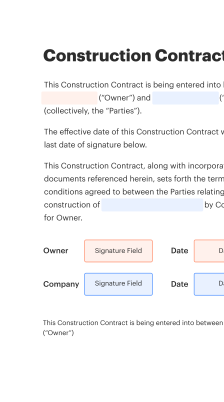
How to create and use a redline affidavit of domicile online

This overview explains the online flow from drafting through finalization, emphasizing version control and signer authentication.

  • Draft document: Upload or create affidavit content in the editor.
  • Enable redlining: Activate tracked changes to record edits and comments.
  • Authenticate signers: Use identity checks before allowing signature actions.
  • Archive final: Lock and store the final affidavit with audit details.
Collect signatures
24x
faster
Reduce costs by
$30
per document
Save up to
40h
per employee / month

Quick setup: preparing a redline affidavit of domicile

Follow these essential steps to prepare, redline, and finalize a legally defensible affidavit of domicile using an electronic workflow.

  • 01
    Create base affidavit: Draft the initial affidavit with required jurisdictional language.
  • 02
    Invite collaborators: Assign roles and permit redline edits to authorized parties only.
  • 03
    Collect signatures: Authenticate signers and obtain signatures with time-stamps.
  • 04
    Finalize record: Lock the final version and export the immutable audit trail.

Managing audit trails for redline affidavit transactions

An organized audit trail demonstrates authenticity; use these actions to collect and preserve necessary events and metadata for each affidavit.

01

Record events:

Log view, edit, and sign events
02

Timestamp changes:

Capture precise UTC timestamps
03

Store signer metadata:

Keep signer IP and device info
04

Export logs:

Provide downloadable audit reports
05

Embed proofs:

Include signatures and certificates
06

Preserve versions:

Archive each redline iteration
be ready to get more

Why choose airSlate SignNow

  • Free 7-day trial. Choose the plan you need and try it risk-free.
  • Honest pricing for full-featured plans. airSlate SignNow offers subscription plans with no overages or hidden fees at renewal.
  • Enterprise-grade security. airSlate SignNow helps you comply with global security standards.
illustrations signature

Recommended workflow settings for affidavit redlining

These default configuration suggestions support controlled editing, sequential approvals, and secure finalization for redline affidavit workflows.

Workflow Setting Name and Configuration Default settings used for redline affidavit workflows
Routing order for multiple signers Sequential routing by role
Reminder Frequency for pending actions 48 hours after inactivity
Maximum edit sessions per user Three concurrent edit locks
Document retention policy for affidavits Store for minimum five years
Finalization and locking behavior Automatic lock after last signature

Device and browser considerations for redlining and signing

Redline and eSignature workflows for affidavits of domicile work across modern browsers and mobile platforms but require current OS and security configurations for best results.

  • Desktop browsers: Chrome, Edge, Safari supported
  • Mobile support: iOS and Android apps available
  • Document formats: PDF preferred for consistent redlining

Ensure devices run supported OS versions, enable browser security features, and use PDF export for notarizations or court submissions to minimize compatibility issues.

Security controls relevant to redline affidavits of domicile

Audit trail: Comprehensive event log
Data encryption: AES 256-bit at rest
Transport security: TLS encrypted in transit
Access controls: Role-based permissions
Two-factor authentication: Optional for signer verification
Document locking: Tamper-evident finalization

Real-world scenarios using redline affidavits of domicile

These examples show how a tracked affidavit can clear title or accelerate probate by preserving edit history and authentication details.

Probate settlement with contested residence

A decedent's heirs disputed last domicile based on separate records and communications

  • Estate counsel generated a redline affidavit showing edits and supporting citations
  • Title company reviewed timestamped sign-offs and notarization status

Resulting in a documented resolution accepted by the probate court and enabling a timely asset distribution.

Title closing where residency affects tax treatment

A realtor needed a definitive residence date for transfer tax calculation

  • The closing team used a redline affidavit to collect sign-offs and evidence in sequence
  • The insurer confirmed the consistent version and notarization before issuing policy

Resulting in a cleared closing where tax classification was accepted by local authorities.

Best practices for secure and accurate redline affidavits of domicile

Adopt consistent procedures to ensure redlines are traceable, signatures are authenticated, and final documents meet jurisdictional and insurer expectations.

Verify signer identity and authority before redlining
Confirm legal authority and identity using government ID verification or multi-factor methods prior to allowing edits or signatures, reducing later challenges to the affidavit's validity.
Preserve the full change history and metadata
Keep the complete redline record, timestamps, IP addresses, and user IDs attached to the affidavit so courts and insurers can review the document's provenance during disputes or audits.
Use jurisdiction-specific language and notarial formats
Apply templates with the precise wording required by the relevant state or county and capture any required notarial acknowledgments to avoid rejections or requests for amendment.
Limit editor roles and require approvals
Assign minimal editing permissions to necessary parties and require sequential approvals so edits are intentional and reviewed, producing a defensible final affidavit.

FAQs About redline affidavit of domicile

Answers to common technical, legal, and workflow questions about preparing, redlining, and finalizing affidavits of domicile electronically.

How major eSignature providers support redline affidavit workflows

This comparison highlights in-document redlining, mobile capabilities, and audit trail detail across leading eSignature vendors relevant to affidavit preparation.

Feature Comparison for eSignature Vendors signNow (Recommended) DocuSign Adobe Sign
Support for in-document redline editing Limited Limited
Mobile redlining capability
Exportable audit trail detail Full Full Full
Integrated notary or notarization metadata Third-party Third-party
be ready to get more

Get legally-binding signatures now!

Common timing and retention milestones for affidavit workflows

Track key deadlines for signings, court submissions, and record retention to ensure compliance and support any future audit or legal need.

Signature collection window:

7 to 30 days typical

Notarization scheduling timeframe:

Within two weeks of final sign-off

Court submission deadline:

Varies by jurisdiction

Retention for probate records:

Minimum five years recommended

Audit log preservation:

Retain with document indefinitely

Pricing snapshot for affidavit redline and signing needs

Representative starting prices and typical enterprise offerings for vendors commonly used to prepare, redline, and sign affidavits of domicile.

Pricing Overview by Vendor signNow (Recommended) DocuSign Adobe Sign Dropbox Sign OneSpan Sign
Starting price per user per month $8 per user/month (annual) $25 per user/month $14.99 per user/month $15 per user/month Contact sales for pricing
Free trial or free tier availability Free trial available Free trial available Free trial available Free tier with limits Trial available on request
Enterprise plan and support options Enterprise plans with dedicated support Enterprise support and integrations Enterprise contracts and SLAs Business and enterprise tiers Enterprise-grade offerings
Advanced template and API access Included in business plans Available in higher tiers Available via enterprise Included in paid plans Available via enterprise
Virtual notarization or notary integrations Integrated or partner notary services Partner integrations required Partner integrations available Partner workflows Integrated advanced options

Streamline complicated workflows

Prepare, deliver, and maintain workflows of any intricacy, digitally from virtually anywhere. Scalable electronic signature functionality allow you to exchange documents with the right people in the proper way and set up roles for every receiver. Stream document workflows faster and simpler than ever before.

Automate document flow

Optimize complex signing procedures with airSlate SignNow�s highly effective features to boost your operation. Manage your automatic eSignature workflows to ensure they're operating at peak performance with immediate notices and reminders.

Enhance in team communication

Join teammates together in a safe, shared environment. Manage paperwork, use form templates and notices to deliver more efficient cross-organization communication. Free your workers from having to hang out on repeating routines to enable them to concentrate on beneficial, business-critical tasks.

Integrate into your current network

Manage your assignments with market-leading integration. Collect Salesforce, Microsoft Teams, and SharePoint all in one business flow. Connect your applications to a single system for countless possibilities and more efficiency.

Stay compliant with best-in-class data security

Feel safe with the knowledge that your information is protected by the latest in encryption security. airSlate SignNow is GDPR and eIDAS compliant and offers you awareness into your eSigning experience with court-admissible audit trails. Configure user access permissions and roles to regulate who has access to what.


walmart logo
exonMobil logo
apple logo
comcast logo
facebook logo
FedEx logo
be ready to get more

Get legally-binding signatures now!