Request Initial Liquidation Agreement Template

Eliminate paper and improve document managing for higher performance and countless opportunities. Sign anything from a comfort of your home, quick and professional. Explore the best way of doing business with airSlate SignNow.

Award-winning eSignature solution

What a request initial liquidation agreement template is

A request initial liquidation agreement template is a standardized document used to initiate the liquidation of specified assets, claims, or obligations under predefined terms. It captures the parties involved, the liquidation triggers, timelines for valuation and payment, allocation of proceeds, and any required representations and warranties. Templates reduce drafting errors, ensure consistent clause placement, and include signature fields and metadata for tracking. When used with compliant eSignature platforms, templates support lawful electronic signing, provide audit trails, and help enforce execution workflows for financial, insolvency, or creditor claim contexts.

Why use a template for requesting initial liquidation agreements

Templates streamline negotiation and execution by ensuring consistency across requests, reducing drafting time and errors while preserving essential legal and transactional elements in a repeatable format.

Why use a template for requesting initial liquidation agreements

Common challenges when preparing liquidation request documents

  • Ambiguous liquidation triggers that lead to disputes and require renegotiation or supplementary documentation to resolve.
  • Incomplete counterparty data and missing signatures that delay execution and require repeated follow-up communications.
  • Manual routing and paper processes that extend timelines and increase the risk of lost or untracked documents.
  • Insufficient audit trails or weak authentication that raise enforceability concerns and compliance risks.

Representative user profiles for liquidation agreement templates

Loan Servicer

A loan servicer uses the template to issue standardized liquidation requests across hundreds of accounts, ensuring each notice includes required triggers, payment instructions, and signature fields while preserving a complete execution record for investor reporting and regulatory review.

Corporate Counsel

Corporate counsel drafts and approves the template to ensure legal sufficiency, document consistency, and enforceability in court or arbitration, while integrating authentication and retention policies to meet compliance obligations.

Organizations and roles that commonly use liquidation request templates

Financial operations, legal teams, and loan servicers commonly use templates to standardize requests for initial liquidation and speed execution.

  • Loan servicers and asset managers who handle routine liquidation events and portfolio enforcement.
  • In-house counsel and external law firms preparing enforceable, consistent documents for distressed transactions.
  • Trustees, bankruptcy administrators, and creditors coordinating claim liquidations and distributions.

Templates help these users reduce review cycles, simplify compliance checks, and preserve a consistent record for audits and dispute resolution.

Additional features to support liquidation agreement workflows

Beyond core template tools, the right platform supports compliance, integrations, mobile signing, and administrative controls for enterprise use.

ESIGN Compliance

Built-in support for ESIGN and UETA electronic signature standards to help validate enforceability under U.S. law.


Role Management

Granular permissions let administrators assign template creation, send, and audit roles across teams for governance.

Mobile Signing

Responsive signing experience for tablets and phones so counterparties can review and sign on the go.

Custom Branding

Match documents and email notifications with organizational branding while retaining required legal language and metadata.

Third-Party Integrations

Connect templates to CRMs, cloud storage, and case management systems to automate data population and archival.

API Access

Programmatic template management and sending to embed liquidation workflows into enterprise systems and automation scripts.

be ready to get more

Choose a better solution

Core template features for liquidation agreement requests

Effective templates combine reusable fields, signer workflows, conditional logic, and compliance metadata to support repeatable, auditable liquidation requests across portfolios.

Template Fields

Custom, repeatable fields allow prefilled party details, collateral descriptions, and numeric placeholders while preserving required legal language and ensuring consistent placement across documents for rapid reuse.

Conditional Logic

Field visibility and signer obligations can change based on predefined conditions, enabling variants of the liquidation request to adapt to different trigger events without separate templates.

Signer Workflow

Sequential or parallel signing order supports structured approvals by servicers, counsel, trustees, and counterparties, with role-based fields and signature anchors for clear responsibilities.

Audit Trail

A complete, tamper-evident record captures timestamps, IP addresses, authentication methods, and document versions to support enforceability and post-execution review.
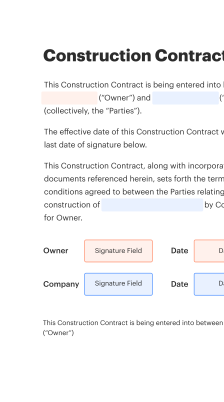
How to create and use the template online

An online workflow lets you author, configure signing rules, assign recipients, and activate tracking for each template instance.

  • Author: Upload draft and position editable fields.
  • Configure: Set signer order and authentication methods.
  • Assign: Add recipient emails and role labels.
  • Execute: Send and monitor completion in the dashboard.
Collect signatures
24x
faster
Reduce costs by
$30
per document
Save up to
40h
per employee / month

Step-by-step: create a request initial liquidation agreement template

Follow these core steps to prepare a clear, enforceable template suitable for electronic execution and tracking.

  • 01
    Draft core terms: Define parties, triggers, and payment mechanics.
  • 02
    Add signature blocks: Include signer roles and required fields.
  • 03
    Configure authentication: Select email, SMS, or ID verification.
  • 04
    Test and publish: Validate fields and save as reusable template.

Checklist to finalize and send a liquidation request template

Use this grid-style checklist to validate legal, operational, and technical readiness before sending a template-based request.

01

Confirm parties:

Verify all party names and contact emails.
02

Validate triggers:

Ensure liquidation criteria are explicit.
03

Set signer order:

Choose sequential or parallel signing.
04

Choose authentication:

Apply required verification methods.
05

Preview document:

Test field placements and conditional logic.
06

Track delivery:

Enable reminders and monitoring settings.
be ready to get more

Why choose airSlate SignNow

  • Free 7-day trial. Choose the plan you need and try it risk-free.
  • Honest pricing for full-featured plans. airSlate SignNow offers subscription plans with no overages or hidden fees at renewal.
  • Enterprise-grade security. airSlate SignNow helps you comply with global security standards.
illustrations signature

Recommended workflow settings for liquidation request templates

These default configuration settings streamline review and execution while maintaining governance and traceability for each template instance.

Workflow Configuration Setting Name for Templates Default configuration values for requests
Reminder Frequency for outstanding signatures Every 48 hours until completion, max three reminders
Signature Routing Order for signers Sequential by role: servicer, counsel, trustee, counterparty
Authentication Method for high-value requests Email plus SMS two-factor authentication
Document Retention Period for records Seven years archived with version history
Bulk Send Enabled for batch requests Enabled for portfolio-level issuance

Device and system requirements for using templates and signing

Ensure recipients and senders meet basic platform requirements to avoid signing interruptions across desktop and mobile environments.

  • Supported browsers: Current Chrome, Edge, Safari, Firefox
  • Mobile OS support: iOS and Android current versions
  • PDF compatibility: Standard PDF/A and image formats supported

For secure and reliable operation, keep browsers and mobile OS up to date, enable cookies and TLS, and ensure recipients can receive email and SMS for authentication when required.

Security and protection features relevant to liquidation templates

Encryption at rest: AES-256 encryption applied
Encryption in transit: TLS 1.2+ for data
Access controls: Role-based permissions
Authentication: Multi-factor options available
Audit logs: Immutable activity records
Document watermarking: Conditional visual protection

Industry examples using initial liquidation agreement templates

Two illustrative scenarios show how templates accelerate liquidation workflows and preserve compliance while documenting execution and transfers.

Distressed Asset Sale

A servicer sends a templated liquidation request to multiple secured creditors to begin asset disposition with defined triggers and timelines

  • Prepopulated fields for collateral description and valuation method
  • Faster creditor acknowledgement and reduced negotiation cycles

Resulting in a clearer execution timeline and improved recovery rates for stakeholders.

Bankruptcy Claim Settlement

A trustee uses a template to propose settlement and liquidation terms to claimants during plan confirmation, ensuring identical terms and required disclosures

  • Standard signature blocks and authentication methods included
  • Reduces administrative burden and ensures audit-ready records

Leading to a streamlined settlement approval process and reliable distribution accounting.

Best practices for accurate request initial liquidation agreement templates

Apply these practices to reduce disputes, speed execution, and maintain a defensible record for each liquidation request.

Use clear liquidation triggers and definitions
Define specific events that trigger liquidation, use consistent terminology, and include objective criteria to reduce ambiguity and minimize disputes over whether the template applies to a given situation.
Prepopulate critical financial and collateral details
Where possible, auto-fill account numbers, collateral descriptions, and valuation methods to reduce manual entry errors and speed counterparty review and acceptance of the request.
Apply appropriate authentication and signer roles
Select authentication levels that match transaction risk, require role-based approvals for counsel and trustees, and ensure each signature is associated with clear legal authority.
Retain complete audit and version history
Keep immutable logs of edits, sends, authentications, and signed copies so you can demonstrate the document’s integrity and the process that led to execution.

Frequently asked questions about request initial liquidation agreement template

Answers to common legal, technical, and operational questions about drafting, sending, and enforcing liquidation request templates.

Quick feature comparison for request initial liquidation agreement templates

Compare essential capabilities across leading eSignature providers commonly used for liquidation requests and template workflows.

Feature Capability Comparison Across Providers signNow (Recommended) DocuSign Adobe Sign
ESIGN and UETA legal compliance
Audit trail and certificate detail Detailed Detailed Basic
Mobile signing support and UX Full Full Limited
Template management and Bulk Send Bulk Send Included Paid add-on Included
be ready to get more

Get legally-binding signatures now!

Typical timeline items in an initial liquidation request

A clear timeline reduces confusion. Include dates for key milestones so parties know expectations for review, signing, and settlement.

Initial request issuance date:

Date the request is sent to counterparties.

Document review period end date:

Deadline for counterparty comments or objections.

Signature deadline for all parties:

Final date by which signatures must be returned.

Funds transfer or settlement date:

Planned date for distribution or liquidation proceeds.

Document retention end date:

Date when records move to long-term archival.

Risks and penalties from poor liquidation request handling

Regulatory fines: Monetary penalties
Invalid execution: Signatures challenged
Delayed recovery: Lost value
Data breaches: Exposure fines
Contract disputes: Litigation costs
Reputational harm: Trust erosion

Pricing snapshot for platforms supporting liquidation templates

Representative pricing and plan tiers to help evaluate platform cost for managing templates and transaction volume; enterprise pricing may vary and often requires vendor quotes.

Plan / Provider Pricing Matrix signNow (Featured) DocuSign Adobe Sign OneSpan Dropbox Sign
Monthly individual price starting at Starts at $8 per user per month Starts at $10 per user per month Starts at $9.99 per user per month Enterprise pricing only Starts at $15 per user per month
Small business annual plan indication Approximately $96 per user billed annually Approximately $120 per user billed annually Approximately $120 per user billed annually Custom annual enterprise contracts Approximately $150 per user billed annually
Enterprise & custom pricing notes Custom tiers with volume discounts and SSO Custom enterprise contracts and support Enterprise bundles with Adobe ecosystem Enterprise-only negotiated pricing Enterprise plans available via sales
Per-transaction or API usage fees Typically included in plan, API quotas vary API overage fees may apply API access in selected plans API usage negotiated per contract API quotas within paid plans
Free tier or trial availability Free trial available; limited free tier for basic use Free trial available; no persistent free tier Free trial available; individual plans priced Contact sales for trial options Free trial available; limited features

Simplify complex workflows

Create, execute, and manage workflows of any complexity, electronically from virtually anywhere. Scalable eSignature capabilities allow you to share documents with the right people in the correct order and define roles for each recipient. Execute document workflows faster and easier than ever before.

Automate document management

Optimize complex signing processes with airSlate SignNow’s powerful features to enhance your business. Control your automated eSignature workflows to ensure they're running at peak performance with instant notifications and reminders.

Optimize in team collaboration

Bring teams together in a secure, shared environment. Manage documents, use form templates and notifications to create more efficient cross-organization collaboration. Free your employees from having to spend time on repetitive activities so that they can focus on valuable, business-critical tasks.

Integrate into your existing systems

Run your projects with industry-leading integration. Collect Salesforce, Microsoft Teams, and SharePoint all in one business flow. Connect your software to a single system for endless possibilities and more productivity.

Remain compliant with best-in-class data safety

Feel confident knowing that your information remains secure by the latest in encryption security. airSlate SignNow is GDPR and eIDAS compliant and provides you exposure into your signing procedure with court-admissible audit trails. Set up user access permissions and roles to control who has access to what.


walmart logo
exonMobil logo
apple logo
comcast logo
facebook logo
FedEx logo
be ready to get more

Get legally-binding signatures now!