Template Builder
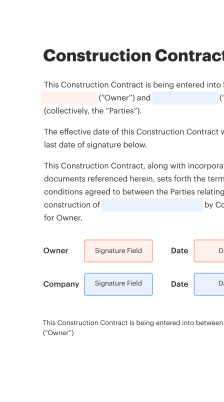
A drag-and-drop template builder extends Word layouts with fillable fields, conditional sections for discounts or service charges, and saved styles to keep bills consistent across shifts and locations.



Standardizing a restaurant bill format in Word reduces calculation errors, accelerates reconciliation, and simplifies staff training while ensuring records meet legal standards for electronic documents under U.S. law such as ESIGN and UETA.

Operations managers configure templates for consistency, set approval workflows, and monitor audit trails across shifts and locations. They coordinate with accounting to ensure necessary fields are present for financial reporting and train staff on template use and troubleshooting procedures.
Accountants validate that finalized bills map correctly to ledger accounts, verify tax calculations and retention policies, and use exported bill data for reconciliations and audits; they also define archival schedules and compliance requirements for signed records.
A drag-and-drop template builder extends Word layouts with fillable fields, conditional sections for discounts or service charges, and saved styles to keep bills consistent across shifts and locations.
Data merge from POS or spreadsheets populates line items, taxes, and totals automatically to eliminate manual entry and speed bill generation during busy service periods.
Send multiple bills or receipts in a single operation for group events or settlements, applying personalized fields and capturing acknowledgments from multiple recipients.
Prebuilt connectors sync templates with POS systems, accounting software, and cloud storage so finalized bills flow directly into financial records without manual uploads.
Comprehensive logs record who generated, viewed, and signed each bill with timestamps and IP metadata to support reconciliations and disputes.
Mobile-optimized viewing and signing let servers and managers create, review, and close bills tableside, reducing wait times and improving guest experience.
Save and version Word templates in shared Drive folders while syncing changes automatically; use Drive triggers to route new bills into signing workflows and preserve audit records in a central repository for accounting access and backup.
Map finalized bill data to ledger entries in QuickBooks or similar systems so totals, taxes, and payment methods import as journal items, reducing manual reconciliation and preserving traceability from bill to general ledger.
Push line-item data from your POS into Word templates using an integration or CSV import, ensuring bills reflect exact order details, modifiers, and applied discounts without manual keying by servers.
Automatically store signed bills in Dropbox or other cloud repositories with folder rules per location, retention policies, and access controls to satisfy internal records retention and audit requirements.
| Workflow Automation Settings and Defaults | Configuration |
|---|---|
| Approval chain per location | Manager approval required |
| Reminder frequency for signers | 24 hours |
| Auto-archive finalized bills | 30 days after signing |
| Notification recipients | Operations and accounting |
| Field validation rules | Require totals and tax fields |
Ensure your staff can access and sign restaurant bills on mobile, tablet, or desktop by confirming browser compatibility, app availability, and network access for shared templates.
For stable operations, standardize on supported browsers and ensure core devices run current OS versions, have reliable internet, and use secure Wi‑Fi or cellular connections; maintain one or two spare devices per shift for redundancy.
A small cafe uses a Word bill template to standardize receipts and tax calculations across registers
Leading to faster checkout, fewer voids, and simpler daily reconciliation with accurate timestamps and a single source of record.
A regional restaurant group deploys a standardized Word bill format across ten locations to unify billing and reporting
Ensures consistent financial records, simplifies audits, and reduces month-end reconciliation time by consolidating structured bills into centralized ledgers.
| Criteria for Restaurant Bill Feature Comparison | signNow (Recommended) | DocuSign |
|---|---|---|
| Availability of the template editor | ||
| Mobile signing and offline support | ||
| Bulk Send for multiple recipients | ||
| HIPAA compliance options | Available | Available |
Nightly full backup
30 days active access
7 years retention
Geo-redundant storage
Quarterly review
| Pricing Tiers and Inclusions | signNow (Recommended) | DocuSign | Adobe Sign | PandaDoc | HelloSign |
|---|---|---|---|---|---|
| Monthly starting price per user | $8 | $10 | $14 | $19 | $15 |
| Free trial availability | Yes, 7 days | Yes, 30 days | Yes, 14 days | Yes, 14 days | Yes, 30 days |
| API access included | Available in paid plans | Available | Available | Available | Available |
| HIPAA / regulated data support | Configurable | Available on request | Available on request | Available | Available on request |
| Multi-user and enterprise discounts | Volume pricing available | Negotiable | Negotiable | Negotiable | Negotiable |