RFP Automation Tools for Hospitality

Streamline your document processes with airSlate SignNow, the easy-to-use solution that helps your business save time and reduce costs.

Award-winning eSignature solution

What rfp automation tools for hospitality do and why they matter

RFP automation tools for hospitality streamline the creation, distribution, and collection of proposals and vendor responses using digital workflows and eSignature. These systems centralize templates, scoring criteria, and approval routing to reduce manual work and standardize responses across property portfolios. For hospitality teams, automation improves turnaround time, enforces consistent compliance controls, and preserves an auditable trail for procurement, contracting, and vendor onboarding while reducing photocopying, printing, and courier delays.

Why implement RFP automation in hospitality operations

Automating RFP processes reduces repetitive tasks, accelerates vendor evaluation, and improves record keeping while maintaining regulatory and operational controls.

Why implement RFP automation in hospitality operations

Common challenges RFP automation addresses

  • Inconsistent proposal formats across properties that complicate scoring and comparison
  • Manual distribution and collection causing delays and lost responses
  • Lack of centralized document history and weak auditability for compliance
  • High administrative overhead from repetitive data entry and approvals

Typical user profiles for RFP automation

Procurement Manager

Manages multi-property sourcing programs, builds standardized RFP templates, assigns scoring criteria, and coordinates approvals. Requires audit trails and integration with procurement systems to ensure consistent vendor on-boarding and contract execution across the hospitality portfolio.

Property General Manager

Initiates local RFPs for services and supplies, reviews vendor proposals, and provides scoring input. Needs simple, mobile-friendly signing and clear visibility into due dates and approvals to expedite local procurements.

Teams and roles that use rfp automation tools for hospitality

Procurement, revenue management, operations, and corporate sourcing commonly rely on automation to coordinate multi-property RFPs and vendor selection.

  • Corporate procurement teams managing vendor contracts across portfolios
  • Property general managers coordinating local vendor evaluations
  • IT and compliance staff enforcing security and retention policies

When configured correctly, automated RFP workflows reduce cycle time and create consistent, auditable vendor records across the hospitality group.

Advanced capabilities for enterprise hospitality workflows

Enterprise RFP automation adds integrations, analytics, and governance controls to support large portfolios and complex vendor ecosystems.

Vendor scoring engine

Automated weighted scoring with configurable criteria and analytics for side-by-side vendor comparison.


Document versioning

Maintain version history and change comparison for contractual terms and RFP revisions.

API access

Programmatic endpoints for integrating RFP status and documents with PMS and procurement systems.

Role-based permissions

Fine-grained access controls limiting template edits, approvals, and exports by role.

Reporting and dashboards

Operational metrics, cycle-time reports, and compliance dashboards for stakeholders.

Retention policies

Configurable retention schedules to meet corporate and legal record-keeping requirements.

be ready to get more

Choose a better solution

Core features to prioritize for hospitality RFPs

Focus on features that reduce manual effort, maintain compliance, and integrate with property systems to provide end-to-end RFP management.

Template Library

Centralized templates with customizable fields ensure consistent RFP structure across properties, simplify updates to terms, and reduce errors when issuing large or frequent requests for proposals.

Bulk Send

Send the same RFP to many vendors at once, track individual response status, and manage reminders automatically to reduce administrative follow-up.

Conditional Routing

Automatically route responses for additional review based on scoring thresholds or vendor attributes, minimizing manual decision steps and enforcing approval policies.

Secure eSignature

Support ESIGN/UETA-compliant signatures with an audit trail and authentication options appropriate for contractual execution and regulatory requirements in the US.
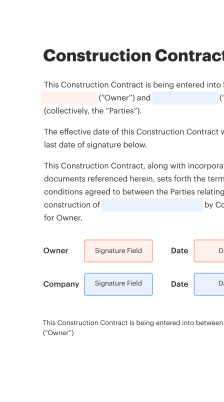
How RFP automation workflows operate

Automation pipelines move an RFP from creation to final signature through defined stages, reducing manual handoffs and ensuring traceability.

  • Template creation: Build reusable RFP templates with fields and scoring.
  • Distribution: Send RFPs to multiple vendors simultaneously.
  • Evaluation: Collect responses and apply scoring rules automatically.
  • Contract execution: Route final documents for eSignature and archival.
Collect signatures
24x
faster
Reduce costs by
$30
per document
Save up to
40h
per employee / month

Quick setup: Implementing RFP automation in hospitality

A concise four-step approach helps teams adopt RFP automation with minimal disruption and clear controls.

  • 01
    Define templates: Create standardized RFP and scoring templates.
  • 02
    Configure routing: Set approval sequence and conditional steps.
  • 03
    Integrate systems: Connect to CRM and procurement databases.
  • 04
    Train users: Provide role-based training and documentation.
be ready to get more

Why choose airSlate SignNow

  • Free 7-day trial. Choose the plan you need and try it risk-free.
  • Honest pricing for full-featured plans. airSlate SignNow offers subscription plans with no overages or hidden fees at renewal.
  • Enterprise-grade security. airSlate SignNow helps you comply with global security standards.
illustrations signature

Recommended workflow configuration settings for hospitality RFPs

Suggested settings balance speed and controls; adjust values to match your organization’s policy and scale.

Feature Configuration
Approval sequence for RFP responses Sequential then parallel
Reminder frequency and escalation rules 48 hours then manager alert
Template publishing and version control Admin-published templates
Vendor scoring and threshold policies Weighted scoring with pass threshold
Document retention and archival schedule 7 years in archival storage

Supported devices and platform requirements

RFP automation tools for hospitality typically support modern desktop and mobile browsers plus native mobile apps where available.

  • Desktop: Chrome, Edge, Safari
  • Mobile: iOS and Android apps
  • Integrations: APIs and webhooks

For optimal performance, use current browser versions, keep mobile apps updated, and confirm SSO and API credentials during initial integration to avoid access interruptions.

Security and authentication features to expect

Data encryption: AES-256 at rest
Transport security: TLS 1.2+ in transit
Access controls: Role-based permissions
Authentication options: Password, SSO
Audit logging: Comprehensive event logs
Regional storage: US-based data centers

Industry examples of RFP automation in hospitality

Two practical examples illustrate how automation reduces manual effort and improves compliance in hospitality sourcing.

Regional Groupwide Vendor Selection

A regional hotel group consolidated disparate RFP documents into a single automated template with scoring fields

  • standardized vendor evaluation criteria
  • reduced time to shortlist by half

Leading to faster contract negotiations and clearer audit records.

Local Services RFP with Mobile Approvals

A property-level RFP for housekeeping suppliers used templated questions and mobile-friendly signing

  • quick supplier submissions
  • on-the-go approvals from the GM

Resulting in timely award decisions and documented compliance for property audits.

Best practices for secure, accurate RFP automation

Adopt operational controls and documentation practices that preserve legal validity and reduce errors across RFP lifecycles.

Standardize templates and scoring criteria across properties
Maintain a central library of approved RFP templates and scoring rubrics to ensure consistent evaluation, reduce ambiguity for vendors, and simplify compliance reviews across the hospitality group.
Enforce role-based permissions and approval thresholds
Implement permissions that separate template editing from sending and approval responsibilities. Configure approval thresholds so high-value contracts require senior sign-off and additional validation steps.
Log and archive every transaction with timestamps
Enable audit trails that capture signer identity, IP, timestamps, and document versions. Use secure archival storage with retention rules aligned to legal and internal policy requirements.
Integrate with procurement and property systems
Connect automation to property management systems and procurement platforms to pre-populate vendor data, reduce manual entry, and keep RFP and contract records synchronized.

Common issues and troubleshooting for RFP automation

Answers to frequent technical and process questions encountered when deploying RFP automation in hospitality operations.

Feature availability: signNow versus major eSignature platforms

A concise availability and capability comparison across common eSignature platforms used in procurement and hospitality workflows.

Feature availability across eSignature platforms signNow (Recommended) DocuSign Adobe Sign
Bulk Send
API for RFP workflows REST API REST API REST API
Role-based access controls
US-based data residency
be ready to get more

Get legally-binding signatures now!

Retention and deadline guidelines for RFP documents

Establish clear deadlines and retention policies that align with operational needs and legal obligations for hospitality records.

Vendor response deadline policy:

Set explicit submission windows and automated reminders.

Approval turnaround timelines:

Define SLAs for each approval tier to avoid bottlenecks.

Contract archival schedule:

Move executed contracts to long-term archive within 30 days.

Retention for procurement records:

Retain procurement documents per policy, commonly seven years.

Periodic review and purging:

Schedule annual reviews to purge outdated templates and contracts.

Regulatory and operational risks to mitigate

Non-compliant signatures: Legal disputes
Weak access controls: Unauthorized access
Poor retention: Record loss
Incomplete audit trails: Litigation exposure
Unsecured storage: Data breach
Inadequate backups: Availability incidents

Pricing snapshot for RFP-focused eSignature use in hospitality

Compare common entry-level and enterprise pricing indicators for planning procurement automation budgets.

Pricing comparison across vendors signNow (Recommended) DocuSign Adobe Sign HelloSign PandaDoc
Free tier availability Limited free plan No free plan Free trial only Limited free plan Free trial
Starting monthly price per user $8 per user $25 per user $30 per user $15 per user $19 per user
Enterprise plans with admin controls Available enterprise plan Available enterprise plan Available enterprise plan Available business plan Available business plan
API included in plan Available with business plan Available with business plan Available with enterprise plan Available via business API Available via API
Contracted support options Email and SLA options Priority support Enterprise support Business support Enterprise support
walmart logo
exonMobil logo
apple logo
comcast logo
facebook logo
FedEx logo
be ready to get more

Get legally-binding signatures now!