Bulk Send
Distribute identical documents to many recipients while preserving individual audit trails and signer-specific fields for mass notifications and acknowledgements.



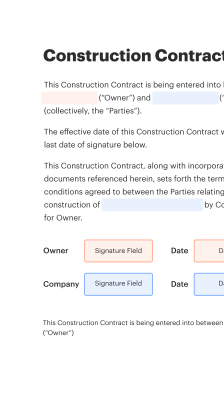
Route e sign request streamlines sequential approvals, reduces manual handoffs, and preserves a comprehensive audit record for compliance and dispute resolution.

An office manager configures routing templates for routine documents such as vendor forms and internal approvals, ensuring signers receive items in the correct order and that reminders and deadlines are applied consistently across recurring processes.
An HR director uses routed requests to manage onboarding and policy acknowledgements at scale, applying identity verification and maintaining retention schedules to satisfy internal governance and regulatory oversight.
Legal, HR, finance, procurement, and operations teams commonly use routed e-sign requests to enforce approval order and preserve compliance.
Routing reduces administrative overhead and centralizes signed documents for retention and reporting across departments.
Distribute identical documents to many recipients while preserving individual audit trails and signer-specific fields for mass notifications and acknowledgements.
Adjust signer sequence dynamically based on form data or approval decisions to model complex business rules without manual intervention.
Programmatically create and monitor routed requests from other systems to automate document-driven processes within existing applications.
Integrate with enterprise identity providers to simplify access and enforce centralized account policies for senders and signers.
Define granular permissions for who can create, modify, send, or view routed requests to maintain separation of duties.
Generate reports on execution metrics, signer activity, and retention to support audits and regulatory reviews.
Reusable templates store predefined fields, signer roles, and routing orders so common documents can be dispatched consistently without rebuilding each time, reducing human error and setup time.
Assign roles such as signer, approver, or reviewer with predefined permissions and sequencing to ensure only appropriate parties can act and the routing logic reflects organizational approval policies.
Support for email verification, SMS codes, knowledge-based authentication, and phone verification lets organizations match identity checks to document sensitivity and compliance needs.
An immutable record of events captures timestamps, IP addresses, and actions taken by each participant, supporting legal admissibility and post-execution audits.
| Primary Workflow Setting Name Header | Configuration (default and custom values) |
|---|---|
| Automatic Reminder Frequency Setting Hours | Every 48 hours until completion |
| Default Signing Order Configuration Setting | Sequential by signer list |
| Maximum Active Requests Per Template | Unlimited or account limit |
| Default Authentication Method Selection | Email verification, optional SMS |
| Document Retention Policy Default Setting | Retain 7 years archival |
Route e sign request workflows are accessible from modern web browsers, mobile apps, and APIs to suit desktop and mobile users.
Ensure browsers are updated and mobile apps are current; when integrating with APIs, follow vendor SDK guidance and secure credentials in accordance with organizational policies.
A clinic routes patient consent forms to intake staff then to a clinician for signature
Resulting in faster visit processing and clearer compliance records.
A procurement team sends supplier agreements first to procurement for review then to legal and finally to finance for approval
Leading to shorter supplier activation times and stronger auditability.
| Feature and Compliance Criteria Comparison Table | signNow (Recommended) | DocuSign | Adobe Sign |
|---|---|---|---|
| Supports Sequential Routing | |||
| Two-Factor Authentication Availability | |||
| Bulk Send Support | |||
| Audit Trail and Tamper Evidence | Comprehensive | Comprehensive | Comprehensive |
7 to 30 days typical
48 hours between reminders
Escalate after 5 days
Archive after final signature
Annual retention audits
| Plan and Vendor Comparison Table | signNow (Recommended) | DocuSign | Adobe Sign | PandaDoc | HelloSign |
|---|---|---|---|---|---|
| Free Trial | Available | Available | Available | Available | Available |
| API Access | Included or add-on | Included | Included | Included | Included |
| Mobile App Availability | iOS & Android | iOS & Android | iOS & Android | iOS & Android | iOS & Android |
| Document Templates and Reuse | Yes, reusable templates | Yes | Yes | Yes | Yes |
| Enterprise-grade Security | SOC2 and encryption | SOC2 and encryption | SOC2 and encryption | SOC2 and encryption | SOC2 and encryption |
Generate, perform, and manage workflows of any complexness, electronically from virtually anywhere. Scalable electronic signature capabilities enable you to share papers with the right users the correct way and determine roles for every signee. Execute document workflows faster and simpler than ever before.
Improve intricate signing processes with airSlate SignNow�s powerful tools to boost your company. Control your automatic eSignature workflows to ensure they're running at top functionality with immediate notifications and alerts.
Join teams together in a safe, shared workplace. Manage paperwork, use form templates and notifications to create more efficient cross-company communication. Free your workers from having to spend time on repeating routines so that they can center on valuable, business-vital duties.
Run your tasks with industry-leading integration. Collect Salesforce, Microsoft Teams, and SharePoint all in one business stream. Hook up your software to a single environment for limitless possibilities and higher productivity.
Feel confident knowing that your data is protected by the most recent in encryption security. airSlate SignNow is GDPR and eIDAS compliant and provides you transparence into your signing procedure with court-admissible audit trails. Configure user access permissions and rights to manage who has access to what.