Route Signed Request with SignNow

Get rid of paperwork and optimize document managing for higher performance and unlimited opportunities. Experience a greater way of doing business with airSlate SignNow.

Award-winning eSignature solution

What route signed request does and why it matters

A route signed request defines an automated handoff that moves a document to the next recipient or destination after a signing event completes. In practice this lets organizations enforce signer order, trigger conditional branches, and deliver signed copies to storage or integration endpoints without manual intervention. For workflows that require multiple approvals, post-sign notifications, or archival to a records system, routing reduces latency and preserves an auditable chain of custody. signNow supports routed signing flows as part of electronic signature workflows used across industries in the United States.

Why use route signed request in everyday workflows

Route signed request automates handoffs, shortens completion time, and preserves an evidentiary trail, reducing manual follow-up and human error in multi-party signing scenarios.

Why use route signed request in everyday workflows

Common routing and signing challenges

  • Misordered recipients or ambiguous signer roles can cause documents to stop mid‑workflow and require manual correction.
  • Lack of conditional routing forces one-size-fits-all flows that neither protect access nor optimize signature order.
  • Mobile signers with limited connectivity may miss routing triggers, delaying downstream approvals and notifications.
  • Insufficient visibility into routing status leads to duplicate requests, confusion, and longer overall turnaround times.

Representative user roles for setting up routes

Account Admin

An administrator configures routing rules, signer roles, and integration endpoints. They maintain templates and retention settings, enforce access controls, and review audit logs to ensure routed documents comply with company policy and legal requirements.

Field Agent

A mobile or remote worker initiates a route signed request at point of service, completes signature steps, and relies on automatic routing to deliver documents to underwriting or records without returning to the office for manual processing.

Teams that commonly use route signed request

Route signed request is useful across departments that handle approvals, compliance, or multi-step authorizations.

  • Human resources teams managing onboarding packets and policy acknowledgments across multiple approvers.
  • Sales operations routing contracts from account executive to legal and then to finance for countersignature.
  • Compliance and records teams automating archival and retention to central repositories after final signature.

Organizations select routed signing to speed processes, ensure consistent order, and maintain a complete audit trail for regulatory or internal review.

Core routing features to look for

A robust route signed request capability combines flexible rules, signer controls, notifications, and integrations to support enterprise workflows and compliance needs.

Routing rules

Create sequential, parallel, or conditional branches based on form data, signer attributes, or external criteria to ensure each document follows the correct path without manual intervention.


Signer roles

Define granular recipient roles and permissions so signers, approvers, and observers have the appropriate actions and access during each stage of the routed workflow.

Automated notifications

Send status alerts, reminders, and escalation messages automatically to reduce lag between steps and ensure routed documents progress without manual chasing.

Expiration controls

Set deadlines and automatic cancellation for routed requests to enforce time-based rules and prevent indefinite pending documents from cluttering workflows.

Audit and reporting

Maintain a detailed, timestamped history of routing events, signer actions, and document deliveries to support legal defensibility and internal audits.

Connectors

Prebuilt integrations and APIs deliver signed documents to storage, CRM, or document management systems, preserving metadata and enabling downstream processing.

be ready to get more

Choose a better solution

Integrations that streamline routed requests

Connecting routed signing to common document and business systems reduces manual steps and ensures signed copies are stored or processed where they belong.

Google Docs

Route signed requests can be initiated from Google Docs drafts, and completed PDFs are returned to a specified Drive folder with metadata preserved to support document lifecycle controls and searchability.

CRM systems

Integrations with CRMs allow routing to start from an opportunity or account record, automatically populate fields, and push completed documents back to the CRM for contract tracking and reporting.

Dropbox

After final signature, routed documents can be delivered to designated Dropbox locations with versioning and folder organization maintained for team access and archival compliance.

Template library

Templates reduce setup time for repeated routed workflows by embedding routing logic, signer roles, and post-sign destinations so teams reuse consistent processes.
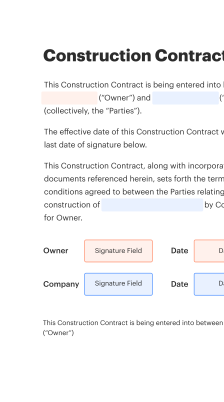
How routed signing flows function technically

Routed flows use triggers and rules to transition documents automatically, invoking notifications, integrations, and storage actions as each signer completes their task.

  • Trigger: Completion of a required signature
  • Evaluate: Apply conditional routing rules
  • Route: Deliver to the next recipient or endpoint
  • Log: Append immutable audit records
Collect signatures
24x
faster
Reduce costs by
$30
per document
Save up to
40h
per employee / month

Simple route signed request setup in four steps

Follow these essential steps to prepare and send a routed signing workflow that moves a document to the correct recipients after each signature completes.

  • 01
    Prepare document: Upload file and add signature fields
  • 02
    Define route: Set sequential or conditional recipient order
  • 03
    Send request: Dispatch to first signer with routing rules
  • 04
    Monitor: Track status and audit trail entries
be ready to get more

Why choose airSlate SignNow

  • Free 7-day trial. Choose the plan you need and try it risk-free.
  • Honest pricing for full-featured plans. airSlate SignNow offers subscription plans with no overages or hidden fees at renewal.
  • Enterprise-grade security. airSlate SignNow helps you comply with global security standards.
illustrations signature

Typical routing workflow configuration settings

Common settings define how a route signed request behaves from initiation to final delivery; adjust defaults to match your business needs.

Setting Name Configuration
Routing Logic Sequential or Conditional
Signature Order Signer order enforced
Reminder Frequency 48 hours
Expiration Period 30 days
Post-sign Destination Configured cloud folder

Platform support and minimum requirements

Route signed request functions across modern desktop and mobile browsers and usually requires only standard connectivity and authentication support.

  • Supported Browsers: Chrome, Edge, Firefox, Safari
  • Mobile OS: iOS and Android supported
  • Required Permissions: Access to storage and email

For best results, ensure devices have current OS/browser updates, stable network access, and any required app-level permissions for integrations and secure authentication.

Security and compliance controls for routed signatures

Encryption in transit: TLS 1.2+ protections
Encryption at rest: AES-256 stored data
Multi-factor authentication: Optional second factor
Audit log: Immutable event trail
Role-based access: Granular permission sets
Certificate signatures: PKI-backed signing option

Industry examples showing route signed request in action

Practical implementations demonstrate how routing accelerates approvals, reduces human touchpoints, and ensures documents reach the right systems after signature.

Mortgage closing

A lender routes loan docs sequentially from borrower to underwriter

  • Conditional routing applies when co-borrowers are present
  • The process reduces manual re-keying and email exchanges

Resulting in faster closings and a complete, timestamped audit trail for compliance and investor review

Employee onboarding

An HR team sends new-hire packets that route to payroll, benefits, and IT based on role

  • Routing conditions select required forms automatically
  • The automation lowers administrative workload and prevents missed steps

Leading to consistent onboarding, faster account provisioning, and centralized retention of signed forms

Best practices for reliable routed signing

Apply consistent configuration, validation, and monitoring to reduce errors and ensure routed signing workflows meet operational and compliance objectives.

Validate recipient order and roles before sending
Confirm each recipient is assigned the correct role and sequence to avoid stoppages. Use template previews and dry-run checks to catch configuration errors prior to live dispatch.
Use templates for repeatable routed workflows
Standardize frequent processes with templates that include routing rules, field placements, and storage destinations. Templates reduce setup time and lower the risk of inconsistent routing logic.
Monitor routing status and automate reminders
Enable automated reminders and status dashboards so administrators identify stalled items quickly and apply corrective actions with minimal manual effort.
Preserve complete audit trails and retention metadata
Capture timestamped events, signer verification details, and destination records to support legal defensibility and comply with internal retention policies.

FAQs and troubleshooting for route signed request

Answers to common problems and configuration questions when working with routed signing flows, including sender setup, delivery issues, and audit log interpretation.

Feature support comparison: routing capabilities

Quick technical comparison of routing and related features across major eSignature providers, with signNow listed first as Recommended for routing utilities.

Feature Criteria for Routing Checks signNow (Recommended) DocuSign Adobe Sign
Sequential routing support
Support for Conditional Routing Rules
API access for routing automation REST API REST API REST API
Included audit trail detail
be ready to get more

Get legally-binding signatures now!

Storage, backup, and retention considerations for routed documents

Define clear retention and backup rules to ensure routed signed documents are available for audit, regulatory review, and business continuity.

Default retention period:

Seven years is common for business records

Immediate backup policy:

Daily backups to redundant cloud storage

Archive location rules:

Store final copies in designated archival folders

Auto-delete after retention:

Configured per policy, often 7 to 10 years

Legal hold procedure:

Suspend deletion when a legal hold is active

Risks of poor routing or weak controls

Invalid signatures: Court challenges
Data breach: Regulatory fines
Non‑compliance: ESIGN/UETA liability
HIPAA violation: Civil penalties
Contract delays: Business loss
Chain gaps: Evidentiary weakness

Pricing snapshot across popular eSignature vendors

Representative entry-level pricing and plan highlights for vendors offering routed signing capabilities; signNow is shown first as Recommended.

Plan or Feature signNow (Recommended) DocuSign Adobe Sign HelloSign PandaDoc
Entry-level Price (Monthly) Approx. $8 per user/month Approx. $10 per user/month Approx. $9.99 per user/month Approx. $15 per user/month Approx. $19 per user/month
Free tier availability Limited free plan available Trial available only Trial available only Free tier with limits Trial available only
Enterprise contract option Yes, custom enterprise agreements Yes, enterprise plans Yes, enterprise agreements Yes, enterprise plans Yes, enterprise offerings
Template and routing features Templates with routing rules included Templates and advanced workflows Templates with conditional routing Templates available Templates and automation
API access level Accessible with paid plans and keys Developer API with plans API access for enterprise plans API available with subscriptions API included in higher tiers

Streamline challenging workflows

Create, perform, and manage workflows of any complexity, electronically from almost anywhere. Scalable electronic signature capabilities let you share papers with the right users the correct way and set up roles for every signee. Perform document workflows faster and easier than ever before.

Automate document flow

Enhance sophisticated signing procedures with airSlate SignNow�s highly effective capabilities to boost your operation. Take control of your automatic eSignature workflows to guarantee they're operating at maximum efficiency with instant notices and reminders.

Enhance in team collaboration

Join teammates together in a secure, shared workplace. Manage documents, use form templates and notifications to deliver more efficient cross-company collaboration. Relieve your staff from having to hang out on recurring actions to enable them to concentrate on beneficial, business-vital duties.

Integrate into your current network

Run your tasks with best-in-class integration. Collect Salesforce, Microsoft Teams, and SharePoint in one business flow. Connect your applications to a single system for limitless opportunities and higher productivity.

Stay compliant with industry-leading data security

Feel confident understanding that your data is protected by the latest in encryption security. airSlate SignNow is GDPR and eIDAS certified and provides you awareness into your eSigning experience with court-admissible audit trails. Configure user access permissions and rights to manage who has access to what.


walmart logo
exonMobil logo
apple logo
comcast logo
facebook logo
FedEx logo
be ready to get more

Get legally-binding signatures now!