Scan Mark: Secure eSignature Solution by SignNow

Remove paper and automate document management for increased productivity and endless possibilities. Enjoy a better way of doing business with airSlate SignNow.

Award-winning eSignature solution

What scan mark Is and How It Fits into eSignature Workflows

scan mark is a mechanism for converting a physical signature or mark captured from a scanned image into a verifiable digital element that can be attached to an electronic document. It typically pairs image recognition with metadata (time, device, file hash) to create a persistent signature object that integrates with an eSignature platform. In regulated U.S. contexts scan mark workflows are configured to meet ESIGN and UETA requirements by maintaining intent, consent records, and tamper-evident audit trails for each signed document. Organizations use scan mark to streamline transitions from paper-first processes to digitally managed records while preserving evidentiary detail.

Why scan mark Can Improve Document Handling

Using scan mark reduces manual re-keying, preserves original signature appearance, and produces a trackable digital artifact for audit and compliance purposes.

Why scan mark Can Improve Document Handling

Common Challenges When Implementing scan mark

  • Poor scan quality can produce unreadable signature images and reduce recognition accuracy, requiring rescanning or manual correction.
  • Inconsistent placement or sizing of marks on scanned pages complicates automated field mapping and increases configuration time.
  • Legal admissibility questions arise if metadata and chain-of-custody are not recorded thoroughly during the scanning and import process.
  • Integration gaps with document storage or signing platforms can cause delays and duplicate records if mappings are not standardized.

User Profiles: Roles and Responsibilities

Compliance Manager

A Compliance Manager configures scan mark policies, verifies metadata capture standards, and enforces audit trail retention schedules. They validate that scanned signatures meet ESIGN and UETA recordkeeping requirements and coordinate with legal counsel on evidentiary needs.

Operations Specialist

An Operations Specialist handles incoming scanned documents, maps signature locations to digital templates, and monitors OCR/recognition results. They troubleshoot scanning quality issues and ensure documents flow into the eSignature system with correct metadata.

Typical Users and Teams That Benefit from scan mark

Organizations that process high volumes of legacy paper forms or that accept faxed and scanned signatures often deploy scan mark to reduce manual processing.

  • Records management teams reconciling archived paper with digital systems for retention and retrieval.
  • Loan and mortgage operations that receive signed paperwork from external partners and need consistent digital records.
  • Healthcare intake and administrative staff capturing patient consent signatures from scanned intake forms.

Teams in compliance, legal intake, HR, loan origination, and healthcare records commonly adopt scan mark as part of a hybrid paper-to-digital strategy.

Functional Tools That Support Reliable scan mark Implementation

A set of features typically required to operationalize scan mark with consistency, quality control, and compliance considerations.

Optical Recognition

High-accuracy image detection locates signature marks and printed names on varied paper backgrounds and produces normalized images for embedding into electronic documents.


Field Anchoring

Template anchors and proximity rules map a scanned signature to the correct electronic field even when scans are slightly shifted or pages are rotated during ingestion.

Metadata Capture

Automatic capture of timestamp, uploader identity, file hash, and capture device details to support evidentiary chain-of-custody and audit requirements.

Batch Processing

Queue-based ingestion and bulk template application for high-volume scanning operations to reduce per-document manual steps and improve throughput.

Quality Alerts

Automated checks that flag low-resolution or distorted scans so operators can re-scan before records are finalized.

Audit Trail Export

Structured export of audit events and metadata to support compliance reviews, legal discovery, and retention audits.

be ready to get more

Choose a better solution

Integration and Template Capabilities Relevant to scan mark

Key integrations and template features make scan mark practical for day-to-day operations and help reduce manual reconciliation between scanned and electronic records.

Google Workspace Integration

Connects scanned documents and templates directly from Google Drive or Docs into the signing workflow so intake images can be routed, mapped to templates, and matched to electronic records without separate downloads or re-uploads.

CRM Integration

Links scan mark artifacts to CRM records so signatures captured on paper are associated with the correct account, opportunity, or contact and any follow-up tasks reflect verified signer metadata.

Dropbox and Cloud Storage

Automates movement of scanned files into secure cloud storage and syncs signed documents back to repositories, preserving both the original scan and the processed electronic version for retention and retrieval.

Custom Document Templates

Allows administrators to create and manage templates that align scanned signature locations to electronic form fields, reducing manual tagging and enabling repeatable scan mark processing for recurring document types.
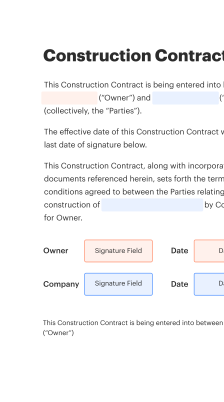
How scan mark Works During Signing and Processing

High-level flow of a scan mark from document ingestion to a verifiable digital record.

  • Ingest: Upload or scan the signed paper document into the system.
  • Detect: Use image processing to locate signature marks on pages.
  • Capture: Extract signature image and associate required metadata.
  • Attach: Embed the scan mark into the electronic document with audit data.
Collect signatures
24x
faster
Reduce costs by
$30
per document
Save up to
40h
per employee / month

Quick Setup: Configure scan mark in Your Workflow

A concise setup sequence for adding scan mark processing to existing document intake and eSignature flows.

  • 01
    Scan Capture: Scan documents at adequate resolution, 300 DPI recommended.
  • 02
    Template Mapping: Define signature locations and field anchors on templates.
  • 03
    Metadata Rules: Configure timestamp, origin, and device metadata capture.
  • 04
    Verification: Enable audit logging and sample verification checks.

Audit Trail: Capturing Evidence for scan mark Transactions

Key steps to ensure each scan mark has a clear, exportable audit trail for compliance and dispute resolution.

01

Capture event:

Log upload time and uploader identity
02

Hashing:

Record cryptographic file hash
03

Metadata attach:

Store device, location, and template ID
04

Signature image:

Include extracted signature image file
05

User consent:

Document signer intent or consent steps
06

Exportability:

Enable structured audit exports
be ready to get more

Why choose airSlate SignNow

  • Free 7-day trial. Choose the plan you need and try it risk-free.
  • Honest pricing for full-featured plans. airSlate SignNow offers subscription plans with no overages or hidden fees at renewal.
  • Enterprise-grade security. airSlate SignNow helps you comply with global security standards.
illustrations signature

Recommended Workflow Configuration for scan mark Automation

Suggested default settings to streamline scanned-signature ingestion, template application, and retention in a typical eSignature-enabled document lifecycle.

Setting Name and Configuration Header Default configuration values used in signNow workflows
Default reminder frequency for signings 48 hours
Default signing order and routing rules Sequential
Default authentication method for scanned uploads Email verification
Default document expiration and archival timing 30 days to archive
Default cloud storage and retention location Encrypted cloud bucket

Security Controls and Authentication Options for scan mark

Document Hashing: File integrity verification
Secure Storage: AES-256 encrypted repositories
Access Controls: Role-based permissions
Multi-factor Authentication: Optional signer verification
Audit Logging: Tamper-evident event records
Transport Security: TLS-encrypted transfers

Industry Examples: scan mark in Practice

Two focused examples show how scan mark supports common U.S. workflows where scanned signatures remain part of the legal record.

Mortgage Operations

A regional mortgage servicer accepts closing documents by courier and scans signed pages into its document management system

  • Template mapping locates borrower signatures and imports them as scan marks
  • The system attaches metadata and links scans to loan records for auditability

Resulting in faster loan boarding and clear evidence of signer intent for regulatory review.

Healthcare Intake

A medical clinic scans patient consent forms at reception and stores them in the EHR as scanned signatures

  • Each scan mark is time-stamped and associated with the intake record
  • Staff use automated matching to link forms to patient charts and validate consent dates

Ensures consistent retention and supports HIPAA-compliant access controls for patient records.

Operational Best Practices for Secure and Accurate scan mark

Follow these practical controls to maintain signature quality, legal defensibility, and efficient handling of scanned signed documents.

Standardize scanning resolution and format across intake locations
Set a minimum scanning resolution (300 DPI recommended) and standard file formats (PDF/A when feasible) to ensure consistent image quality and reliable signature detection while reducing downstream processing variability.
Maintain a documented chain-of-custody and metadata policy
Record who scanned or uploaded the document, when it occurred, and the device or station used; store these metadata elements with the scan mark to support ESIGN, UETA, and internal audit requirements.
Use templates and anchors to reduce manual placement
Create and version templates that include anchor text and coordinate rules so scanned signatures consistently map to the correct electronic fields, minimizing human error and speeding processing.
Implement periodic validation and retention checks
Carry out scheduled audits to validate scan quality, confirm metadata integrity, and purge or archive records according to the organization’s retention policy to reduce legal and storage risks.

FAQs and Troubleshooting for scan mark

Answers to common operational and legal questions when deploying scan mark, plus practical troubleshooting steps for typical failures.

Feature Comparison: scan mark Support Across eSignature Vendors

A concise comparison showing availability and basic capacities for scan mark–related features among common eSignature providers used in the U.S.

Feature signNow (Recommended) DocuSign Adobe Sign
Supports ESIGN and UETA
Bulk send capability
Built-in scanned signature mapping Limited (requires integration)
BAA / HIPAA options Available Available Available
be ready to get more

Get legally-binding signatures now!

Retention and Timing Considerations for scan mark Records

Define retention and archival steps to align scanned signatures and their audit data with legal and business requirements.

Initial retention review period:

30 days for validation and corrective rescans

Standard records retention schedule:

Retention as per organizational policy, often 7 years

Legal hold procedures for litigation:

Immediate preservation until release

Privacy and access review cadence:

Annual access audit for PII-containing documents

Archival format and storage location:

Move to encrypted cold storage after retention threshold

Regulatory Risks if scan mark Is Mismanaged

Noncompliance: ESIGN violations
Evidence Loss: Insufficient audit trail
Data Breach: Unauthorized access
Contract Disputes: Signature authenticity challenged
Financial Penalties: Regulatory fines
Operational Delays: Rework and rescans

Plan and Feature Snapshot Across Leading eSignature Providers

High-level snapshot of plan types and feature availability relevant to organizations evaluating scan mark support and related capabilities.

Plan signNow (Recommended) DocuSign Adobe Sign Dropbox Sign PandaDoc
Entry-level plan name and scope Business plan, core eSign features and templates Personal/Standard plan, single-user focus Individual and Small Business plans Essentials plan, basic eSign Free eSign with limited templates
Free trial or free tier Trial available, paid plans start thereafter Free trial available Free trial available Free tier with limits Free eSign tier available
API access availability Included with business plans and dedicated API plans Available via Developer/API plans API access via Adobe Sign APIs API access on paid plans API access with Business plans
Team management features Role-based users and team templates Advanced admin controls and enterprise plans Admin and enterprise controls Basic team roles Team roles with workspace management
Common advanced authentication Email, SMS, knowledge-based options, and SSO Email, SMS, identity verification, and SSO Email, SMS, certificate-based options, and SSO Email and SSO options Email, SMS, and SSO support

Simplify challenging workflows

Prepare, deliver, and manage workflows of any complexness, electronically from near any place. Scalable eSignature features enable you to share contracts with the right users the right sequence and define roles for every signee. Stream document workflows faster and easier than ever before.

Automate document managing

Enhance intricate signing tasks with airSlate SignNow�s powerful functions to improve your business. Manage your automatic signature workflows to ensure they're operating at top performance with immediate notices and reminders.

Enhance in team communication

Bring teammates together in a protected, shared workspace. Handle documents, use form templates and notices to deliver better cross-organization interaction. Relieve your workers from having to spend time on recurring routines so that they can concentrate on beneficial, business-crucial tasks.

Integrate into your current systems

Manage your projects with industry-leading integration. Capture Salesforce, Microsoft Teams, and SharePoint in one business thread. Link your applications to a single system for countless possibilities and higher efficiency.

Stay compliant with best-in-class data safety

Feel safe with the knowledge that your information is protected by the newest in encryption security. airSlate SignNow is GDPR and eIDAS certified and provides you transparence into your signing procedure with court-admissible audit trails. Configure user access permissions and roles to manage who has access to what.


walmart logo
exonMobil logo
apple logo
comcast logo
facebook logo
FedEx logo
be ready to get more

Get legally-binding signatures now!