Unique ID assignment
Automatic or manual id generation with configurable formats and metadata to uniquely identify every document and support cross-system linking and traceability.




Assigning unique document ids to secure files simplifies tracking, prevents misfiling, and ties signatures and events to a single authoritative record for audits and dispute resolution.

Responsible for ensuring document retention, audit readiness, and regulatory adherence by defining identification schemes, monitoring access logs, and coordinating with legal counsel to validate chain-of-custody for sensitive records.
Implements identifier generation, integrates unique ids with storage and search systems, manages encryption and access controls, and configures API access so applications can programmatically reference documents by id.
Teams responsible for compliance, records management, and high-volume signing workflows typically rely on unique document ids to maintain accuracy and traceability.
Adopting unique document ids reduces manual reconciliation and supports automated processes across departments, improving operational consistency and audit readiness.
Automatic or manual id generation with configurable formats and metadata to uniquely identify every document and support cross-system linking and traceability.
Comprehensive logs that record creation, uploads, signatures, and access events tied to the unique id for forensic and compliance purposes.
Track changes and revisions under a stable id with clear timestamps and signer attribution to avoid ambiguity about which version was executed.
Strong encryption for stored files and secure key management to protect document contents while allowing authorized systems to resolve ids.
Role-based and time-limited access policies mapped to ids, limiting who can view, edit, or download a referenced file.
Reusable templates that include id placeholders, metadata mapping, and signing roles for consistent document generation.
Maps document ids to Google Drive files and adds id metadata to Docs and Sheets, enabling search and automated routing from within Drive and preserving the identifier when files are updated or copied.
Attaches unique ids to contact and opportunity records so agreements and attachments are referenced reliably, supporting automated archival and status tracking within the CRM.
Stores files with id-based filenames or metadata tags, enabling consistent retrieval and synchronization between storage and signing systems while retaining audit associations.
Templates auto-insert identifiers and associated fields into new documents, ensuring every generated contract or form includes a persistent id tied to its audit trail.

| Feature | Configuration |
|---|---|
| Document ID Format | UUID-v4 |
| Auto-ID Assignment | Enabled |
| Retention Period | 7 years |
| Access Expiration | 90 days |
| Reminder Frequency | 48 hours |
Secure id assignment and verification should work across desktop, mobile, and tablet environments to support flexible signing and administration.
Ensure your chosen platform offers consistent id generation, secure storage, and audit export features across all devices, so users can locate or verify documents regardless of where the signature or upload occurred.
A brokerage attaches a unique id to each purchase agreement and addendum to ensure the signed contract version is clear
Resulting in faster closings and clearer audit trails for contract lifecycle management.
A clinic assigns unique ids to patient consent and disclosure documents to maintain chain-of-custody
Ensures accurate patient records and supports HIPAA-compliant reporting, reducing risk during compliance reviews.
| Criteria | signNow (Recommended) | DocuSign | Adobe Sign |
|---|---|---|---|
| Unique Document ID Assignment | Automatic | Automatic | Automatic |
| Audit Trail Completeness | Detailed | Detailed | Detailed |
| HIPAA Support | Available | Available | Available |
| API for ID Lookup |
30 to 90 days
3 to 7 years
7 years or per law
Retention per HIPAA/FERPA rules
Indefinite until released
| Plan | signNow (Recommended) | DocuSign | Adobe Sign | HelloSign | PandaDoc |
|---|---|---|---|---|---|
| Monthly starting price | $8 per user | $10 per user | $9.99 per user | $15 per user | $19 per user |
| Free trial length | 7 days | 30 days | 7 days | 14 days | 14 days |
| API access included | Yes | Yes | Yes | Yes | Yes |
| HIPAA compliance available | Available with BAA | Available with BAA | Available with BAA | Limited | Available with BAA |
| Enterprise security features | SAML, SSO, Audit Logs | SAML, SSO, Audit Logs | SAML, SSO, Audit Logs | SAML, SSO | SAML, SSO, Audit Logs |
Document IDs are helpful whenever you need to find a specific file among all the documents stored on your airSlate SignNow account. In addition, Document IDs are essential for security and audit purposes, allowing you to protect documents from tampering.
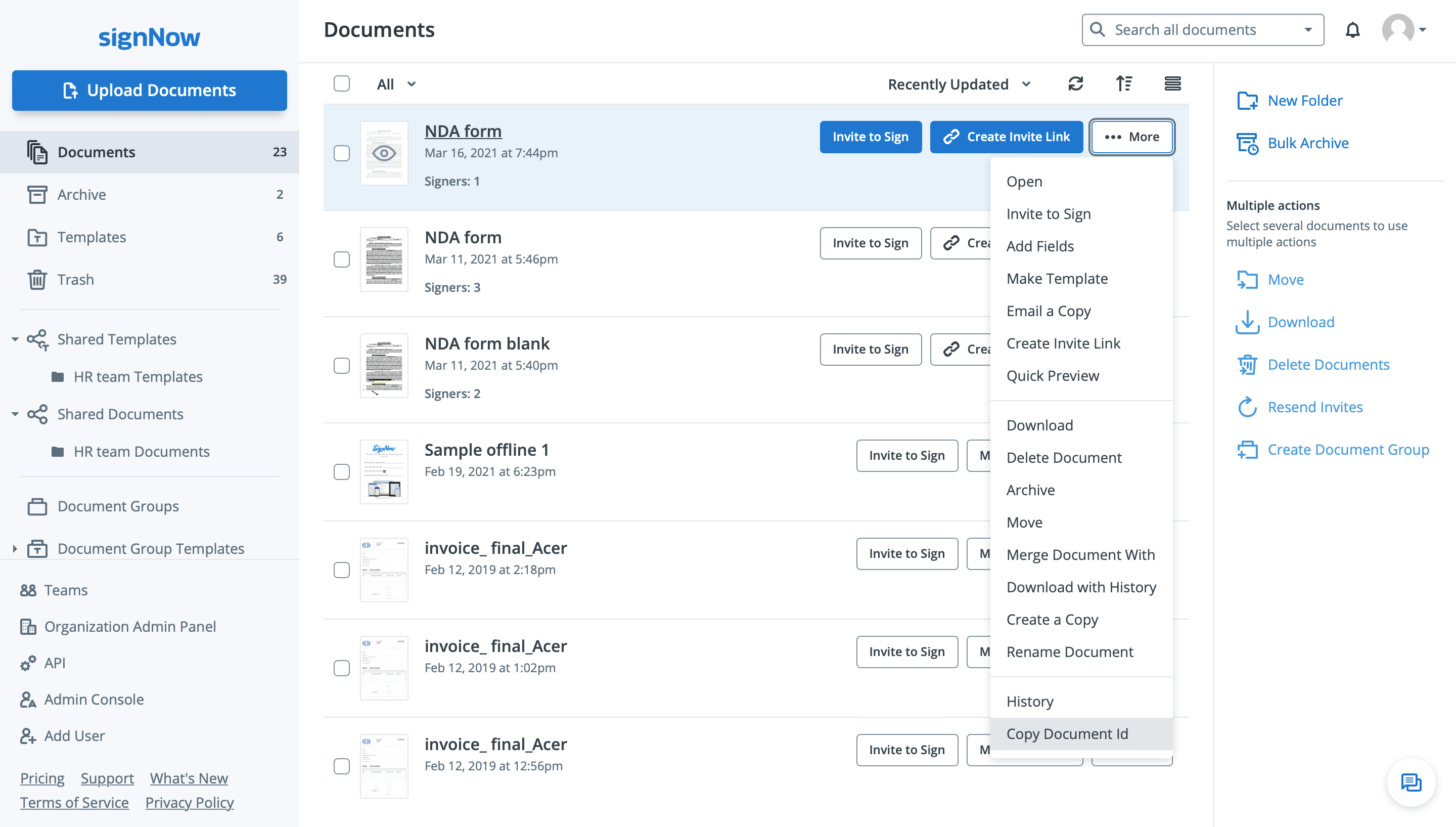
Click More next to a document and select Copy Document ID from the dropdown.
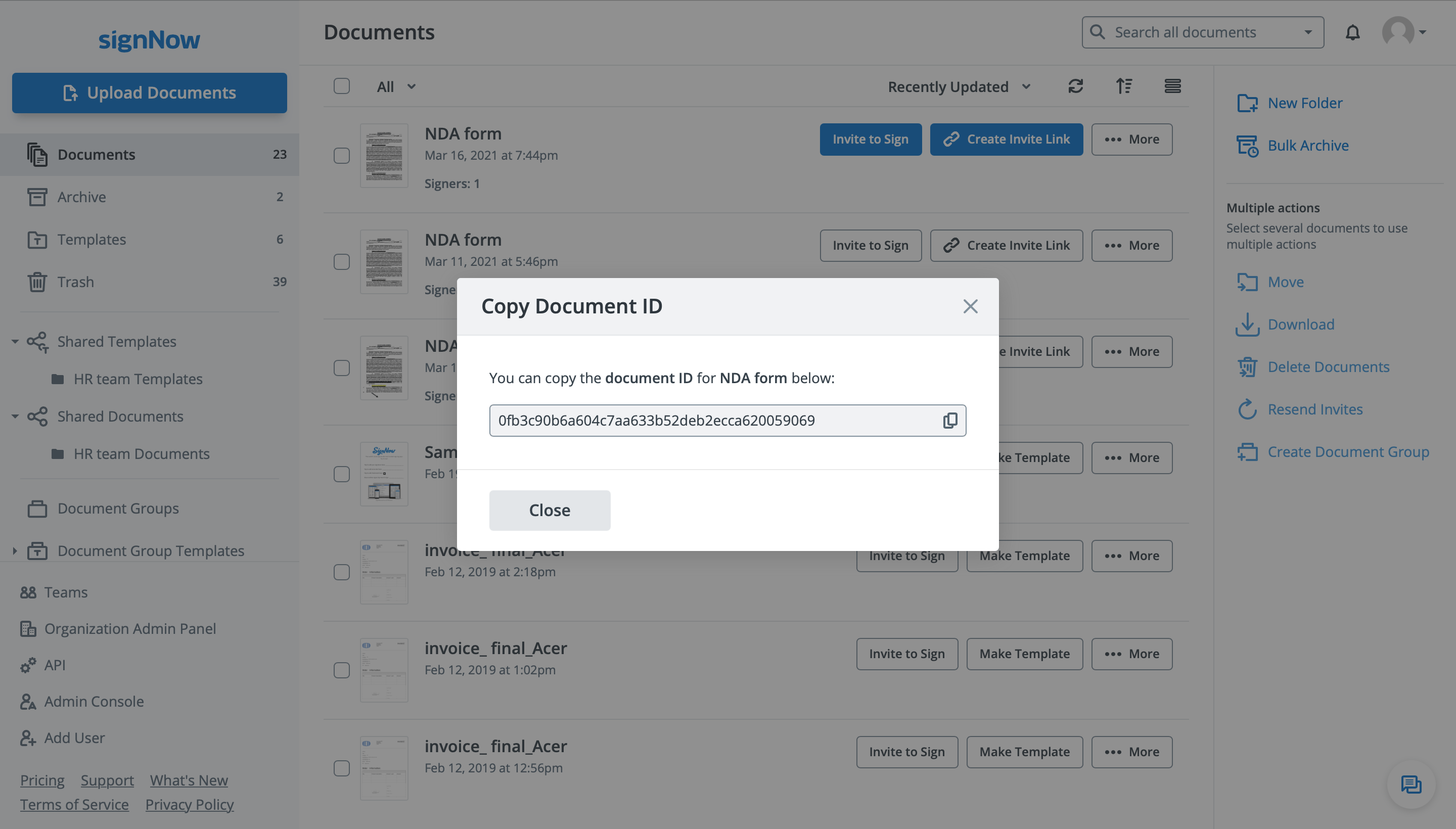
A Document ID will appear in the pop-up window so you can easily copy it in one click.
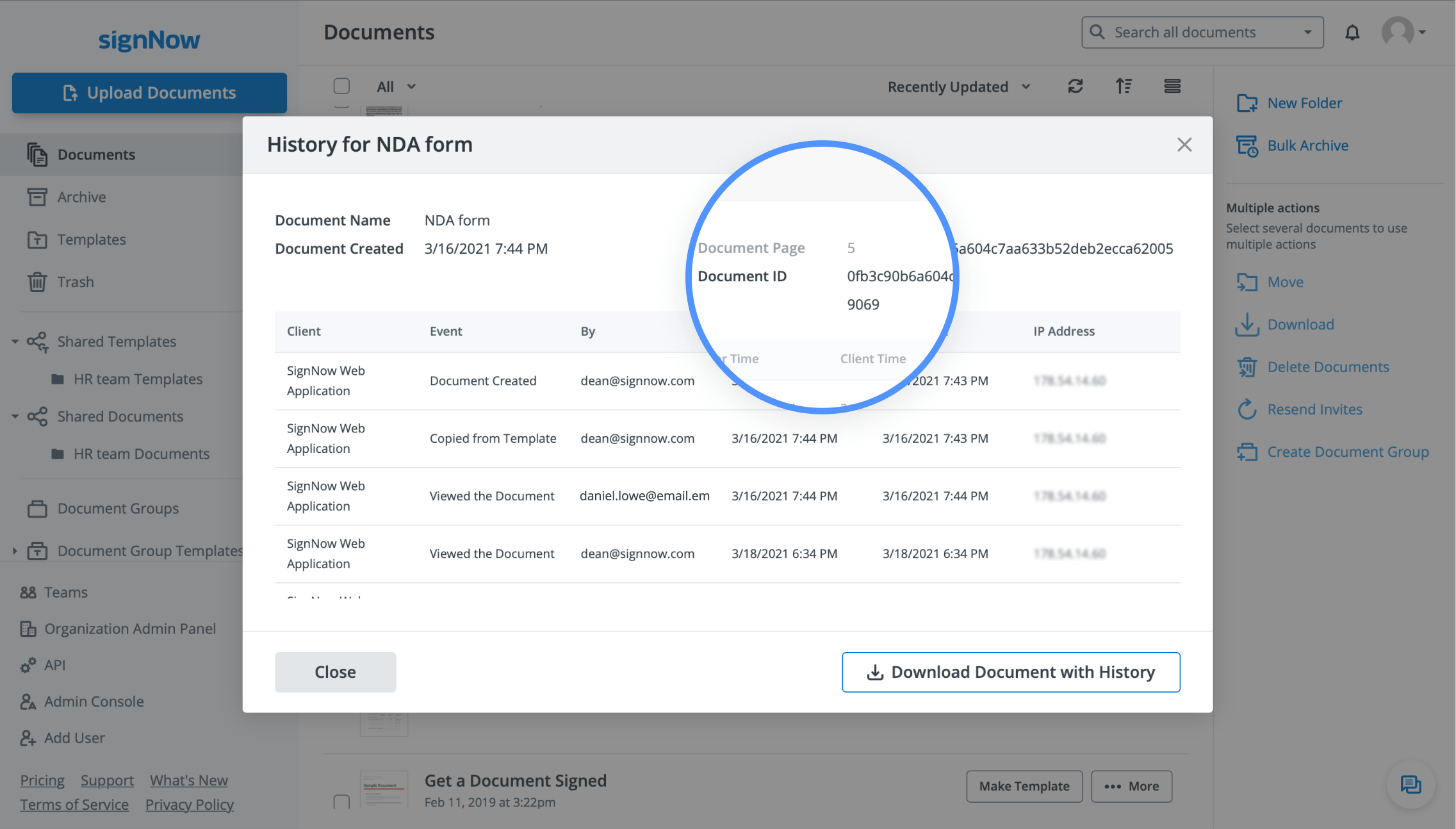
Also, Document IDs appear in History logs (click More > History).
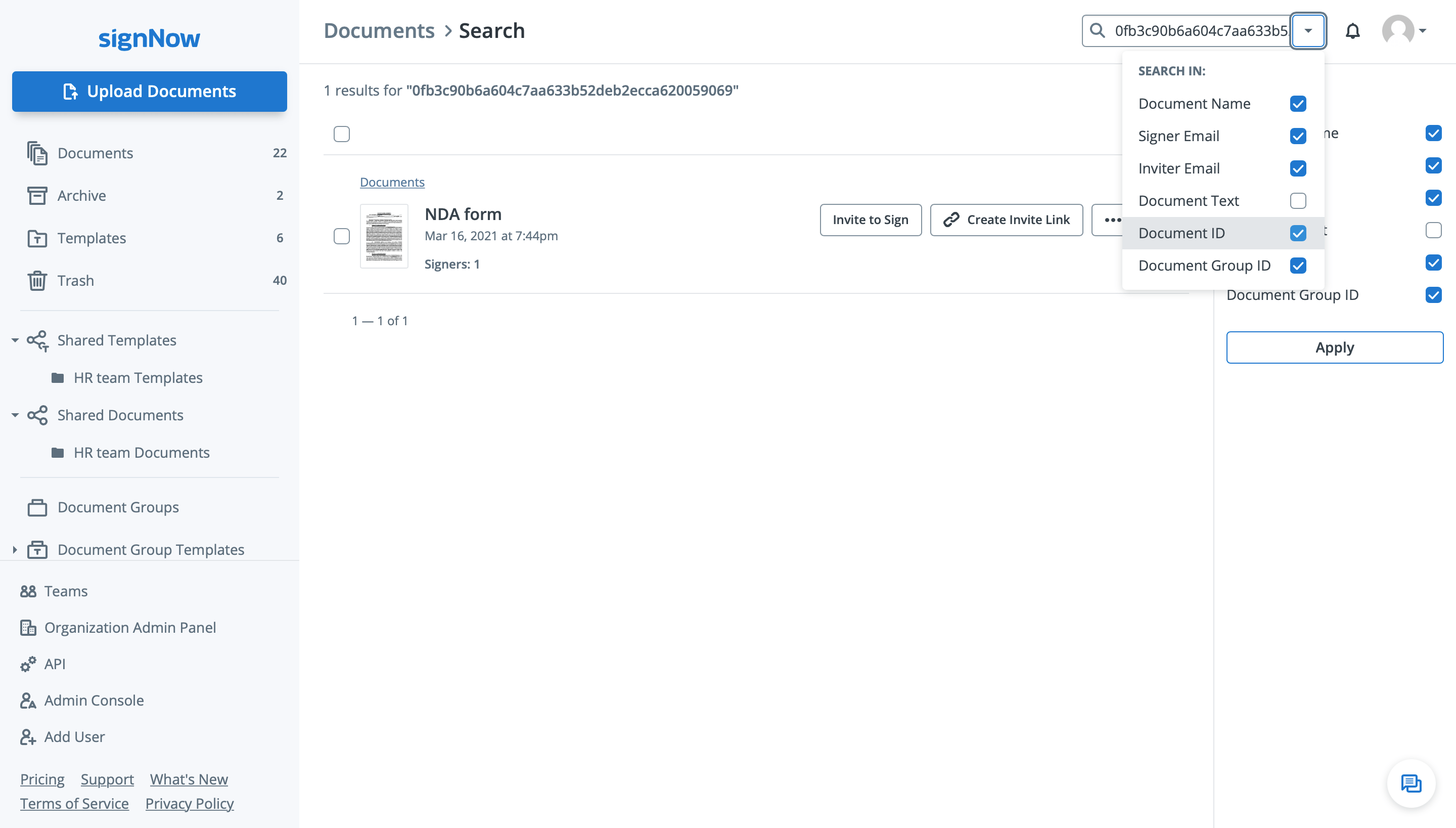
Paste a Document ID in the search bar to easily find your document. Make sure the Document ID filter is enabled before searching.