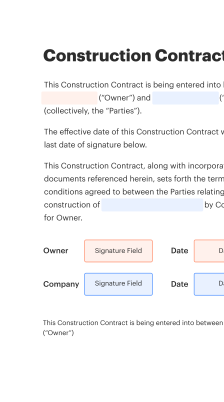
Send Beneficiary Name Securely with SignNow

Get rid of paper and automate digital document processing for more performance and limitless opportunities. eSign anything from a comfort of your home, fast and accomplished. Discover a greater manner of doing business with airSlate SignNow.

Award-winning eSignature solution

What send beneficiary name means for digital documents

The send beneficiary name feature lets a sender specify the legal beneficiary or recipient name that appears in signature requests and associated document metadata. In practice, this ensures the named beneficiary is recorded in the envelope, used for recipient routing, and included in audit logs and certificates of completion. For organizations processing beneficiary-sensitive paperwork such as beneficiary designation forms, trust documents, or insurance disbursements, recording the beneficiary name at send time reduces manual entry errors and helps align signatures with downstream processing and compliance requirements across business units.

Why recording the beneficiary name matters

Including the beneficiary name at send stage improves document accuracy, supports clear recipient intent, and aligns records with legal requirements for transactions that rely on named beneficiaries.

Why recording the beneficiary name matters

Common challenges addressed by sending beneficiary name

  • Mismatched recipient data causing processing delays and manual reconciliation.
  • Manual re-keying of beneficiary details that increases transcription errors.
  • Difficulty proving recipient intent when beneficiary identity is not recorded.
  • Complex routing when multiple potential beneficiaries create ambiguous workflows.

Typical user profiles for beneficiary name workflows

Trust Officer

A trust officer prepares trust amendments and beneficiary change forms, ensuring the named beneficiary is entered correctly when sending documents for signature and retained in the transaction audit to meet fiduciary recordkeeping requirements.

Benefits Manager

A benefits manager coordinates enrollment and beneficiary designation forms across employees, using the send beneficiary name field to reduce rework, ensure accurate payroll and benefits records, and simplify audits of benefit payouts.

Organizations and roles that rely on beneficiary naming

Financial services, insurance teams, estate planners, and HR departments often require explicit beneficiary records during signature workflows.

  • Trust administrators handling beneficiary designations and amendments.
  • Insurance underwriters and claims teams verifying payee names.
  • Payroll and benefits teams managing death benefit or deferred payment beneficiaries.

Recording beneficiary name at send time streamlines downstream verification, reduces exceptions, and supports consistent audit records across teams.

be ready to get more

Choose a better solution

Core tools that support send beneficiary name

Several built-in features help ensure beneficiary name accuracy, traceability, and integration with downstream systems during eSignature workflows.

Prefill fields

Prefill allows senders to programmatically set the beneficiary name before sending so the value appears consistently across all document copies and cannot be altered by subsequent signers, improving accuracy for downstream processing.

Field locking

Field locking prevents signers from changing beneficiary information once set, maintaining document integrity and preserving the original sender-specified beneficiary for legal and compliance purposes.

Validation rules

Validation rules enforce format, character limits, or cross-field checks on the beneficiary name at entry time, minimizing transcription errors and ensuring the name meets organizational or regulatory standards.

Metadata capture

Captured metadata stores the beneficiary name in transaction records and the audit trail, enabling search, reporting, and system-to-system synchronization with CRM or back-office systems.

How the beneficiary name flows through a signing transaction

This sequence shows how the beneficiary name is recorded, validated, and stored during typical eSignature workflows.

  • Sender entry: Sender inputs beneficiary name into field
  • Validation: System validates format and rules
  • Signing: Signers see locked beneficiary field
  • Archival: Name stored in audit and metadata
Collect signatures
24x
faster
Reduce costs by
$30
per document
Save up to
40h
per employee / month

Quick steps to include beneficiary name when sending

Follow these core steps to ensure the beneficiary name is captured and protected during the sending process.

  • 01
    Prepare document: Open template and identify beneficiary field
  • 02
    Enter beneficiary: Prefill the beneficiary name accurately
  • 03
    Lock field: Set field to non-editable for signers
  • 04
    Send: Dispatch with recipient routing and audit enabled

Audit trail steps for beneficiary name transactions

Key audit steps to record beneficiary name actions from creation through archival.

01

Create:

Record sender and timestamp
02

Prefill:

Log data source
03

Validate:

Note validation result
04

Lock:

Capture lock event
05

Sign:

Include signer acknowledgements
06

Archive:

Store immutable record
be ready to get more

Why choose airSlate SignNow

  • Free 7-day trial. Choose the plan you need and try it risk-free.
  • Honest pricing for full-featured plans. airSlate SignNow offers subscription plans with no overages or hidden fees at renewal.
  • Enterprise-grade security. airSlate SignNow helps you comply with global security standards.
illustrations signature

Typical workflow settings for beneficiary name automation

Configure these settings to automate beneficiary name population, validation, and retention across signature workflows.

Setting Name Configuration
Prefill Source CRM record
Validation Rule Set Name format
Field Lock Mode Locked
Reminder Frequency 48 hours
Retention Policy 7 years

Device and platform considerations for beneficiary name workflows

Beneficiary name capture works across modern web browsers and native mobile apps, but ensure platform parity for validation and locking features.

  • Web browsers: Chrome, Edge, Safari
  • Mobile platforms: iOS and Android
  • Offline access: Limited support

For consistent behavior, validate templates and prefill integrations on each target platform, and confirm that client-side validation, field locking, and audit capture operate identically on mobile and desktop before scaling workflows into production.

Security controls related to beneficiary name fields

Field encryption: Data encrypted at rest
Transport security: TLS for data in transit
Access logging: Detailed access records
Role restrictions: Limited edit permissions
Audit trail entry: Immutable timestamped logs
Data masking: Masking for views

Industry examples showing beneficiary naming in practice

Real-world scenarios illustrate how specifying beneficiary name at send reduces errors and supports compliance across sectors.

Insurance payout forms

An insurer sends a claim payout form with the beneficiary name prefilled

  • uses template fields to lock the beneficiary
  • reduces claimant disputes and processing time

Resulting in faster disbursements and clearer audit records that accelerate claims settlement.

Retirement account changes

A retirement plan administrator distributes beneficiary update forms with the beneficiary name recorded at send

  • enforces data validation rules on the field
  • mitigates mismatches between plan records and signed documents

Leading to fewer corrections, smoother recordkeeping, and simpler compliance reporting for audits.

Best practices for secure and accurate beneficiary names

Adopt consistent procedures and controls to reduce errors and maintain compliance when sending beneficiary names with documents.

Use standardized name formats and data validation
Define and enforce a single name format (for example, full legal name with suffixes) and apply field validation at data entry to prevent common variations, abbreviations, or missing components that cause downstream mismatches and administrative burden.
Restrict editing and log changes
Make beneficiary fields sender-only or locked for signers, and ensure all edits are logged with user identity, timestamps, and reason codes to maintain an auditable chain of custody for beneficiary data.
Sync with authoritative systems
Integrate beneficiary fields with authoritative back-office systems or CRMs to prefill and verify data at send time, reducing manual re-entry and ensuring consistency between signed documents and core records.
Train users and document policies
Provide role-based guidance for who may set or change beneficiary names, document the acceptable workflows, and include checks in review processes to catch discrepancies before executing legally binding transactions.

FAQs and troubleshooting for send beneficiary name

Answers to common questions and solutions for issues that can arise when sending documents with a beneficiary name field.

Feature availability: beneficiary naming across vendors

A concise availability comparison showing which providers support beneficiary naming features and key technical limits.

Criteria signNow (Recommended) DocuSign Adobe Sign
Prefill API
Field locking
HIPAA support Optional Optional Optional
Bulk update limits 2,500 records 1,000 records 1,500 records
be ready to get more

Get legally-binding signatures now!

Risks if beneficiary names are mishandled

Processing delays: Settlement hold-ups
Payout errors: Incorrect beneficiaries
Regulatory exposure: Compliance gaps
Audit failures: Incomplete records
Fraud risk: Unauthorized changes
Reputational harm: Customer trust loss

Pricing and plan characteristics across eSignature vendors

High-level pricing and plan traits to consider when evaluating beneficiary name functionality and enterprise needs across providers.

Plan Feature signNow (Featured) DocuSign Adobe Sign Dropbox Sign PandaDoc
Starting monthly price $8 per user $10 per user $9 per user $12 per user $19 per user
Free trial 14 days 30 days 14 days 14 days 14 days
Minimum users 1 user 1 user 1 user 1 user 1 user
API access Included with plans Paid add-on Included with plans Included with plans Paid add-on
HIPAA support Available Available Available Limited Available

Simplify complex workflows

Create, execute, and manage workflows of any complexity, electronically from virtually anywhere. Scalable eSignature capabilities allow you to share documents with the right people in the correct order and define roles for each recipient. Execute document workflows faster and easier than ever before.

Automate document management

Optimize complex signing processes with airSlate SignNow’s powerful features to enhance your business. Control your automated eSignature workflows to ensure they're running at peak performance with instant notifications and reminders.

Optimize in team collaboration

Bring teams together in a secure, shared environment. Manage documents, use form templates and notifications to create more efficient cross-organization collaboration. Free your employees from having to spend time on repetitive activities so that they can focus on valuable, business-critical tasks.

Integrate into your existing systems

Run your projects with industry-leading integration. Collect Salesforce, Microsoft Teams, and SharePoint all in one business flow. Connect your software to a single system for endless possibilities and more productiveness.

Stay compliant with best-in-class data protection

Feel safe understanding that your information is protected by the most recent in encryption security. airSlate SignNow is GDPR and eIDAS compliant and provides you transparence into your signing procedure with court-admissible audit trails. Configure user authorization and roles to regulate who has access to what.


walmart logo
exonMobil logo
apple logo
comcast logo
facebook logo
FedEx logo
be ready to get more

Get legally-binding signatures now!