Templates
Reusable templates let teams standardize documents, predefine fields and signers, and apply consistent branding and legal language to reduce setup time and human error across recurring transactions.




send document for signing and sign reduces manual handling, accelerates approvals, and preserves a verifiable record of consent while aligning with U.S. electronic signature legislation and common business practices.

An HR Manager prepares offer letters and employee forms, configures signer fields, and tracks completion status. They rely on templates, identity verification, and retention policies to ensure compliant employee records while minimizing administrative overhead across hiring workflows.
A Sales Representative sends quotes and contracts to customers, sets signing order for multiple parties, and monitors signature progress. They use reminders and integrations with CRM systems to keep deals moving and to automatically update opportunity records after signatures complete.
Organizations of all sizes use digital signing to reduce turnaround time and maintain compliant records for audits or disputes.
Reusable templates let teams standardize documents, predefine fields and signers, and apply consistent branding and legal language to reduce setup time and human error across recurring transactions.
Bulk Send enables sending the same document to many recipients with individualized fields, simplifying mass acknowledgements, policy confirmations, and large-scale consent gathering while tracking each recipient separately.
Conditional logic displays fields only when relevant, guiding signers through forms and preventing incomplete or inapplicable entries that could invalidate or delay the agreement.
Define roles and signing order to ensure documents are signed in the correct sequence and that responsibilities are clear for multi-party agreements and approvals.
Automated reminders and expiration policies keep signature requests active and help teams manage deadlines while reducing manual follow-up tasks and lost opportunities.
Comprehensive audit trails capture timestamps, IP addresses, and authentication events to support enforceability and provide evidence in case of disputes or compliance reviews.
Connect send document for signing and sign to Google Docs and Drive to initiate signing directly from documents, auto-save signed PDFs back to Drive, and maintain folder-based retention policies that align with team workflows and access controls.
Integrate with CRMs to merge contact and opportunity data into contract templates, trigger signature requests from deal stages, and push signed copies and status updates back to the customer record for auditability.
Sync completed documents to cloud repositories such as Dropbox or Google Drive to centralize storage, apply backup and retention rules, and ensure easy retrieval for compliance or customer inquiries.
Work with common editors to convert and prepare documents for signing, preserving formatting and allowing placeholders to be mapped to signer fields before sending.

| Workflow Setting Name (Technical Header) | Default configuration and typical value |
|---|---|
| Reminder Frequency for Signers (Days) | Send reminders 48 hours after initial request; repeat weekly twice. |
| Expiration Period for Documents (Days) | Set expiration at 30 days with option to extend manually. |
| Notification Settings for Sender | Immediate email on signature and daily digest for pending items. |
| Field Validation Rules and Enforcement | Require mandatory fields and pattern checks for emails and SSNs. |
| Signing Order and Role Assignment | Sequential signing by role with optional parallel subflows enabled. |
Ensure your devices run supported OS versions and that browser settings allow secure cookies and TLS connections to maintain stability and security during upload, signing, and download processes.
A clinic generates a patient consent form with prefilled demographics and HIPAA compliance settings.
Resulting in a HIPAA-aligned signed consent stored with retention metadata for audits.
A sales team uses a template to populate customer and product details automatically from CRM.
Leading to faster close rates and consistent contract records for revenue recognition.
| Feature Criteria for Signing Comparison | signNow (Recommended) | DocuSign | Adobe Sign |
|---|---|---|---|
| Bulk Send available | |||
| Embedded signing SDK | |||
| HIPAA compliance options | |||
| Native CRM integrations |
Maintain signed contracts for at least seven years or per industry-specific requirements.
Perform daily backups with encrypted off-site copies for disaster recovery.
Archive inactive agreements annually to reduce active storage costs.
Review user access quarterly to ensure proper controls.
Apply approved destruction after retention period and legal hold clearance.
| Providers | signNow (Recommended) | DocuSign | Adobe Sign | HelloSign | PandaDoc |
|---|---|---|---|---|---|
| Free tier or trial availability | Limited free plan available | Free trial only | Free trial only | Free tier with limits | Free trial available |
| Core eSignature plan cost (approx.) | Low-cost monthly plan | Mid-range enterprise pricing | Mid-range monthly pricing | Budget-friendly options | Mid-range pricing |
| Bulk Send included | Included in select plans | Add-on or advanced plan | Add-on feature | Included in paid plans | Included in advanced plans |
| API access availability | Available with developer plans | Extensive API available | API with enterprise tiers | Limited API available | API on business plans |
| HIPAA-ready options | Business plans support HIPAA | Enterprise only | Enterprise only | Business agreements possible | Enterprise compliance options |
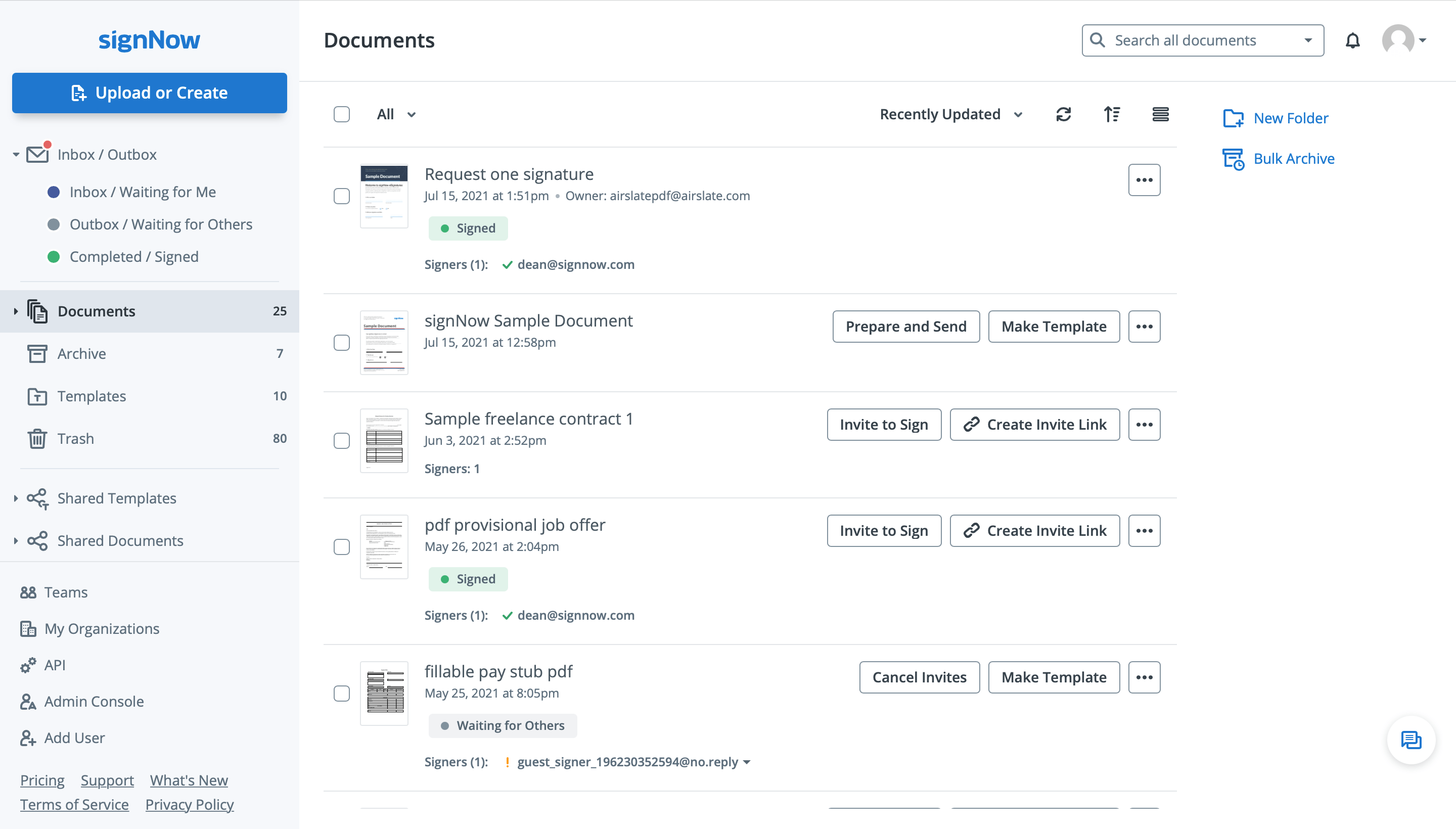
airSlate SignNow makes it easy to eSign contracts, agreements, and forms on any device. In addition, it allows you to send documents for eSignature to other parties and track the status of your request in real-time.
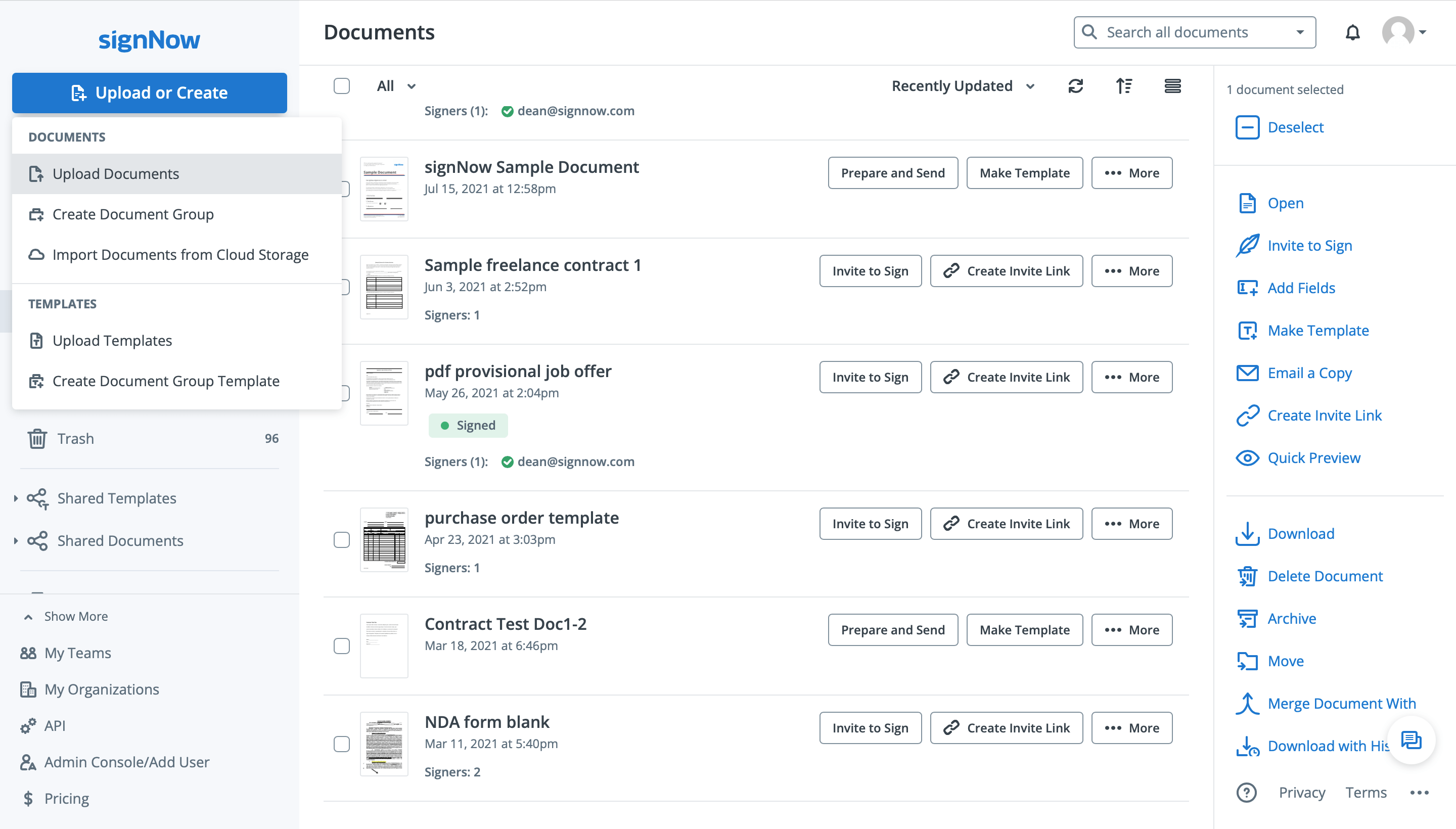
Start by uploading your document to airSlate SignNow. Hover over the Upload or Create button in the airSlate SignNow dashboard and select Upload Documents.
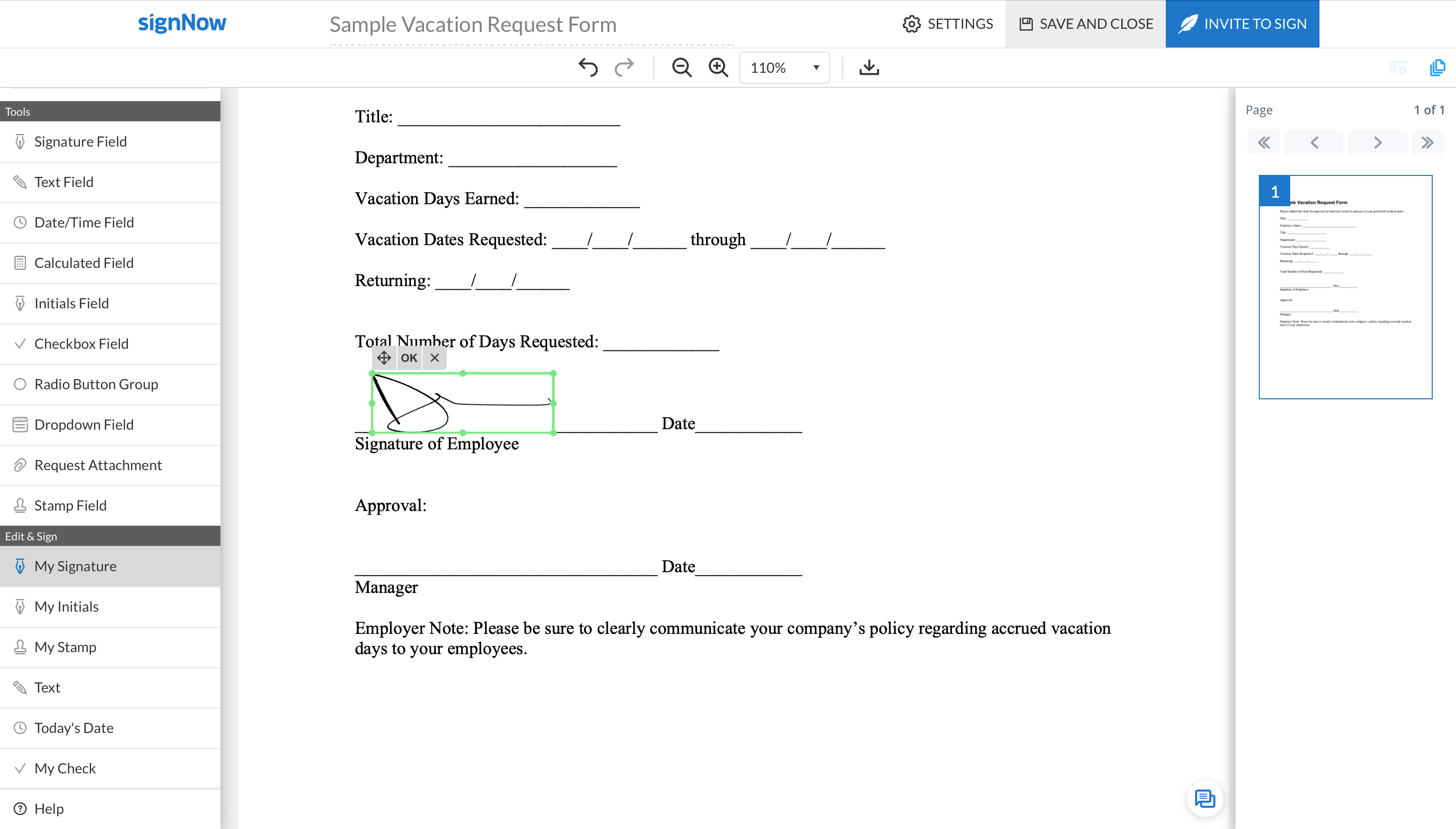
Open the uploaded document in the editor and select My Signature in the toolbar on the left. Click anywhere on the document to drop your signature.
Note: If you are using airSlate SignNow for the first time, you will need to create your signature by typing, drawing, or uploading its image.
Move the signature across the page and adjust its size using drag and drop.
Click Save and Close to save your changes and return to the dashboard. From there, you can download your file or send it to someone else.
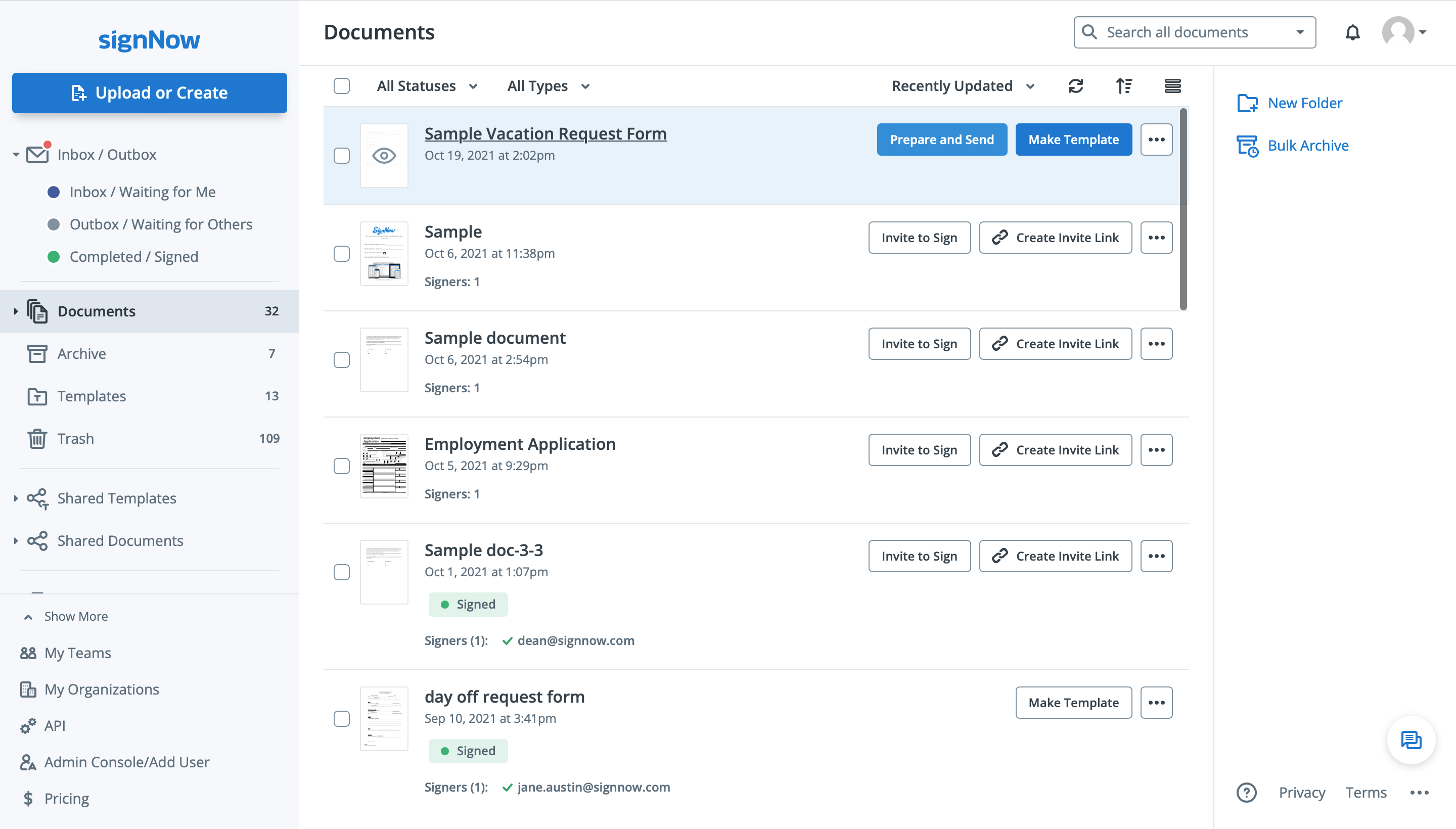
Upload your document to airSlate SignNow and click Prepare and Send.
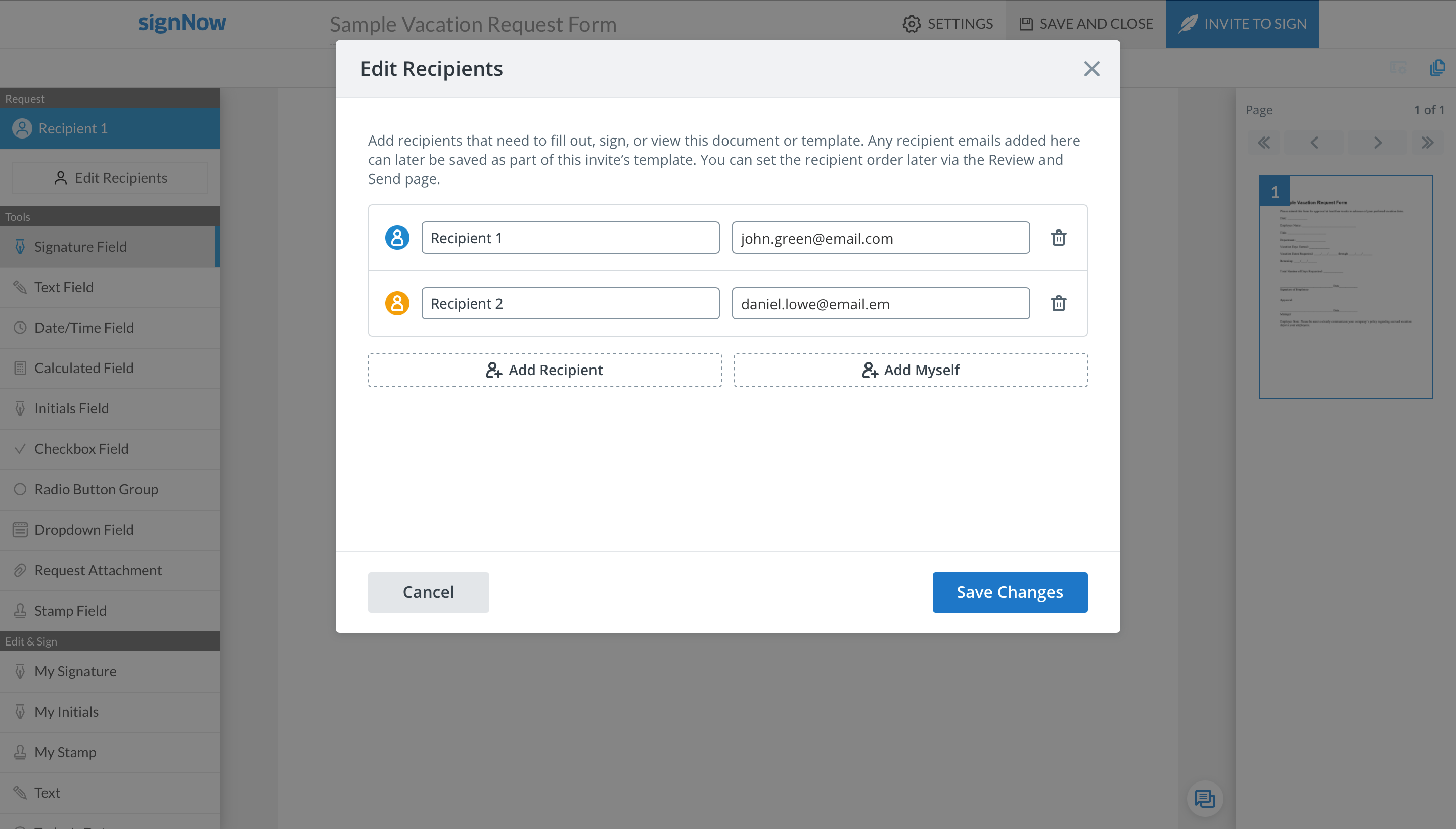
The document opens in the editor. Click Edit Recipients and add as many signers as you need.
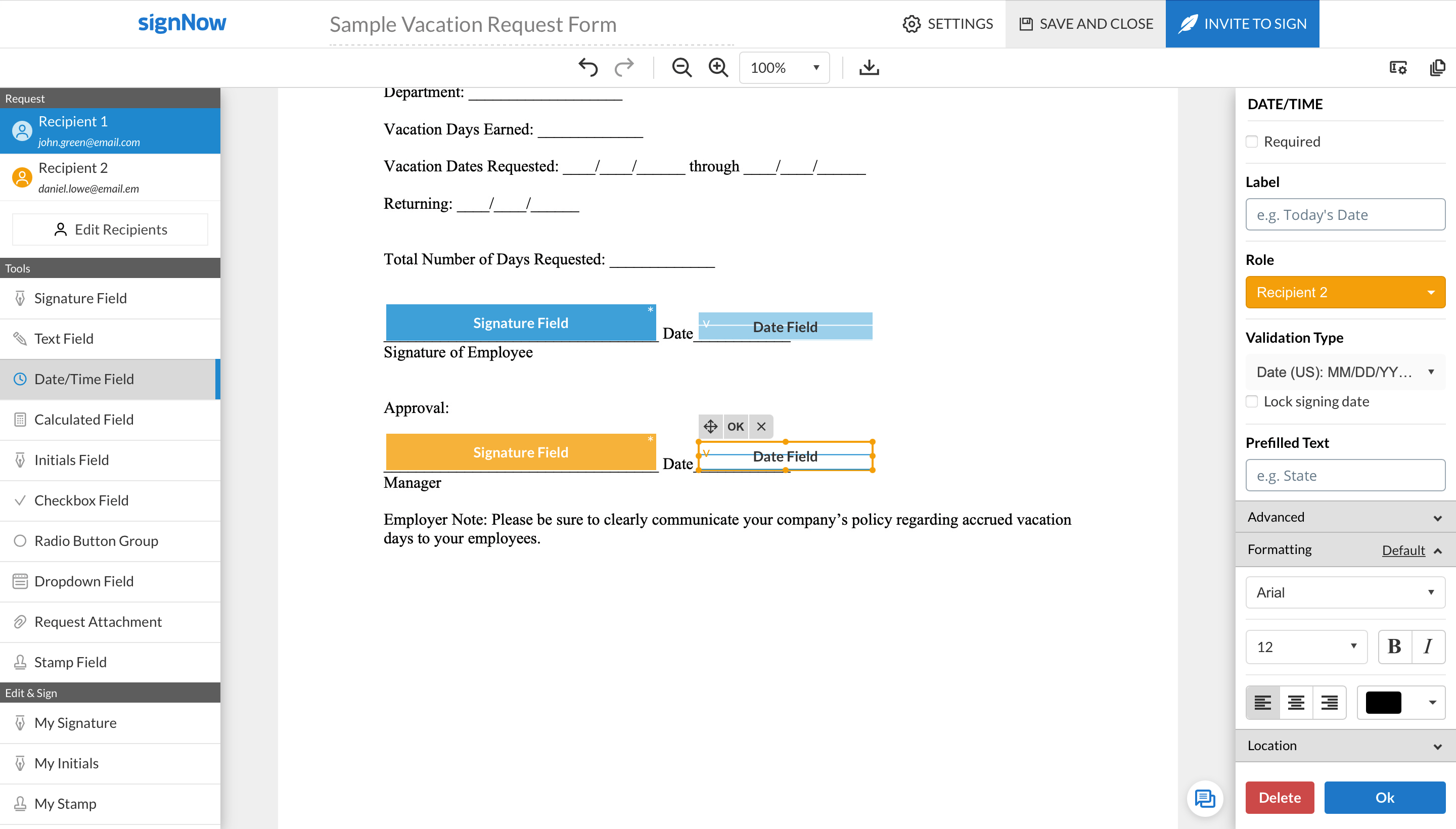
Drag and drop fillable fields on the document from the left-hand sidebar and adjust their size and positioning. Then, click Invite to Sign.
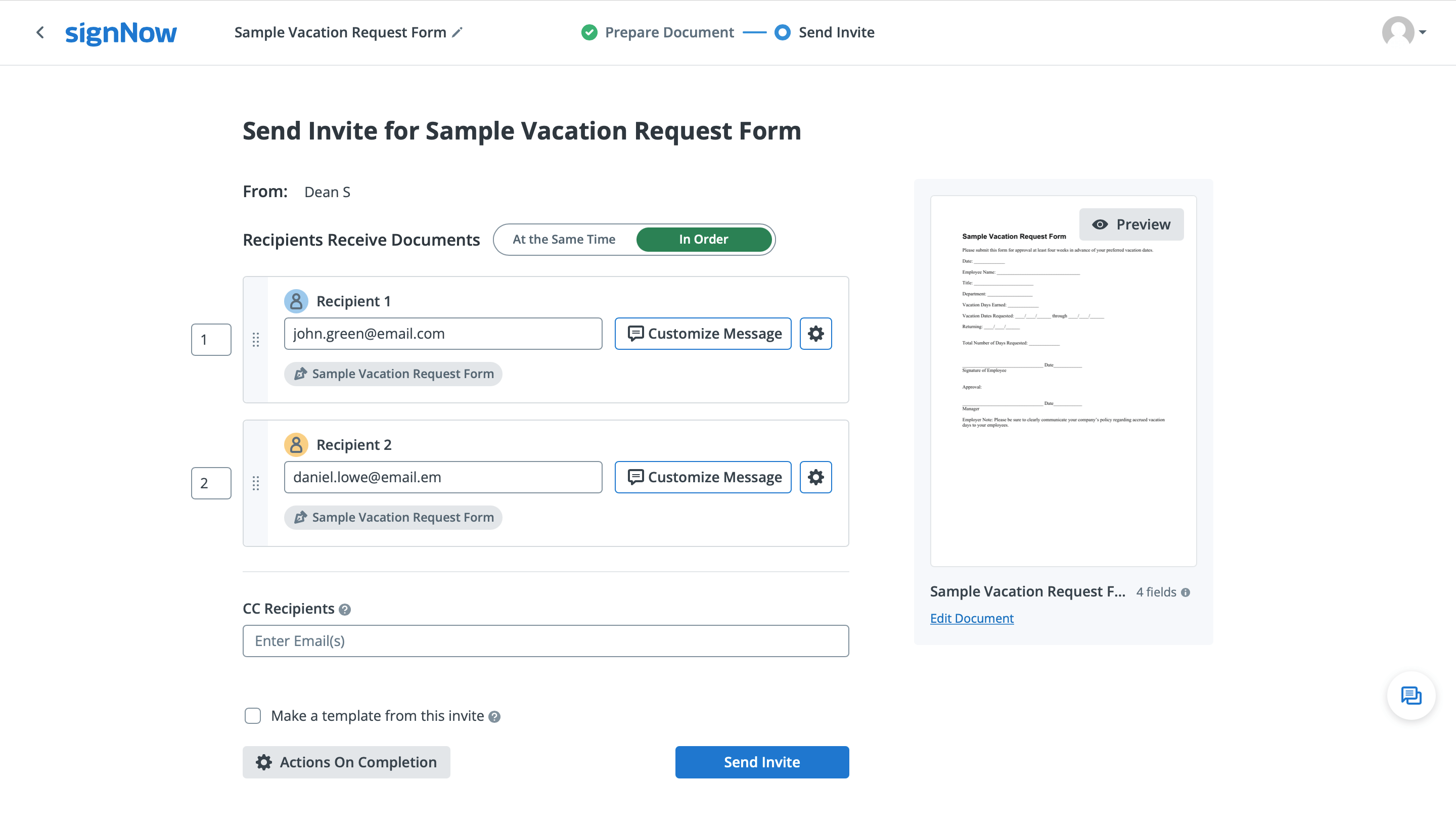
Optional: Set a signing order and add CC’d recipients. Customize your email subject and message (the Customize Message button), and set signer reminders and a verification method (the gear icon).
Click Send Invite to complete the process.
You can track the status of your documents in the airSlate SignNow dashboard.