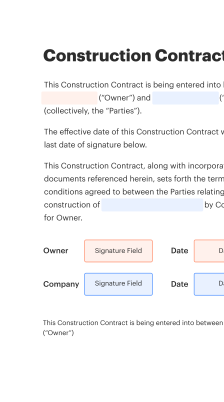
Sign Architect Agreement Template for Secure Transactions

Remove paper and improve document management for higher efficiency and limitless possibilities. Enjoy a greater manner of doing business with airSlate SignNow.

Award-winning eSignature solution

What a sign architect agreement template is and why it matters

A sign architect agreement template is a reusable document that standardizes contractual terms for architectural services, scope, deliverables, fees, and liability provisions. Organizations use a template to speed contract creation, reduce negotiation time, and ensure consistent legal language across projects. Templates also simplify audits, version control, and signature collection by providing fields for signatures, dates, and attachments. When deployed with an eSignature platform, a template can enforce signing order, track progress, and produce an auditable record for compliance and long-term retention.


Why use a template for architect agreements

Using a standardized sign architect agreement template reduces drafting errors, enforces consistent terms, and accelerates approvals for project teams and clients.

Why use a template for architect agreements

Common document and signing challenges

  • Inconsistent clauses across projects creating exposure and rework during negotiations.
  • Version control issues leading to signing outdated or incorrect contract copies.
  • Delayed approvals when signers are unavailable or lack clear signing order.
  • Difficulty demonstrating compliance without a complete, tamper-evident audit trail.

Representative user roles for architect agreement templates

Contract Manager

A Contract Manager oversees template creation, updates standard clauses, and coordinates internal reviews. They ensure each sign architect agreement template reflects current firm policy and regulatory requirements, and they manage permissions so only authorized staff can edit master templates.

Project Architect

A Project Architect uses templates to prepare client agreements, attach scopes of work, and request signatures. They rely on predefined fields for deliverables and milestones, reducing administrative time and improving consistency across multiple projects.

Teams and roles that commonly use architect agreement templates

Legal, procurement, project management, and architecture teams rely on templates to maintain consistent contract terms and reduce administrative burden.

  • Legal teams ensure required clauses and insurance language are present.
  • Project managers use templates to accelerate onboarding and approvals.
  • Finance and procurement track payment terms and budget alignment.

Cross-functional use improves contract accuracy, reduces cycle time, and makes compliance audits simpler by centralizing approved language.

Additional template features to consider

Advanced capabilities that improve template usability, enforceability, and integration into project workflows for architect agreements.

Custom Fields

Create structured fields for project-specific data such as site addresses, permit numbers, or fee schedules; use field types for dates, numbers, and conditional visibility to prevent data entry errors and to standardize contract metadata.

Conditional Logic

Show or hide sections based on selected options, such as project type or fee structure, so templates adapt automatically and minimize manual editing for alternate contract terms.

Reusable Clauses

Maintain a clause library to insert approved warranty, indemnity, or insurance language into templates, ensuring consistent legal wording across agreements and simplifying updates when policy changes are required.

Bulk Send

Send a single template to many recipients with individualized fields populated from a CSV or connector; useful for issuing standardized engagement letters or consent forms to multiple projects simultaneously.

Integrations

Connect templates to document storage, CRM, or project management tools to automatically archive signed agreements, populate client records, and trigger follow-up workflows in downstream systems.

Developer API

Use REST APIs and SDKs to programmatically create templates, prefill fields, initiate signing, and retrieve signed documents for integration with enterprise systems and custom automation.

be ready to get more

Choose a better solution

Essential features for effective architect agreement templates

The following capabilities make templates practical and secure for architectural contracts across small firms and enterprises.

Template Editor

A visual editor lets you create reusable architect agreement templates with placeholders for client names, project schedules, fee schedules, and scope exhibits. Templates can embed exhibits and attachments and include conditional sections to adapt language for different project types without manual redrafting.

Form Fields

Custom form fields capture structured data such as project codes, deliverable dates, and fee breakdowns. Fields can be required, prefilled, or calculated, and they ensure each executed agreement contains consistent contract metadata for reporting and integration with downstream systems.

Signing Controls

Set signer order, require witness or notary steps where necessary, and enforce authentication methods. Signing controls reduce errors, ensure the correct sequence of approvals, and support compliance with organizational policies for higher-value contracts.

Audit Trail

An immutable audit trail records timestamps, IP addresses, and each action taken on the template and signed agreement. This record supports dispute resolution, legal defensibility, and internal audits without relying on manual note-taking.

How a sign architect agreement template works in practice

This outlines the typical flow from template selection to signed contract, emphasizing automation and auditability.

  • Select template: Choose the approved architect agreement template.
  • Customize fields: Fill client-specific details and attachments.
  • Define signers: Set signing order and authentication.
  • Execute and store: Collect signatures and save an auditable record.
Collect signatures
24x
faster
Reduce costs by
$30
per document
Save up to
40h
per employee / month

Quick steps to create a sign architect agreement template

A brief sequence for building a usable architect agreement template, from clause selection to deployment for signing.

  • 01
    Draft core clauses: Assemble scope, fees, and liability language.
  • 02
    Add fields: Place signature, date, and custom data fields.
  • 03
    Set permissions: Restrict editing to authorized users.
  • 04
    Publish template: Make template available for sending and reuse.
be ready to get more

Why choose airSlate SignNow

  • Free 7-day trial. Choose the plan you need and try it risk-free.
  • Honest pricing for full-featured plans. airSlate SignNow offers subscription plans with no overages or hidden fees at renewal.
  • Enterprise-grade security. airSlate SignNow helps you comply with global security standards.
illustrations signature

Typical workflow settings for architect agreement templates

Recommended default settings when configuring template workflows to balance security and speed for typical architectural projects.

Configuration Default value for that setting
Reminder frequency for pending signatures 48 hours by default
Signer authentication requirement level per organization policy Email with optional SMS
Template retention and versioning policy settings Retain seven years
Notification workflow for completed agreements Email and webhook notifications
Access control for template editing Role-based admin only

Platform and device support for using templates

sign architect agreement templates should be accessible from common desktop and mobile platforms to support field staff and remote reviewers.

  • Desktop browsers: Chrome, Edge, Firefox support
  • Mobile devices: iOS and Android apps available
  • Integrations: API and connector support

Ensure the chosen eSignature platform supports current browser versions and offers mobile apps when onsite approvals are needed, and verify API availability for integration with project management and document storage systems.

Key security and protection features for templates

Encryption at rest: AES-256 encryption applied
Encryption in transit: TLS 1.2/1.3 protocols
Access controls: Role-based permissions
Audit logging: Immutable signature logs
Data residency: US-based storage options
HIPAA support: Business associate agreements

Industry examples using architect agreement templates

Two practical examples show how templates streamline contracting for architectural services across common project types.

Architectural Firm

A mid-sized architectural firm standardized its project agreement into a template to reduce drafting time and ensure consistent liability language for client proposals.

  • Uses centralized template with preapproved insurance and indemnity clauses.
  • Reduces review cycles and clarifies deliverables for clients.

Resulting in faster project kickoffs and fewer contract revisions during negotiations, improving schedule predictability.

General Contractor

A contractor adopted a sign architect agreement template to capture coordination terms and payment schedules before mobilization.

  • Integrates scope exhibits and milestone-based payments into the template.
  • Simplifies subcontractor coordination and client billing.

Leading to clearer expectations, fewer invoice disputes, and more predictable cash flow during construction phases.

Best practices for secure and accurate architect agreement templates

Follow these recommended practices when authoring, approving, and using sign architect agreement templates to reduce risk and improve efficiency.

Maintain a central, version-controlled template library
Store master templates in a controlled repository with version history and an approval workflow so only current, legally reviewed language is used. Clearly mark archived versions and restrict edits to legal or designated administrators to prevent unauthorized changes.
Use required fields and validation for key terms
Make essential fields like client name, contract value, and delivery milestones mandatory and apply validation rules to avoid incomplete agreements. Validation prevents downstream disputes and ensures contract data is usable for reporting and billing purposes.
Configure signer authentication appropriate to contract risk
For high-value or regulatory contracts, require stronger authentication such as SMS verification or knowledge-based authentication. Align authentication choices with your organization’s risk tolerance and the legal context for enforceability.
Document retention and backup policies
Apply consistent retention schedules for signed agreements, maintain secure backups, and record retention rationale. Ensure access controls prevent unauthorized deletion and that retention policies comply with client and regulatory requirements.

FAQs and common issues for sign architect agreement templates

Answers to frequent questions about preparing, sending, and storing sign architect agreement templates, plus steps to resolve typical issues.

Feature comparison: signNow (Recommended) versus other providers

A concise comparison of common template and signing capabilities across leading eSignature providers relevant to architect agreements.

Feature comparison across signing providers signNow (Recommended) DocuSign Adobe Sign
Legal validity in US transactions ESIGN, UETA ESIGN, UETA ESIGN, UETA
Bulk send daily transaction limits Up to 1000 Varies by plan Up to 500
Supported signer authentication methods list Email, SMS, KBA Email, SMS, KBA Email, SMS
API integration options and documentation REST API, SDKs REST API, SDKs REST API
be ready to get more

Get legally-binding signatures now!

Risks to consider when using templates

Invalid signatures: Legal disputes
Outdated clauses: Regulatory noncompliance
Unauthorized edits: Contractual exposure
Poor retention: Audit failures
Weak authentication: Identity risk
Insufficient backups: Data loss

Streamline complicated workflows

Generate, execute, and control workflows of any difficulty, electronically from almost anywhere. Scalable eSignature functionality ensure you can share papers with the right people in the proper order and determine roles for each signee. Execute document workflows faster and simpler than ever before.

Automate document managing

Optimize sophisticated signing tasks with airSlate SignNow�s powerful features to improve your operation. Take control of your automatic eSignature workflows to ensure they're running at peak functionality with fast notifications and alerts.

Optimize in team collaboration

Bring teammates together in a safe, shared environment. Manage paperwork, use form templates and notices to produce more efficient cross-company communication. Free your staff from having to hang out on repeated activities so that they can center on valuable, business-crucial duties.

Integrate into your current network

Manage your tasks with best-in-class integration. Collect Salesforce, Microsoft Teams, and SharePoint all in one business stream. Hook up your software to a single environment for endless opportunities and more productiveness.

Stay compliant with market-leading data safety

Feel safe knowing that your data is protected by the most up-to-date in encryption security. airSlate SignNow is GDPR and eIDAS compliant and gives you awareness into your signing experience with court-admissible audit trails. Configure user access permissions and roles to regulate who has access to what.

walmart logo
exonMobil logo
apple logo
comcast logo
facebook logo
FedEx logo
be ready to get more

Get legally-binding signatures now!