Sign DOCX Securely with SignNow

Eliminate paper and optimize document managing for higher performance and endless possibilities. Enjoy a greater strategy for doing business with airSlate SignNow.

Award-winning eSignature solution

What it means to sign docx files electronically

Signing a DOCX file electronically means applying a legally valid electronic signature to a Microsoft Word document format without printing, scanning, or mailing. The process typically includes uploading the DOCX, placing signature and data fields, authenticating signers, and producing a tamper-evident final file and audit record. In U.S. contexts, valid electronic signatures must meet ESIGN and UETA rules; implementation requires secure signer identity, intent evidence, and retained transaction records to support enforceability in business and regulatory workflows.

Why sign docx files instead of using paper

Electronic signing of DOCX reduces turnaround time, lowers operational costs, and provides consistent audit trails while supporting regulatory compliance in many U.S. use cases.

Why sign docx files instead of using paper

Typical obstacles when you need to sign docx

  • Document format mismatches when signatures are applied can alter layout or metadata, causing downstream processing errors.
  • Insufficient signer identity checks increase legal risk and may invalidate signatures under ESIGN or UETA criteria.
  • Missing audit trails or incomplete retention policies make it difficult to prove transaction integrity during disputes.
  • Poorly configured workflows lead to delays, lost documents, and repeated manual intervention across departments.

Representative user roles for signing DOCX files

HR Manager

An HR Manager uses DOCX signing to distribute offer letters and policy acknowledgements. They value consistent templates, signer tracking, and centralized storage that integrates with HRIS systems to maintain personnel records and demonstrate compliance with internal audit policies.

Sales Representative

A Sales Representative relies on signed proposals and contracts in DOCX format to finalize deals. They need fast turnaround, mobile signing options, and template reuse to reduce friction in closing and maintain an auditable history of signature acceptance.

Organizations that commonly sign DOCX files

Companies and institutions across HR, sales, finance, and education frequently process DOCX documents that require signatures.

  • Human resources teams for offer letters, policies, and onboarding paperwork.
  • Sales and account teams for contracts, SOWs, and NDAs with clients.
  • Finance and legal departments for approvals, vendor agreements, and audits.

These groups rely on reliable eSignature workflows and clear audit trails to maintain compliance and operational efficiency.

Core features to look for when you sign DOCX files

Effective DOCX signing combines document fidelity, signer verification, workflow controls, integrations, and robust audit and storage features for regulatory confidence.

Document fidelity

Preserves original DOCX layout, fonts, and metadata so the signed output matches the author’s intent across devices and viewers.


Signer authentication

Offers multiple authentication methods such as email, SMS, access code, and SAML/SSO to match risk profiles and internal policies.

Templates

Reusable DOCX templates with preconfigured fields, roles, and conditional logic reduce repetitive setup for common agreements and forms.

Bulk Send

Ability to send the same DOCX to many recipients with individualized fields and tracking to streamline high-volume transactions.

Audit trail

Generates an immutable activity log capturing timestamps, IP addresses, and verification steps for each signing event.

Integrations

Connects with cloud storage, CRM, and document management systems to automate storage and record-keeping workflows.

be ready to get more

Choose a better solution

Integrations and template tools for DOCX workflows

Integrations and templating make DOCX signing repeatable, auditable, and easier to manage across common enterprise systems.

Google Workspace

Native integration supports importing DOCX content from Google Drive, sending for signature, and saving signed copies back to designated Drive folders for centralized access and retention.

CRM integrations

Prebuilt connectors to Salesforce and Microsoft Dynamics allow generating DOCX contracts from records, mapping fields, and returning signed documents to the CRM for downstream processes.

Cloud storage

Direct links to Dropbox, Box, and OneDrive automate storage of original and signed DOCX files and maintain folder-based retention policies.

Custom templates

Create and share DOCX templates with placeholders, conditional fields, and role assignments to standardize contracts and reduce manual editing errors.
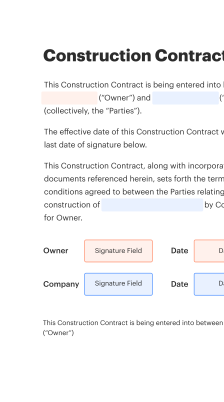
How signing a DOCX typically flows in a platform

A standard signing flow converts word processing content into a transaction with signer actions, verifications, and an auditable output.

  • Prepare: Upload DOCX, set fields, and configure recipients.
  • Send: Deliver signing requests via chosen channels.
  • Sign: Signers authenticate and apply signatures online.
  • Record: System logs events and issues the final document.
Collect signatures
24x
faster
Reduce costs by
$30
per document
Save up to
40h
per employee / month

Quick steps to sign a DOCX document

Follow these concise steps to convert a DOCX into a legally valid signed document while preserving formatting and audit records.

  • 01
    Upload file: Add the DOCX to the eSignature platform workspace.
  • 02
    Place fields: Insert signature, date, and data fields as needed.
  • 03
    Authenticate signer: Select email, SMS, or SSO verification methods.
  • 04
    Finalize: Complete signing and generate a sealed PDF copy.

Managing audit trails for signed DOCX transactions

An audit trail documents every step of a DOCX signature lifecycle to support legal enforceability and internal compliance reviews.

01

Event timestamp:

Record date and time for actions
02

IP capture:

Log signing device IP addresses
03

Authentication method:

Note verification method used
04

Signer actions:

Capture field completion and signatures
05

Document versions:

Preserve pre- and post-signing copies
06

Exportable evidence:

Provide logs in portable formats
be ready to get more

Why choose airSlate SignNow

  • Free 7-day trial. Choose the plan you need and try it risk-free.
  • Honest pricing for full-featured plans. airSlate SignNow offers subscription plans with no overages or hidden fees at renewal.
  • Enterprise-grade security. airSlate SignNow helps you comply with global security standards.
illustrations signature

Common workflow settings for DOCX signing

Typical workflow configurations automate reminders, routing, and retention when processing DOCX documents through an eSignature platform.

Setting Name Configuration
Reminder Frequency 48 hours
Signature Order Sequential
Expiration Period 14 days
Retention Policy 7 years
Notification Settings Email only

Platform and device requirements for signing DOCX

Verify system compatibility before sending DOCX for signature to avoid formatting or delivery problems.

  • Desktop browsers: Chrome, Edge, Safari
  • Mobile support: iOS and Android apps
  • File compatibility: DOCX and PDF accepted

Keep software and browser versions current, and use the provider’s recommended settings for best results when preparing DOCX files for signing.

Security controls to protect signed DOCX files

Encryption at rest: AES-256 encrypted storage
Encryption in transit: TLS 1.2+ for data transfer
Access controls: Role-based permissions
Authentication options: Email, SMS, or SSO
Audit logging: Immutable activity records
Document sealing: Tamper-evident signatures

Industry examples of signing DOCX in practice

Two concise case outlines show how signed DOCX workflows reduce friction and maintain compliance across common U.S. business scenarios.

Enterprise HR onboarding

A large employer replaces paper onboarding with signed DOCX templates to collect new-hire forms and acknowledgements quickly

  • Uses prefilled fields and role-based routing for HR approvals
  • Reduces time-to-hire and centralizes personnel records for audits

Resulting in faster onboarding and consistent regulatory documentation across locations.

Sales contract execution

A mid-market sales team sends DOCX proposals for signature to customers with embedded pricing and editable fields

  • Leverages template libraries and Bulk Send to speed repetitive agreements
  • Ensures each transaction includes a complete audit trail, signer authentication, and retention metadata

Leading to accelerated deal closure and clearer contract provenance.

Recommended practices for signing DOCX securely and efficiently

Adopt consistent policies and controls when converting DOCX into signed documents to reduce risk and improve reliability.

Maintain original document versions and metadata
Keep a controlled master DOCX in a secure repository and apply signatures to copies to preserve source files and trace content changes over time.
Use templates with predefined fields and roles
Standardize frequently used DOCX templates to reduce setup errors, ensure required data is captured, and simplify audits and reporting requirements.
Select authentication based on transaction risk
Match authentication strength—email, SMS, access code, or SSO—to the sensitivity of the document and regulatory expectations for evidence of signer identity.
Retain complete audit records and exportable logs
Ensure the platform provides immutable logs and exportable evidence that include timestamps, IP addresses, and verification steps for dispute resolution.

FAQs and troubleshooting when you sign DOCX files

Common questions and resolution steps for issues that arise while converting, sending, or verifying signed DOCX documents in eSignature platforms.

Feature availability when you sign DOCX: vendor comparison

A concise availability and capability comparison for signNow and two widely used eSignature platforms regarding DOCX workflows and controls.

Feature signNow (Featured) DocuSign Adobe Sign
Bulk Send support availability
Template libraries and conditional fields
Mobile app signing capability
HIPAA compliance options Available via BAA Available via BAA Available via BAA
be ready to get more

Get legally-binding signatures now!

Typical retention and deadlines for signed DOCX documents

Retention policies and signature deadlines vary by document type; apply conservative defaults aligned with legal, tax, and internal audit needs.

01

Employee records retention

Retain signed onboarding and employment documents for recommended statutory periods.

02

Contract expiration tracking

Set reminders for renewal and termination clauses ahead of key dates.

03

Tax and financial documents

Keep signed financial DOCX files according to IRS recordkeeping timelines.

04

Legal dispute holds

Apply legal holds to preserve evidence when litigation is anticipated.

Suggested timelines for DOCX signing tasks

Establish clear, measurable deadlines for each stage of the DOCX signing workflow to meet operational needs and regulatory timelines.

Initial signer response time:

3-5 business days

Reminder frequency for signers:

48 hours between reminders

Escalation to manager:

After 7 days without signature

Retention review interval:

Annually for policy validation

Archival schedule:

Move to long-term storage after 7 years

Risks from improper DOCX signing practices

Regulatory fines: Potential monetary penalties
Contract disputes: Invalidated agreements
Data breaches: Exposure of PII or PHI
Operational delays: Workflow interruptions
Reputational harm: Loss of client trust
Audit failures: Noncompliant records

Plan characteristics across leading eSignature vendors

High-level plan summaries and feature distinctions for signNow and other common eSignature providers to help compare DOCX signing capabilities and compliance support.

Plan / Vendor signNow (Recommended) DocuSign Adobe Sign Dropbox Sign PandaDoc
Entry-level plan summary Basic Business plan includes essential eSignature features and templates for individual users Personal plan supports single-user signatures with limited features Acrobat subscription includes eSign with document editing and export Free tier offers limited eSignature actions and storage Free eSign plan provides basic signing for small teams
Template and Bulk Send availability Includes reusable templates and Bulk Send for mass distribution Templates and Bulk Send available on mid-level plans Templates available, Bulk Send on higher tiers Templates available on paid plans Templates and mass send available on paid tiers
API and developer access API access available with developer keys and paid plans API available via commercial plans and developer account API access included in enterprise offerings API available on Business plans API available for advanced plans and enterprise
Compliance and enterprise options Enterprise controls and BAAs available for regulated industries Enterprise and BAA options for regulated customers Enterprise compliance features and BAAs available Business plans support enterprise features and BAAs Enterprise plans offer compliance controls and BAAs
Mobile and offline signing Full mobile apps with offline signing capabilities Mobile apps with offline features on paid tiers Mobile signing via Acrobat mobile app Mobile app support with offline caching Mobile apps with offline signing on paid plans
Support and training Email and phone support plus documentation and onboarding resources Tiered support with paid plan options and training Enterprise-level support and implementation services available Support via help center and paid plan options Customer success resources for paid accounts and onboarding

Make simpler challenging workflows

Prepare, execute, and control workflows of any complexness, electronically from virtually anywhere. Scalable electronic signature functionality enable you to exchange contracts with the right people in the correct order and define roles for every recipient. Stream document workflows faster and simpler than ever before.

Automate document flow

Optimize intricate signing tasks with airSlate SignNow�s effective functions to improve your business. Control your automated eSignature workflows to guarantee they're running at maximum performance with instant notifications and reminders.

Enhance in team collaboration

Get teams together in a protected, shared workspace. Handle paperwork, use form templates and notices to produce more efficient cross-organization collaboration. Relieve your employees from having to hang out on repeated routines so that they can focus on beneficial, business-critical duties.

Integrate into your current systems

Work your tasks with best-in-class integration. Capture Salesforce, Microsoft Teams, and SharePoint all in one business stream. Link your applications to a single environment for limitless opportunities and more productivity.

Remain compliant with market-leading data safety

Feel safe knowing that your information remains secure by the most recent in encryption security. airSlate SignNow is GDPR and eIDAS compliant and provides you awareness into your eSigning experience with court-admissible audit trails. Set up user authorization and roles to regulate who has access to what.


walmart logo
exonMobil logo
apple logo
comcast logo
facebook logo
FedEx logo
be ready to get more

Get legally-binding signatures now!