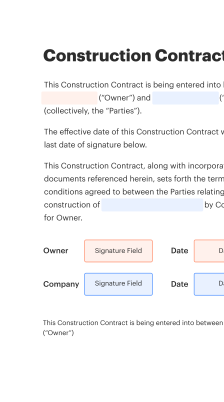
Sign Form with SignNow's Secure eSignature Solution

Get rid of paper and automate document managing for higher productivity and countless possibilities. Enjoy a better strategy for running your business with airSlate SignNow.

Award-winning eSignature solution

What a sign form is and how it works

A sign form is a digital document or template prepared to collect legally binding electronic signatures and structured data from one or more parties. It typically includes signature fields, date fields, and optional data-entry fields that guide signers through required inputs. In a U.S. context, properly executed sign forms rely on compliant platforms that meet ESIGN and UETA requirements, capture an audit trail, and protect data with encryption and access controls. Organizations use sign forms to replace paper-based approvals, streamline workflows, and reduce manual handling while retaining evidentiary records.

Why using an electronic sign form matters

A sign form reduces turnaround times, centralizes signed records, and lowers the operational overhead tied to printing, mailing, and physical storage.

Why using an electronic sign form matters

Common challenges when switching to digital sign forms

  • Ensuring legal validity across jurisdictions requires careful platform and process choices.
  • Integrating sign forms with existing CRMs or document stores can need custom mapping.
  • Maintaining security and least-privilege access adds administrative overhead for teams.
  • Managing template versions and document retention policies is essential for audits.

Typical user roles interacting with sign forms

HR Manager

Responsible for preparing onboarding sign forms, assigning signature order, and ensuring required fields are present. The HR Manager monitors completion, exports signed copies, and enforces retention schedules to meet internal and regulatory policies.

Legal Counsel

Reviews template language, validates signature methods against ESIGN and UETA requirements, and documents chain-of-custody. Legal Counsel maintains audit requirements and advises on when advanced authentication or notarization is necessary.

Who typically uses sign forms

Organizations across sectors adopt sign forms to speed approvals, reduce paper, and ensure auditable records for compliance.

  • Human resources teams for onboarding paperwork and benefits enrollment.
  • Real estate and finance for contracts, disclosures, and lending documents.
  • Education and healthcare for consent forms and institutional authorizations.

Adoption patterns differ by volume and regulatory requirements, with larger organizations requiring more governance and smaller teams favoring ease of use.

Core sign form features to evaluate

Key capabilities determine how effectively a platform handles volume, compliance, and integrations for sign forms.

Template Library

Reusable templates reduce repetitive setup and ensure consistent field placement, allowing administrators to manage standardized form versions across teams and maintain a central library for compliance purposes.

Bulk Send

Batch distribution capabilities let users send identical sign forms to large recipient lists with individualized tracking and reporting to streamline mass acknowledgments.

Conditional Fields

Fields that appear based on prior inputs adapt the form to each signer’s situation and reduce errors by hiding irrelevant questions and enforcing conditional logic.

Advanced Authentication

Options such as SMS codes, knowledge-based verification, and digital certificates support higher-assurance transactions and meet stricter regulatory or internal policy needs.

Audit Logs

Comprehensive, tamper-evident logs record signer events, timestamps, IP addresses, and document versions to support legal admissibility and internal reviews.

Integrations

Prebuilt connectors to common CRMs, cloud storage, and productivity tools automate data flow, reduce manual steps, and keep signed documents synchronized with business systems.

be ready to get more

Choose a better solution

Integration and template features for sign forms

Integration points and template tools determine how sign forms fit into existing processes and systems.

Google Workspace

Integration with Google Docs and Drive allows users to convert documents into sign forms directly from their workspace, apply signature and form fields, and save signed copies back to Drive with consistent folder structures and access controls.

CRM Connectors

Native integrations with CRMs map contact and opportunity data to form fields, trigger sends from CRM events, and log signed documents back to customer records for a single source of truth.

Cloud Storage

Connectors for Dropbox, Box, and OneDrive let organizations route final signed PDFs to designated folders, apply retention labels, and maintain backups consistent with corporate storage policies.

Template Management

Team templates let administrators lock fields, predefine signer roles, and version templates so users cannot alter critical language while enabling day-to-day form generation.

How a sign form workflow progresses

A typical sign form workflow moves through preparation, delivery, signing, and archival while preserving an audit trail.

  • Draft: Create template and assign mandatory fields.
  • Authenticate: Choose sign-in or verification method for recipients.
  • Sign: Recipients apply electronic signatures to required fields.
  • Store: System archives signed copy and audit log.
Collect signatures
24x
faster
Reduce costs by
$30
per document
Save up to
40h
per employee / month

Quick setup: create your first sign form

Follow these core steps to assemble, send, and track a sign form in a compliant eSignature environment.

  • 01
    Prepare: Upload and format the document for signing.
  • 02
    Place Fields: Add signature, date, and data-entry fields.
  • 03
    Set Recipients: Define signer order and authentication method.
  • 04
    Send: Distribute via email or direct link and monitor status.

Audit trail essentials for sign form transactions

Maintain a clear, immutable record of signer activity and document state changes to support legal defensibility and internal controls.

01

Event Timestamp:

Record precise date and time of actions
02

Signer Identity:

Capture authentication method and identifier
03

IP Address:

Log originating network address
04

Document Versioning:

Maintain previous versions and change history
05

Field-level Changes:

Track edits to form fields and values
06

Exportable Log:

Provide audit export for legal review
be ready to get more

Why choose airSlate SignNow

  • Free 7-day trial. Choose the plan you need and try it risk-free.
  • Honest pricing for full-featured plans. airSlate SignNow offers subscription plans with no overages or hidden fees at renewal.
  • Enterprise-grade security. airSlate SignNow helps you comply with global security standards.
illustrations signature

Workflow settings to configure for sign forms

Recommended workflow defaults and configurable settings to streamline sign form operations and ensure consistent behavior.

Workflow Setting Name and Configuration Default Value
Reminder Frequency 48 hours
Signature Order Enforcement Sequential
Expiry Duration 30 days
Notification Settings Email only
Retention Policy 7 years

Platform and device requirements for sign forms

sign form capabilities should be accessible across modern desktop and mobile platforms with minimal configuration.

  • Desktop: Modern browsers supported
  • Mobile: iOS and Android apps available
  • Connectivity: Stable internet required for signing

For offline signing or advanced authentication, verify device-level settings, supported OS versions, and any browser restrictions before deploying at scale.

Security features to look for with sign forms

Encryption: At-rest and in-transit encryption
Access Controls: Role-based permissions
Authentication: Multi-factor options available
Audit Trail: Immutable signing records
Document Integrity: Tamper-evident seals
Data Residency: US-based storage options

Real-world sign form examples by industry

Two concise examples show how sign forms replace paper workflows and support compliance across sectors.

Healthcare Consent Forms

A clinic converts patient consent documents to sign forms that include required HIPAA attestations and signature fields

  • Pre-populated patient demographics reduce data entry errors
  • Faster patient throughput and consistent consent records improve compliance

Resulting in reduced paper handling and clearer audit trails for clinical operations

Real Estate Transaction Packets

A brokerage bundles offers, disclosures, and agency agreements into a single sign form packet with sequential signing

  • Conditional fields show only relevant disclosures based on property type
  • Consolidated signing shortens closing timelines and centralizes signed records for escrow

Leading to improved transaction visibility and fewer missing documents at closing

Best practices for creating accurate, secure sign forms

Adopt standard procedures to reduce errors, improve compliance, and simplify signer experience when preparing sign forms.

Use standardized template naming and version control
Maintain a single template source with clear versioning and change logs to ensure all signers receive the correct document and to simplify audit reviews and legal defensibility.
Limit required fields to essential information only
Overloading forms with optional or redundant fields increases signer friction and error rates; require only what is necessary for the transaction and validate input formats where possible.
Enable appropriate signer authentication based on risk
Use email verification for low-risk acknowledgments, and require multi-factor or identity verification for high-value or regulated transactions to strengthen evidentiary posture.
Document retention aligned with legal and corporate policy
Define retention periods, export procedures, and archival storage with access controls to meet audit requirements and ensure timely purging of outdated records.

FAQs and troubleshooting for sign form issues

Answers to frequent questions and steps to resolve common problems encountered when preparing, sending, or completing sign forms.

Feature availability: sign form basics across providers

A concise comparison of core sign form capabilities across three widely used eSignature providers, focusing on basic availability and compliance support.

Feature Comparison Across Major Providers signNow DocuSign Adobe Acrobat Sign
ESIGN and UETA Legal Validity
Audit Trail and Tamper Evidence Detailed Detailed Detailed
Mobile App Signature Support
Bulk Send and Template Automation
be ready to get more

Get legally-binding signatures now!

Retention and deadline guidelines for signed forms

Set retention and access timelines to support audits, compliance, and business operations for signed forms.

Standard retention period for business contracts:

7 years for most commercial agreements

Financial and tax document retention rule:

Maintain for at least 7 years per tax guidance

Healthcare and HIPAA-covered record retention:

Follow state and federal mandates, typically several years

Student records and FERPA considerations:

Comply with institutional timelines and FERPA requirements

Immediate access window for recent forms:

Ensure fast retrieval for 30 to 90 days

Risks and penalties for improper sign form use

Contract disputes: Invalid signatures risk unenforceable agreements
Regulatory fines: Noncompliance can trigger penalties
Data breaches: Exposure of PII leads to liabilities
Operational delays: Missing signatures halt processes
Loss of records: Poor retention harms audits
Reputational harm: Customer trust erosion

Pricing and capability snapshot for sign form solutions

Snapshot of entry-level pricing and select capabilities across five established eSignature providers to inform cost and feature comparisons.

Pricing and Feature Matrix signNow DocuSign Adobe Acrobat Sign PandaDoc Dropbox Sign
Starting price (monthly) $8 per user billed annually $10 per user billed monthly $9.99 per user billed monthly $19 per user billed monthly $15 per user billed monthly
Free trial length 7 days trial available 30 days trial available 7 days trial available 14 days trial available 14 days trial available
Included eSignatures per month Unlimited on most plans Depends on plan Unlimited on many plans Limits on lower tiers Unlimited on most plans
Advanced workflows included Available on mid and enterprise plans Enterprise tiers Included in higher tiers Included in higher tiers Enterprise plans
HIPAA compliance option Business associate agreement available BAA available BAA available BAA upon request BAA available

Simplify complex workflows

Generate, deliver, and manage workflows of any complexness, digitally from almost anywhere. Scalable eSignature functionality ensure you can share contracts with the right users the proper way and assign roles for each signee. Execute document workflows faster and simpler than ever before.

Automate document management

Improve intricate signing procedures with airSlate SignNow�s highly effective capabilities to boost your operation. Manage your automatic eSignature workflows to ensure they're operating at maximum functionality with quick notifications and alerts.

Optimize in team communication

Bring teammates together in a protected, shared workplace. Handle paperwork, use form templates and notifications to create more efficient cross-company collaboration. Free your employees from having to spend time on repetitive activities to enable them to focus on valuable, business-vital duties.

Integrate into your existing framework

Work your assignments with market-leading integration. Capture Salesforce, Microsoft Teams, and SharePoint all in one business flow. Link up your software to a single system for endless opportunities and more productiveness.

Stay compliant with industry-leading data protection

Feel confident understanding that your data remains secure by the latest in encryption security. airSlate SignNow is GDPR and eIDAS certified and offers you exposure into your eSigning experience with court-admissible audit trails. Set up user authorization and roles to control who has access to what.


walmart logo
exonMobil logo
apple logo
comcast logo
facebook logo
FedEx logo
be ready to get more

Get legally-binding signatures now!