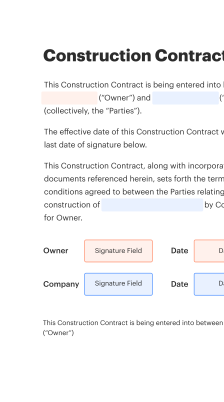
Signature on Chromebook: Secure eSignatures with SignNow
What a signature on Chromebook means for eSigning
Why using an eSignature on Chromebook can help
Signing on Chromebooks reduces dependence on paper, speeds approvals, and supports remote teams with consistent web-based workflows. It keeps documents auditable and helps meet U.S. electronic signature statutes when deployed correctly.
Common challenges when implementing signatures on Chromebooks
- Browser compatibility issues with older Chrome OS builds can block advanced signing features until updated.
- Offline signing and local certificate use are limited on Chromebooks compared with full desktop environments.
- Integrating with legacy on-premise document systems may require middleware or API workarounds.
- Ensuring strict identity proofing and HIPAA workflows needs explicit configuration and vendor support.
Typical user profiles for Chromebook eSigning
IT Administrator
IT Administrators configure device policies, manage single sign-on and enforce security settings across Chromebook fleets. They assess vendor compliance with ESIGN, UETA and HIPAA, enable API access for integrations, and ensure the chosen eSignature provider supports Chrome OS browser workflows and enterprise device management.
Sales Manager
Sales Managers use Chromebook-compatible signing to send sales contracts and collect signatures quickly. They rely on templates, Bulk Send capabilities, and real-time status updates to reduce closing times and keep records consistent across CRM systems while ensuring signer identity is recorded.
Teams and roles that commonly use signatures on Chromebooks
Educational staff, small-business owners, remote workers, and field teams often rely on Chromebook-compatible eSigning for routine approvals and forms.
Across these groups, a consistent, compliant web-based eSignature tool simplifies document handling while retaining auditability and record retention.
Choose a better solution
Key tools that improve signatures on Chromebooks
Browser Signing
A true browser-based signing interface removes the need for native installs on Chromebooks and ensures consistent access from any Chrome OS device while maintaining secure server-side processing and storage.
Reusable Templates
Templates let teams predefine required fields and text blocks, reducing setup time for recurring document types and ensuring required information is captured consistently across signers.
Identity Verification
Multiple verification options such as email, SMS codes, and single sign-on (SAML/SSO) provide flexible identity checks appropriate for low- to medium-risk transactions on Chromebooks.
Audit Trail
Automated audit logs capture signer IP, timestamps, and action history to create an evidentiary record that supports ESIGN/UETA compliance and dispute resolution.
How Chromebook-friendly eSigning works in practice
-
Upload: User uploads a PDF or document from local storage or cloud drive.
-
Configure fields: Add signature, date, and data fields for recipients.
-
Send: Dispatch the document via email link or embedded signing route.
-
Audit and store: Platform records signature metadata and archives the signed file.
Step-by-step: complete a signature on Chromebook
-
01Open document: Log in and upload the file to the eSignature web app.
-
02Place fields: Drag signature, initials, and required fields onto the document.
-
03Authenticate signer: Choose email, SMS, or SSO for signer verification.
-
04Complete signing: Signer applies signature and system records audit trail.
Why choose airSlate SignNow
-
Free 7-day trial. Choose the plan you need and try it risk-free.
-
Honest pricing for full-featured plans. airSlate SignNow offers subscription plans with no overages or hidden fees at renewal.
-
Enterprise-grade security. airSlate SignNow helps you comply with global security standards.
Common workflow settings for Chromebook eSigning
| Setting Name | Configuration |
|---|---|
| Reminder Frequency | 48 hours |
| Signature Order | Sequential |
| Template Library Access | Shared team folder |
| Auto-Reminders Enabled | Yes |
| Required Fields Enforcement | Enabled |
Platform and browser requirements for signing on a Chromebook
Chromebooks require an up-to-date Chrome browser and network access to use web-based eSignature platforms reliably.
- Chrome OS version: Latest stable build
- Browser support: Chrome browser
- Network access: TLS-enabled connection
Managed Chromebooks with regular system updates and enforced policies provide the most reliable environment for eSigning; ensure any third-party integrations and API calls are permitted by device and network policies before deploying widely.
Real-world uses of signatures on Chromebooks
K12 Enrollment Forms
A school district used Chromebook-accessible signing to collect enrollment and permission slips from parents quickly, reducing in-person paperwork and manual scanning
- Template-driven forms minimized errors across hundreds of records
- Signer authentication recorded via email and optional SMS verification
Resulting in faster processing and centralized records that simplify FERPA-compliant retention and audits.
Small Business Contracting
A regional services firm processed client agreements on Chromebooks during site visits, replacing paper contracts with a browser-based signing flow
- Prebuilt templates ensured consistent terms and required fields
- Status notifications updated CRM records automatically after signature completion
Resulting in shorter sales cycles and reliable audit trails for client invoicing and compliance reviews.
Best practices for secure and accurate Chromebook signing
FAQs and troubleshooting for signatures on Chromebooks
- Why won't the signature field accept my input?
Ensure the Chromebook's Chrome browser is updated to the current stable release and that browser JavaScript is enabled. If the field still fails, clear browser cache or try an incognito window to rule out extension conflicts before checking the document template for locking rules.
- Can I sign documents offline on a Chromebook?
Most web-based eSignature services require an online connection to validate identity and record audit data. Offline signing is limited on Chromebooks; where needed, use a provider that supports offline mobile signing or a dedicated native client on an alternate device.
- How do I prove signer identity on Chromebook workflows?
Use multi-factor authentication options such as SMS one-time codes or SAML single sign-on. The provider's audit trail should include timestamp, IP address, and verification steps to support ESIGN and UETA compliance for recorded intent.
- What causes failed document uploads from Google Drive?
Check that the eSignature app has permission to access Drive files and that the document is in a supported format like PDF or DOCX. Large or corrupted files may fail and should be converted to PDF and retried.
- How do I maintain HIPAA compliance when signing on Chromebooks?
Use a vendor that offers HIPAA-compliant configurations and a Business Associate Agreement, enable strict access controls, encrypt stored documents, and ensure Chromebooks are managed under enterprise policies that protect PHI transmission and storage.
- Who do I contact about strange audit log entries?
Review the platform's audit details for IP, timestamp, and action type; if entries appear anomalous, escalate to your IT security team and open a support case with the eSignature vendor so they can analyze server-side logs and recommend remediation steps.
Comparison: signature on Chromebook feature support
| Feature | signNow (Recommended) | DocuSign | Adobe Sign |
|---|---|---|---|
| Browser-based signing | |||
| Audit trail included | |||
| Bulk Send capability | |||
| API access |
Get legally-binding signatures now!
Risks and compliance penalties tied to improper eSigning
Feature comparison across providers for Chromebook signing
| Plan/Feature | signNow (Featured) | DocuSign | Adobe Sign | PandaDoc | Dropbox Sign |
|---|---|---|---|---|---|
| Free trial available | Yes | Yes | Yes | Yes | Yes |
| Mobile app availability | Yes | Yes | Yes | Yes | Yes |
| API and developer tools | Yes | Yes | Yes | Yes | Yes |
| Bulk Send / mass signing | Yes | Yes | Yes | Yes | Yes |
| HIPAA compliance option | Yes | Yes | Yes | Optional | Yes |
Streamline challenging workflows
Generate, execute, and maintain workflows of any intricacy, electronically from near any place. Scalable electronic signature capabilities ensure you can share contracts with the right users the proper sequence and set up roles for each signee. Complete document workflows faster and simpler than ever before.
Automate document managing
Improve sophisticated signing processes with airSlate SignNow�s powerful features to boost your business. Control your automatic eSignature workflows to make sure they're operating at top efficiency with instant notices and reminders.
Optimize in team communication
Get teams together in a protected, shared environment. Handle paperwork, use form templates and notifications to deliver more efficient cross-organization communication. Free your staff from having to hang out on repetitive routines to enable them to focus on valuable, business-essential projects.
Integrate into your current network
Run your tasks with best-in-class integration. Collect Salesforce, Microsoft Teams, and SharePoint in multi functional business flow. Link up your applications to a single unit for countless opportunities and more productiveness.
Stay compliant with market-leading data security
Feel safe knowing that your information remains secure by the most up-to-date in encryption security. airSlate SignNow is GDPR and eIDAS compliant and offers you visibility into your eSigning experience with court-admissible audit trails. Set up user access permissions and roles to regulate who has access to what.