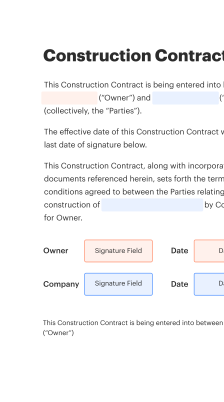
Signed Doc: Secure eSignature Solutions with SignNow

Remove paper and automate digital document processing for increased efficiency and limitless possibilities. Experience a greater way of doing business with airSlate SignNow.

Award-winning eSignature solution

What a signed doc means in practice

A signed doc refers to a document that has been executed using an electronic signature, creating a record of intent comparable to a handwritten signature. In the United States, electronically signed documents are generally enforceable under ESIGN and UETA when signatures are linked to signer identity and consent. A valid signed doc also includes an audit trail recording signer events, timestamps, and IP addresses, and can incorporate authentication steps, document integrity checks, and tamper-evident seals to support admissibility in business and legal contexts. Many organizations use solutions such as signNow to manage these requirements securely.

Why using an electronic signed doc matters

Using a signed doc speeds approvals, reduces paper handling, and improves record accuracy while supporting legal validity under U.S. statutes. It centralizes audit trails and can lower administrative costs without sacrificing basic security or compliance needs.

Why using an electronic signed doc matters

Common challenges when adopting signed doc workflows

  • Selecting appropriate authentication that balances security and signer convenience can be difficult for diverse user groups.
  • Ensuring document formatting and field placement remain consistent across devices often requires template management.
  • Integrating signed doc processes with existing systems like CRMs or document storage can need technical setup.
  • Managing retention schedules and deletion policies while meeting legal hold or regulatory obligations adds administrative overhead.

Typical users and roles managing signed docs

Legal Counsel

Legal counsel reviews and approves the legal terms included in signed docs, verifies that eSignature workflows meet ESIGN and UETA standards, and advises on retention policies and admissibility requirements for litigation or regulatory audits.

HR Manager

HR managers use signed docs for offers, tax forms, and policy acknowledgements; they configure templates, set signer order, and ensure records link to personnel files while protecting employee data under FERPA or HIPAA where applicable.

Who relies on signed docs

Organizations across sectors use signed docs to accelerate routine approvals, secure agreements, and maintain compliance records.

  • Small businesses and freelancers for contracts, invoices, and client agreements.
  • HR and recruiting teams for offer letters, onboarding forms, and nondisclosure agreements.
  • Healthcare and education administrators for consent forms and protected information handling.

Signed docs are practical for any team that needs consistent authentication, auditability, and a reduced paper footprint.

be ready to get more

Choose a better solution

Integrations and features that support signed doc workflows

Core integrations streamline signed doc creation and storage by connecting common content, CRM, and file systems to the signing process.

Google Docs

Connect Google Docs to the signing platform to initiate signed docs directly from documents, preserve version history, and synchronize completed agreements back to Drive for centralized storage and collaboration.

CRM Integration

Integrate with CRMs like Salesforce to auto-fill contact and deal data into templates, trigger signature requests from record pages, and record execution status back to the CRM for sales and legal visibility.

Dropbox

Use Dropbox integration to import documents into the signing workflow and automatically archive completed signed docs to designated folders with consistent naming and retention policies.

Reusable Templates

Create templates for recurring documents that include fixed fields, signer roles, and conditional logic to minimize setup time and reduce field-placement errors across repeated transactions.

How to create and use a signed doc online

An online signed doc workflow typically moves from document preparation to signer authentication, then to signing and archiving with a complete audit trail.

  • Prepare: Upload or create a document and add required fields.
  • Authenticate: Choose an authentication method appropriate for risk level.
  • Sign: Recipients apply electronic signatures on any device.
  • Record: System captures timestamps, IPs, and the signature certificate.
Collect signatures
24x
faster
Reduce costs by
$30
per document
Save up to
40h
per employee / month

Step-by-step: completing a signed doc

Follow these basic steps to create, route, and finalize a signed doc while preserving an audit record and ensuring signer clarity.

  • 01
    Upload document: Import PDF or Word file into the signing platform.
  • 02
    Place fields: Add signature, date, and data fields where required.
  • 03
    Set recipients: Define signer order and assign roles for each recipient.
  • 04
    Send and monitor: Send for signature and track status until completion.
be ready to get more

Why choose airSlate SignNow

  • Free 7-day trial. Choose the plan you need and try it risk-free.
  • Honest pricing for full-featured plans. airSlate SignNow offers subscription plans with no overages or hidden fees at renewal.
  • Enterprise-grade security. airSlate SignNow helps you comply with global security standards.
illustrations signature

Typical workflow settings for signed doc automation

Configure these workflow settings to align signing processes with organizational policies and automate routine actions while preserving auditability.

Workflow Setting and Configuration Header Default value or chosen configuration for each setting
Reminder Frequency for Pending Signatures Send reminders every 48 hours until signature received, then stop
Document Expiration and Auto-Delete Period Set expiration at 30 days with auto-delete after retention period
Signing Order and Sequential Routing Rules Enable sequential routing so signers complete in predetermined sequence
Authentication Requirements for Signers in Workflow Require email plus optional SMS OTP for higher-risk transactions
Audit Trail Retention Timeframe in Days Retain full audit logs for 3650 days unless legal hold applies

Security features commonly applied to signed docs

Encryption: AES-256 at rest and TLS in transit
Access controls: Role-based permissions and SSO
Authentication: Email, SMS OTP, or knowledge-based checks
Audit trail: Comprehensive signer event logging
Document integrity: Tamper-evident sealing and hashing
Data residency: Configurable storage region options

Industry scenarios that use signed docs

Real-world examples show how signed docs reduce cycle times and improve recordkeeping across common enterprise processes.

Healthcare Consent and Intake

A medical clinic digitizes patient intake paperwork to collect signatures and consent efficiently

  • Secure forms include authentication and audit trails to verify signer identity
  • This reduces front-desk processing time and stores records securely for HIPAA compliance

Resulting in faster patient throughput and auditable records for regulatory review.

Sales Contracts and Renewals

A sales team sends standard contracts via an integration with their CRM to remove manual steps

  • Templates pre-fill customer and product details to reduce errors and time to signature
  • Automated reminders and status tracking shorten the sales cycle and create a clear audit trail for finance teams

Leading to quicker deal closure and consistent contract storage for internal controls.

Best practices for secure and accurate signed docs

Applying consistent controls and clear procedures reduces risk and improves signer experience when managing signed docs across teams.

Standardize templates and field placement across forms
Use approved templates to ensure all required legal language and fields are present, minimizing signer confusion and reducing errors that can invalidate or delay documents.
Match authentication level to document risk
For low-risk acknowledgements, email authentication may suffice; for contracts or HIPAA-covered forms, require multi-factor or knowledge-based authentication and retain stronger evidentiary records.
Maintain clear retention and access policies
Define how long signed docs and associated audit trails are stored, who can access them, and how legal holds are applied to meet regulatory and litigation obligations.
Train users on signature etiquette and legal basics
Provide concise guidance on proper field placement, signer order, and legal considerations so staff understand when an electronic signature is sufficient and how to preserve enforceability.

FAQs about signed doc processes

Common questions about signed docs cover legality, authentication, audit trails, device support, integrations, and what to do when signatures fail.

Feature comparison for common signed doc providers

A concise feature checklist helps evaluate signed doc capabilities across established vendors with U.S. compliance considerations in mind.

US eSignature Vendor Feature Comparison signNow (Recommended) DocuSign Adobe Sign
US legal validity (ESIGN, UETA) confirmed
Authentication methods supported Email, SMS, 2FA Email, SMS, 2FA Email, 2FA
Bulk send or mass signature capability Bulk Send Bulk Send Bulk Send
HIPAA compliance options available Business Associate Agreement BAA available BAA available
be ready to get more

Get legally-binding signatures now!

Risks and penalties from improper signed doc handling

Noncompliance fines: Regulatory penalties possible
Contract disputes: Enforceability may be challenged
Data breaches: Exposure of sensitive information
Operational delays: Lost time resolving signature issues
Audit failure: Incomplete records cause findings
Reputational harm: Client trust can erode

Pricing and plan comparison for signing services

Compare entry-level availability and common plan characteristics to assess cost and fit for signed doc use cases across providers.

Pricing Plans by Vendor signNow (Recommended) DocuSign Adobe Sign PandaDoc HelloSign
Free tier availability and limitations Limited free plan with basic signing and templates No permanent free tier; trial available Included with some Adobe plans or trial Free trials and limited free tier Free trial with limited features
Entry-level paid plan starting point Individual plans start with per-user monthly pricing for basic eSignatures Individual and small business plans start at standard monthly fees Part of Adobe Acrobat subscription with monthly cost Team plans start at a moderate monthly rate Small business plans start at competitive monthly rates
Business and team plan highlights Business plans include templates, Bulk Send, and integrations suitable for teams Business plans include advanced workflows and integrations Business plans emphasize document management and Adobe ecosystem Team plans include CRM and workflow features Team plans focus on simplicity and API options
Enterprise features and custom pricing notes Enterprise options include SSO, dedicated support, and compliance controls, pricing by quote Enterprise includes advanced admin controls, integrations, and compliance support Enterprise integrates with Adobe enterprise licensing and governance Enterprise adds advanced workflow and SSO with quote Enterprise supports API and SSO with quote
API access and developer support availability API access available with developer documentation and rate quotas based on plan API available with SDKs and tiered limits API available via Adobe Sign REST API with documentation API available with PandaDoc developer resources API access provided with usage tiers and support

Simplify complex workflows

Generate, execute, and manage workflows of any complexness, electronically from virtually anywhere. Scalable electronic signature functionality let you exchange contracts with the right people in the correct sequence and define roles for every recipient. Stream document workflows faster and easier than ever before.

Automate document management

Optimize complex signing procedures with airSlate SignNow�s highly effective features to boost your company. Control your automatic signature workflows to ensure they're running at peak efficiency with fast notices and alerts.

Optimize in team collaboration

Join teams together in a safe, shared workplace. Handle documents, use form templates and notices to deliver better cross-organization communication. Relieve your staff from having to hang out on recurring activities to enable them to focus on valuable, business-vital projects.

Integrate into your current network

Run your jobs with best-in-class integration. Collect Salesforce, Microsoft Teams, and SharePoint in one business flow. Link up your software to a single system for countless opportunities and more efficiency.

Stay compliant with industry-leading data protection

Feel safe knowing that your data is protected by the latest in encryption security. airSlate SignNow is GDPR and eIDAS certified and gives you awareness into your signing procedure with court-admissible audit trails. Set up user authorization and roles to manage who has access to what.


walmart logo
exonMobil logo
apple logo
comcast logo
facebook logo
FedEx logo
be ready to get more

Get legally-binding signatures now!