Small Business Invoice Template for RD

Streamline your invoicing process with airSlate SignNow's intuitive platform. Enjoy seamless eSigning and document management tailored for your research and development needs.

Award-winning eSignature solution

Defining a small business invoice template for rd

A small business invoice template for rd is a standardized billing document organized for repeatable use by registrants, retailers, or research departments that require consistent invoicing fields. It typically includes payer and payee details, itemized charges, tax calculations, invoice numbers, payment terms, and optional attachment fields for receipts or purchase orders. Templates designed for digital workflows support electronic delivery, embedded signature fields, and automated data mapping to accounting software. When combined with an eSignature and document management solution, the template reduces manual entry, improves traceability, and supports secure, auditable transactions for small business operations.

When a template improves billing accuracy and speed

Using a tailored invoice template for rd ensures consistent data capture, minimizes rework, and simplifies reconciliation for small teams. Templates reduce errors and standardize the presentation of charges and payment terms across clients.

When a template improves billing accuracy and speed

Common challenges with manual invoice templates

  • Inconsistent field formats across invoices lead to reconciliation delays and manual corrections that consume staff time.
  • Missing or incorrect tax and regulatory fields can cause delayed payments and require follow-up for clarifications.
  • Non-standard invoice numbering and versioning make it harder to maintain a single source of truth for records.
  • Paper or unstructured electronic invoices lack reliable audit trails and increase exposure to disputes and compliance reviews.

Typical users and how they use the template

Independent Consultant

Consultants use the small business invoice template for rd to standardize billing across clients, include hourly or project line items, add expense attachments, and present payment terms clearly to reduce disputes and speed collections.

Small Retailer

Retailers adapt the template to include SKU-level charges, tax breakdowns, and integrated payment links so customers can complete transactions quickly while exporting invoice data to accounting tools for reconciliation.

Organizations and roles that rely on templates

Small businesses, consultants, and nonprofit teams commonly use tailored invoice templates to accelerate billing while preserving record consistency.

  • Freelancers who bill multiple clients with recurring deliverables and variable line items.
  • Small retailers needing standard receipts that integrate with inventory and accounting workflows.
  • Service departments that require approved templates for grant reporting or departmental chargebacks.

Templates streamline approvals and enable clearer audit trails, making collections and financial reporting more predictable for small teams.

Advanced template capabilities for small teams

Beyond core fields, these capabilities increase efficiency, support compliance, and assist in scaling invoicing processes for small businesses.

Conditional Fields

Fields that appear only when triggered by specific selections, such as tax exemptions or milestone billing, help keep invoices concise and reduce data entry mistakes while ensuring necessary information is captured when required.


Calculated Line Items

Formulas for discounts, prorations, and compound tax calculations automate complex total computations and maintain consistency across invoices, reducing downstream reconciliation work.

Template Versioning

Version control for templates records changes over time so teams can reproduce historical invoices, comply with audit requests, and avoid accidental edits to active billing formats.

Multi-currency Support

Automatic currency formatting and exchange rate fields allow invoices to present totals in the client’s currency while preserving base accounting figures for bookkeeping.

Pre-filled Client Data

Integrations that pre-populate client contact and billing details cut repetitive entry, reduce address errors, and speed the invoice issuance process for recurring customers.

Electronic Signature Fields

Embedded signature blocks ensure approval or acceptance can be recorded directly on the invoice, producing an auditable signature record linked to the invoice metadata.

be ready to get more

Choose a better solution

Essential features for an effective invoice template

The following features help small businesses maintain accuracy, reduce disputes, and support faster payments when using an invoice template for rd.

Custom Fields

Custom fields let you capture client-specific identifiers such as account numbers, project codes, or grant references so invoices map cleanly to internal ledgers and external compliance requirements.

Automated Calculations

Built-in tax and total calculations remove manual math, update when quantities or rates change, and reduce line-item errors that otherwise lead to payment delays and reconciliations.

Payment Integration

Embedded payment links and integrations with payment processors let recipients pay directly from the invoice, improving conversion and shortening days sales outstanding for small teams.

Reusable Templates

Saving templates with preset terms and line structures ensures invoices remain consistent across customers, simplifying training, auditability, and month-end aggregation.
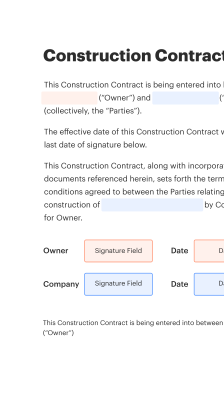
How the template functions in a digital workflow

This sequence explains how a completed template becomes an issued invoice and how signatures and payments are handled.

  • Populate: Fill template with client and line-item data.
  • Review: Validate totals, taxes, and terms before sending.
  • Deliver: Send via email with secure access link.
  • Track: Monitor delivery, views, and payment status.
Collect signatures
24x
faster
Reduce costs by
$30
per document
Save up to
40h
per employee / month

Quick setup steps for your invoice template

Follow these four steps to prepare a functional small business invoice template for rd and start issuing consistent invoices.

  • 01
    Choose fields: Select required invoice fields and terms.
  • 02
    Add branding: Insert logo and contact information.
  • 03
    Set defaults: Define tax rates and payment terms.
  • 04
    Save template: Store as reusable template for future invoices.

Operational checklist to issue an RD invoice

Use this six-step checklist to prepare, approve, and issue an RD-specific invoice with clarity and control.

01

Verify client details:

Confirm billing and tax information.
02

Confirm contract terms:

Match invoicing terms to agreement.
03

Populate line items:

Enter services, quantities, and dates.
04

Apply taxes and discounts:

Calculate taxes or concessions correctly.
05

Obtain required approvals:

Route to approvers with signature fields.
06

Send and monitor:

Deliver invoice and track status.
be ready to get more

Why choose airSlate SignNow

  • Free 7-day trial. Choose the plan you need and try it risk-free.
  • Honest pricing for full-featured plans. airSlate SignNow offers subscription plans with no overages or hidden fees at renewal.
  • Enterprise-grade security. airSlate SignNow helps you comply with global security standards.
illustrations signature

Recommended workflow settings for invoice automation

The table below lists suggested configuration settings to automate reminders, approvals, and retention for invoices created from the template.

Feature Configuration
Default automatic reminder email frequency 7 days
Standard approval routing order for invoices Two-step approval
Invoice archival and retention policy 7 years
Late fee calculation and application rules Apply after 30 days
Duplicate invoice detection and prevention Enabled by default

Supported devices and platform considerations

The small business invoice template for rd is usable across modern desktop browsers and mobile devices, but certain features may require specific platform capabilities.

  • Desktop browsers: Chrome, Edge, Safari
  • Mobile devices: iOS and Android apps
  • Integration apps: API and connector support

For full functionality, including in-app signature capture, bulk operations, and direct accounting integrations, confirm that your platform version is current and that any connected apps support secure authentication and API access before deploying templates at scale.

Security controls to protect invoice data

Encryption at rest: AES-256 level encryption
Encryption in transit: TLS 1.2+ protected
Access controls: Role-based permissions
Authentication options: Multi-factor support
Audit logging: Immutable event records
Data residency: Configurable regional storage

How different small businesses apply the template

Two short examples show how the template adapts to common small business billing needs and outcomes.

Professional Services Billing

A freelance designer used a template to standardize hourly rates and retainers, ensuring invoice fields matched contract terms

  • included line-item descriptions and a consolidated expense section
  • reduced query volume and shortened payment cycles by clarifying charges

Resulting in faster collections and cleaner records that supported quarterly bookkeeping.

Retail Order Invoicing

A small online retailer integrated the template with order exports to include SKU, quantity, and tax calculations automatically

  • added a link for online card payment and a purchase order reference field
  • reduced manual entry and returned fewer customer inquiries about charges

Resulting in fewer reconciliation errors and a smoother month-end close process for the owner.

Best practices to keep invoices accurate and compliant

Adopting consistent formatting and procedures reduces disputes, improves collections, and supports compliance for small business invoice templates.

Include clear invoice line item descriptions
Provide concise but specific descriptions for each line item so clients can verify charges quickly; include dates, hours, SKU codes, and any relevant reference numbers to prevent back-and-forth inquiries.
Maintain consistent invoice numbering and versioning
Use a structured numbering scheme and never reuse numbers; include revision IDs on corrected invoices and keep originals archived to maintain an auditable record for tax and legal reviews.
Document payment terms and late fee policies
State payment due dates, accepted payment methods, and any late fees in the template to set clear expectations; make sure terms comply with local regulations regarding late charge disclosures.
Keep customer contact and tax details up to date
Verify billing addresses, tax identification numbers, and business names before sending invoices; incorrect tax details can trigger tax liabilities, require corrections, and slow payments.

Frequently asked questions about the template

Answers to common questions about implementation, legal validity, and operational troubleshooting for small business invoice templates for rd.

Feature availability: signNow and alternatives

A concise comparison of common capabilities across popular eSignature providers relevant to small business invoice templates.

Criteria signNow (Recommended) DocuSign Adobe Sign
ESIGN / UETA compliance
Bulk Send
API access REST API REST API REST API
HIPAA support Available Available Available
be ready to get more

Get legally-binding signatures now!

Timing and retention guidelines for invoices

Set clear due dates and retention windows to meet accounting and legal needs while managing cash flow predictably.

Standard payment due net thirty days:

30 days from invoice date

Short-term contractor invoices due net fifteen days:

15 days from invoice date

Immediate payment required for deposits or retainers:

Due on receipt

Retention of invoice records for tax audits:

Keep for seven years

Automated reminders before and after due date:

Send at 7-day intervals

Legal and operational risks to consider

Late payments: Cashflow impact
Tax errors: Fines possible
Noncompliance: Regulatory penalties
Data breach: Loss exposure
Disputed invoices: Revenue delays
Missing records: Audit failures

Pricing and plan features across providers

Price and plan features vary; this table summarizes representative entry-level offerings and common feature availability for small businesses evaluating eSignature providers.

Plan signNow (Recommended) DocuSign Adobe Sign Dropbox Sign PandaDoc
Starter monthly price per user $8/user/mo $10/user/mo $12/user/mo $15/user/mo $19/user/mo
Free trial availability Yes Yes Yes Yes Yes
API access on plan Included Limited Included Paid add-on Included
Bulk sending capability Included Add-on Included Included Included
HIPAA-compliant option Available Available Available Available Available
walmart logo
exonMobil logo
apple logo
comcast logo
facebook logo
FedEx logo
be ready to get more

Get legally-binding signatures now!