Stack Break Affidavit for Secure eSignatures

Award-winning eSignature solution

Defining the stack break affidavit and its role in digital transactions

A stack break affidavit is a sworn statement documenting a discontinuity or change within a bundle of sequential documents or records, often used to confirm the integrity of a record set after reordering, insertion, or redaction. In digital workflows this affidavit explains the reason for a non-contiguous sequence, identifies affected pages, and records who authorized the change. Properly drafted, it supports chain-of-custody, preserves evidentiary value, and helps receiving parties, courts, or regulators understand why the document stack does not follow original pagination or sequencing.

Why a stack break affidavit matters for reliability and compliance

A stack break affidavit provides a concise, signed record explaining document breaks or edits, reducing disputes and supporting admissibility during audits or litigation.

Why a stack break affidavit matters for reliability and compliance

Common challenges that prompt a stack break affidavit

  • Unclear pagination after combining files can create questions about completeness and authenticity.
  • Redactions or removed pages without explanation raise audit and legal admissibility concerns.
  • Transfers between systems or formats may alter sequence or metadata, obscuring original order.
  • Signatory or reviewer confusion about document continuity can delay transactions and approvals.

Representative roles that draft or accept stack break affidavits

Notary Public

A Notary Public often notarizes the affiant's signature on a stack break affidavit and confirms identity. The notary records the act in a journal, ensuring the affidavit carries the expected formal authentication required for many legal or real estate processes.

Loan Officer

A Loan Officer typically requests and reviews a stack break affidavit when loan closing documents are edited or consolidated. They rely on the affidavit to confirm completeness for underwriting, provide clarity to title companies, and support regulatory recordkeeping obligations.

Typical users and teams that rely on stack break affidavits

Legal teams, compliance officers, loan processors, and records managers commonly prepare and rely on stack break affidavits when document order changes occur.

  • In-house legal counsel verifying file continuity for litigation or dispute response.
  • Title and mortgage teams documenting page insertions or order adjustments during closing.
  • Records managers and archivists maintaining chain-of-custody for regulated retention.

Those responsible for custody, audit trails, and regulatory submissions use these affidavits to clarify changes and reduce downstream review friction.

Core features that streamline stack break affidavit management

Use these features to create, attach, sign, and preserve stack break affidavits while maintaining compliance and traceability across digital workflows.

Templates

Prebuilt affidavit templates standardize language, reduce drafting errors, and ensure every affidavit includes required facts and identifiers for legal clarity.


Audit trail

Detailed, tamper-evident logs capture who created, viewed, signed, and attached the affidavit, supporting later verification during audits or disputes.

Authentication

Multiple signer authentication methods, including email verification, SMS codes, and multi-factor authentication, help confirm the affiant's identity.

Notary support

Capabilities for in-person notarization records or integration-ready options for remote online notarization where legally permitted.

Version control

Track original and revised document sets, linking affidavits to the correct version and preserving previous iterations for review.

Document linking

Attach affidavits directly to the affected file set so reviewers retrieve the affidavit with the documents it explains.

be ready to get more

Choose a better solution

Integration-friendly features that support stack break affidavits

Integrations with common productivity and storage tools help attach affidavits to the right file version and maintain continuity across systems.

Google Docs

Direct export and version linking allow affidavits to be prepared in Google Docs and attached to the final PDF, preserving source metadata and edit history for audit purposes.

CRM integration

Attach an affidavit to CRM records so sales, legal, and compliance teams see the document context; the integration stores a copy and links it to the customer or deal.

Dropbox

Save and sync the affidavit alongside the adjusted document stack in Dropbox, ensuring the affidavit travels with the file set and remains available for downstream reviewers.

Cloud storage

Automatic archival to enterprise cloud storage retains affidavits with related documents, supporting retention policies and centralized retrieval for audits.
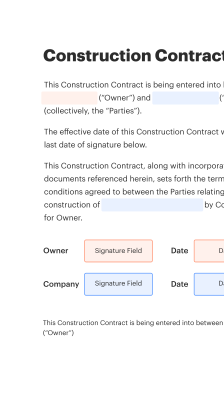
How a stack break affidavit fits into a digital signature workflow

A stack break affidavit is created and attached at the point where document sequencing changes, then signed and retained with the transaction record.

  • Prepare affidavit: Draft explanations and reference document IDs.
  • Attach to record: Associate affidavit with the impacted file bundle.
  • Execute signature: Affiant signs electronically or in-person.
  • Retain together: Store affidavit with original documents and audit log.
Collect signatures
24x
faster
Reduce costs by
$30
per document
Save up to
40h
per employee / month

How to create a stack break affidavit: a simple four-step process

Follow these core steps to draft a clear stack break affidavit that documents changes, identifies parties, and supports legal or regulatory review.

  • 01
    Identify change: Specify pages affected and reason for the break.
  • 02
    Describe action: Detail edits, insertions, deletions, or reorders made.
  • 03
    Provide attribution: Name the person authorizing and the date executed.
  • 04
    Sign and notarize: Affiant signs; notarize if required for jurisdiction.

How to validate and preserve a stack break affidavit record

These validation and preservation steps help ensure the affidavit remains credible and accessible for the lifecycle of the record.

01

Confirm identity:

Verify signer identity using chosen authentication method.
02

Capture metadata:

Record file hashes, timestamps, and system IDs.
03

Attach affidavit:

Link affidavit to the corrected document stack.
04

Notarize if required:

Obtain notarization where jurisdiction or counterparty requires it.
05

Archive together:

Store affidavit and documents in the same retention container.
06

Log chain of custody:

Update audit logs to reflect custody changes and access.
be ready to get more

Why choose airSlate SignNow

  • Free 7-day trial. Choose the plan you need and try it risk-free.
  • Honest pricing for full-featured plans. airSlate SignNow offers subscription plans with no overages or hidden fees at renewal.
  • Enterprise-grade security. airSlate SignNow helps you comply with global security standards.
illustrations signature

Suggested workflow settings for processing stack break affidavits

Configure workflow settings to automate notifications, attachments, and retention when a stack break affidavit is created and signed.

Feature Configuration
Reminder Frequency 48 hours
Attachment Enforcement Required
Signature Authentication MFA
Retention Tagging Legal-7yrs
Audit Log Capture Enabled

Platform and device considerations for signing a stack break affidavit

Stack break affidavits can be created and signed on desktops, tablets, and mobile devices, but platform capability and authentication options may vary.

  • Desktop browsers: Full feature set
  • Mobile apps: Optimized signing
  • Tablet support: Stylus signatures available

When planning execution, confirm the chosen platform supports required authentication, notarization workflows, and archival integrations so the affidavit and related records meet legal and operational requirements.

Security controls relevant to stack break affidavit records

Encryption in transit: TLS encryption
Encryption at rest: AES-256 encryption
Access controls: Role-based permissions
Authentication: Multi-factor options
Document integrity: SHA-256 hashing
Audit logging: Immutable logs

Real-world scenarios where stack break affidavits resolve issues

Below are two concise case narratives showing how a stack break affidavit clarifies document sequence changes and preserves transaction continuity.

Real Estate Closing Adjustment

A closing agent combined multiple lender disclosures into a single PDF following last-minute updates

  • Identified the replaced pages and timestamped the change
  • Confirmed signatures and who authorized the merge

Resulting in accepted closing records and a clear audit trail that avoided title underwriting delay.

Regulatory Record Correction

A healthcare records team removed duplicate pages from a patient document set and consolidated files

  • Noted which pages were removed and why
  • Showed approvals from privacy and compliance reviewers

Ensures the amended set retained evidentiary weight and met retention requirements without regulatory ambiguity.

Best practices for accurate, secure stack break affidavits

Adopt consistent drafting, signing, and retention practices to ensure affidavits are clear, legally defensible, and easy to locate during reviews.

Use precise page and file identifiers
Reference exact file names, page ranges, and, if available, document hashes to unambiguously identify what changed and prevent confusion during audits or legal review.
Record authorization and reason clearly
Include a concise explanation of why the break occurred and who approved it, linking to supporting documentation or approvals where applicable for a complete record.
Sign with verifiable methods
Use verifiable signatures—electronic signatures that meet ESIGN/UETA requirements or notarized wet signatures when jurisdiction or counterparty requires additional authentication.
Store with the associated documents
Retain the affidavit together with the amended document stack and audit logs in your records system, and apply retention policy tags to ensure consistent preservation and retrieval.

FAQs About stack break affidavit

Common questions and answers about drafting, executing, and retaining stack break affidavits in digital workflows are provided below to address routine concerns.

Availability and basic capability comparison

A direct feature availability comparison between leading eSignature providers highlights which vendors support core capabilities important for affidavits and record continuity.

Feature signNow (Recommended) DocuSign
Legally binding in US
Audit trail available
Bulk send capability
Native mobile app
be ready to get more

Get legally-binding signatures now!

Retention and key dates to track for stack break affidavits

Define retention periods and key deadlines to ensure affidavits and related documents meet regulatory and operational recordkeeping obligations.

Affidavit execution date:

Date the affidavit is signed by the affiant.

Document modification date:

Date when the underlying document stack was changed.

Notarization record date:

Date the notary completed the notarization, if applicable.

Retention start date:

Commences on the document modification or execution date.

Legal hold trigger:

Event that suspends normal destruction under litigation or investigation.

Risks and potential penalties for improper affidavit handling

Invalid evidence: Excluded
Regulatory fines: Monetary penalty
Contract disputes: Delays
Reputational harm: Loss of trust
Operational delays: Process hold
Legal exposure: Liability risks

Representative pricing and positioning across providers

A high-level view of entry-level pricing, free tiers, authentication capabilities, and recommended use cases to help assess provider fit for affidavit workflows.

Plan / Vendor signNow (Featured) DocuSign Adobe Sign HelloSign
Starting Price (approx.) From $8/user/mo From $10/user/mo From $10/user/mo From $15/user/mo
Free tier available No Limited trials No Limited free tier
Major auth methods Email, SMS, MFA Email, SMS, MFA Adobe ID, MFA Email, SMS
Enterprise SLA Available Available Available Available
Best use case Cost-effective document signing Broad enterprise integrations Document workflows with Adobe apps Simple API integrations

How to Stack break affidavit For Free

Stack break affidavit feature gets easily available when you make use of airSlate SignNow's complete eSignature platform. Use this solution for your business irrespective of the sector you’re doing work in. The set of features presented by airSlate SignNow perfectly suits for people who attempt to make their enterprise strategies more productive and streamline their workflow.

Be assured that your contracts will always be organized properly, filled out by the appropriate parties and signed digitally using the digital signature that complies with the ESIGN Act and also other governmental requirements. Integrate fillable fields to make any document interactive, collect signatures from many persons and apply receiver authentication to make sure that the document was received by the appropriate individual. All this you are able to do when working either from the desktop computer or from the mobile gadget to save lots of time and close essential deals on-the-go.


walmart logo
exonMobil logo
apple logo
comcast logo
facebook logo
FedEx logo
be ready to get more

Get legally-binding signatures now!