Taxi Bill Format Word for Financial Services

Streamline your documentation process with airSlate SignNow's eSignature tools, designed for efficiency and cost savings.

Award-winning eSignature solution

What a taxi bill format word for financial services is and why it matters

A taxi bill format Word template for financial services is a standardized document created in Microsoft Word that captures fare details, trip metadata, client billing information, and accounting fields required for expense reporting and reimbursement. Financial services teams use these templates to ensure invoices and expense records meet internal policy, auditability, and regulatory requirements. When combined with an eSignature-enabled workflow, the Word format supports digital approval, tracking, and retention while keeping a familiar layout for accounting teams and external partners.

Why standardizing a taxi bill format in Word helps finance teams

Standard Word templates reduce errors, speed approvals, and create consistent records for accounting and audits.

Why standardizing a taxi bill format in Word helps finance teams

Common challenges when adopting a taxi bill format Word template

  • Inconsistent fields and layouts lead to missing billing data and additional reconciliation time for accounting staff.
  • Manual approvals and paper routing increase processing time and reduce visibility into signer status and exceptions.
  • Lack of standard tax, fee, or allocation fields can cause errors in expense categorization and reporting.
  • Poor version control in Word files results in outdated templates circulating and incorrect invoice submissions.

Representative user profiles for taxi bill templates

Finance Manager

Responsible for overseeing expense processes and ensuring taxi bills conform to chart-of-accounts mapping. The Finance Manager reviews templates for required accounting fields, enforces policy-compliant entries, and coordinates with IT to publish a controlled Word template for the organization.

Travel Coordinator

Coordinates vendor relationships and collects taxi invoices from drivers or networks. The Travel Coordinator ensures each Word-format bill contains trip identifiers, client codes, tax details, and a signer or approver signature to validate charges before processing.

Teams and roles that commonly use taxi bill format Word templates

Finance, expense management, procurement, and compliance teams rely on consistent billing templates to capture trip-level cost data and support audit trails.

  • Expense processors who reconcile employee or client travel costs against policies and ledgers.
  • Procurement and vendor managers who track invoicing from transportation providers and reconcile master agreements.
  • Compliance and audit teams that verify accurate fee allocation and retention for regulatory or tax requirements.

Standard templates combined with electronic signing and storage provide clear accountability across drivers, approvers, and finance reviewers.

Additional tools and automation that improve taxi bill processing

Enhance accuracy and speed by leveraging automation, integrations, and role controls tailored to financial services workflows.

Field Validation

Real-time validation for numeric fields, tax calculations, and mandatory client codes reduces manual corrections and enforces policy.


Bulk Send

Send standardized billing templates to multiple drivers or approvers in one operation to accelerate collection and reduce administrative overhead.

Integration Connectors

Prebuilt connectors to common accounting and expense platforms enable automated import of invoice data and reduce manual journal entries.

Conditional Workflows

Route invoices differently based on amount, client, or cost center to ensure appropriate approvals for high-value charges.

Role-Based Permissions

Limit who can edit templates, approve invoices, or export financial data to maintain separation of duties.

Document Conversion

Auto-convert Word templates to locked PDFs with embedded audit information for secure archival.

be ready to get more

Choose a better solution

Key features to support taxi bill format Word templates

Select tools and capabilities that ensure accuracy, auditability, and easy integration with accounting systems.

Template Library

Centralized storage for controlled Word templates that ensures version control, enforces standard fields, and allows finance administrators to publish updates to all users.

Field Mapping

Map template fields to accounting system variables so data captured in Word can flow directly into AP, ERP, or expense management platforms without manual rekeying.

Audit Trail

Capture signer identity, IP address, timestamps, and version history to satisfy internal auditors and regulatory requirements while preserving a legally defensible record.

Secure Storage

Encrypt stored final documents, apply retention policies, and restrict access to approved finance personnel to maintain confidentiality and compliance.
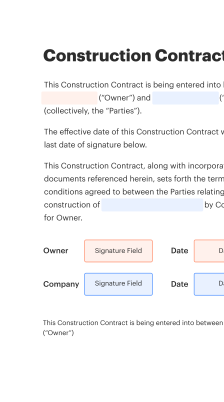
How to use the Word taxi bill format with an eSignature workflow

Integrate the Word template into a digital workflow so submitters populate fields and approvers sign electronically.

  • Upload template: Store the Word file in the document repository or eSignature template library.
  • Prepare document: Auto-fill fields using mail merge or integration data.
  • Send for signature: Route to approvers with defined signing order and reminders.
  • Archive final copy: Save PDF/A with audit trail for compliance retention.
Collect signatures
24x
faster
Reduce costs by
$30
per document
Save up to
40h
per employee / month

Step-by-step: create a taxi bill format Word template

Follow these steps to build a clear, finance-ready Word template suitable for electronic approval and storage.

  • 01
    Define required fields: List date, times, origin, destination, fare, tax, tip, and client codes.
  • 02
    Set accounting fields: Include GL code, cost center, and project ID fields.
  • 03
    Add approval area: Create signer, title, and date fields for approvers.
  • 04
    Lock template: Protect the header/footer and enforce form fields.

Audit trail and recordkeeping steps for signed taxi bills

Maintain a reliable audit trail to support compliance, disputes, and internal reviews.

01

Capture signer details:

Record name and contact for each signer.
02

Timestamp events:

Log each signature and action time.
03

Record IP addresses:

Store IP for verification and traceability.
04

Version history:

Preserve earlier drafts and changes.
05

Exportable logs:

Provide CSV or PDF audit exports.
06

Retention tagging:

Apply metadata for automated retention handling.
be ready to get more

Why choose airSlate SignNow

  • Free 7-day trial. Choose the plan you need and try it risk-free.
  • Honest pricing for full-featured plans. airSlate SignNow offers subscription plans with no overages or hidden fees at renewal.
  • Enterprise-grade security. airSlate SignNow helps you comply with global security standards.
illustrations signature

Suggested workflow configuration for taxi bill approval and archival

A sample workflow configuration aligns template submission, automatic validation, approval routing, and archival for financial compliance.

Setting Name Configuration
Reminder Frequency for Pending Signers 48 hours
Required Field Enforcement for Finance Codes On
Approval Escalation Threshold for High Amounts Manager+Director
Final Document Format for Archive PDF/A
Retention Tagging and Auto-Delete Policy 7 years

Platform and device requirements for managing taxi bill Word templates

Ensure your environment supports Microsoft Word editing, secure file storage, and an eSignature solution compatible with Word documents.

  • Desktop editing: Microsoft Word 2016 or later.
  • Mobile viewing: iOS and Android PDF viewers supported.
  • eSignature integration: Browser or native app with Word import.

Confirm that any chosen eSignature provider offers a web interface and mobile apps for reviewers, supports secure storage and audit logs, and integrates with your accounting or document management systems to automate data transfer and retention.

Security and compliance considerations for taxi bill templates and eSignatures

ESIGN and UETA: Legally recognize electronic signatures in U.S. transactions.
HIPAA considerations: Protects health-related billing information when applicable.
FERPA impact: Applies if student travel billing includes educational records.
Audit trail: Provides immutable signer and timestamp records.
Access controls: Role-based permissions limit template editing and viewing.
Encryption in transit: TLS protects documents during transfer.

Industry examples of taxi bill format Word templates in use

Practical examples show how templates streamline billing across common financial workflows.

Corporate Expense Reimbursement

A finance team standardizes a Word taxi bill template to capture date, fare, tip, client code, and expense category

  • Template includes approval and accounting fields for automated coding
  • Reduces reconciliation time and errors by providing consistent data

Leading to faster reimbursements and cleaner ledger entries.

Managed Travel Vendor Billing

A procurement group collects monthly taxi bills from a contracted vendor using the shared Word template

  • Each bill includes PO number and service-level details
  • Enables automated import into AP systems and simplifies dispute handling

Resulting in accurate vendor payments and streamlined invoice matching.

Best practices for secure and accurate taxi bill format Word templates

Follow established practices to reduce errors, ensure compliance, and streamline processing across finance operations.

Use controlled template distribution and version control
Maintain a single source of truth for the Word template, restrict editing rights to administrators, and publish change logs when fields or accounting mappings are updated.
Validate mandatory fields before submission
Enforce required form fields and implement client-code checks to prevent incomplete or misallocated expense submissions that would otherwise cause rework.
Combine Word templates with electronic signatures and audit logs
Apply eSign workflows that record signer identity and timestamps under ESIGN/UETA to create admissible records and simplify future audits.
Archive in standardized formats with retention policies
Convert final signed documents to PDF/A, tag with metadata, and apply retention schedules aligned to tax and organizational recordkeeping requirements.

FAQs about taxi bill format Word templates and eSignature workflows

Answers to common questions about creating, sending, signing, and storing taxi bill templates in Word format with electronic signatures.

Feature comparison for taxi bill eSignature handling

Compare key technical capabilities across leading eSignature providers for handling Word-based taxi bills.

E-Signature Provider Comparison and Features signNow (Featured) DocuSign Adobe Sign
HIPAA Compliance Available
Bulk Send Capability
API Type REST API REST API REST API
Native Google Docs Integration Add-on Add-on
be ready to get more

Get legally-binding signatures now!

Typical processing timeline for taxi bill submissions

A standard timeline helps set expectations for submitters, approvers, and finance processors.

01

Submission by employee or vendor

Same day or within 48 hours of trip completion.

02

Initial validation by coordinator

1 to 2 business days for completeness checks.

03

Approval routing

1 to 3 business days depending on approvers.

04

Finance review and coding

1 to 5 business days for reconciliation.

05

Payment processing

Scheduled according to pay runs.

06

Archival and retention tagging

Immediate after finalization.

07

Audit readiness window

Maintain records for statutory retention.

08

Exception resolution

Depends on complexity; typically days to weeks.

Retention and document deadlines for taxi bill records

Finance teams must apply retention schedules that meet tax, audit, and internal policy requirements.

Standard retention for general records:

7 years for tax-related records in many jurisdictions.

Expense reimbursement records retention:

Maintain for at least 3 to 7 years depending on tax guidance.

HIPAA-related billing retention:

Follow health record retention schedules when patient data is involved.

Contract and vendor billing retention:

Retain until after contract closeout plus statutory period.

Audit hold procedures:

Implement immediate preservation when under audit or litigation.

Risks of improper taxi bill handling

Noncompliance fines: Regulatory penalties may apply.
Audit failures: Missing records raise audit findings.
Data breaches: Improper storage risks exposure.
Reimbursement errors: Incorrect fees cause overpayments.
Contract disputes: Incomplete invoices hinder resolution.
Operational delays: Manual approvals slow processing.

Pricing and plan comparison for eSignature providers used with Word templates

High-level plan and pricing signals to evaluate total cost and included features for finance-oriented taxi bill workflows.

Plan and Pricing Comparison signNow (Featured) DocuSign Adobe Sign Dropbox Sign PandaDoc
Starting price per user per month $8 $10 $19 $12 $19
Free trial or free tier availability Free trial Free trial Free trial Free tier Free trial
Bulk sending and template management Included Add-on Add-on Included Included
API access included Included Included Included Included Included
HIPAA-compliant option Available Available Available Not standard Available
Enterprise support and onboarding Standard Premium Premium Business Premium
walmart logo
exonMobil logo
apple logo
comcast logo
facebook logo
FedEx logo
be ready to get more

Get legally-binding signatures now!