Template Engine
Validate reusable templates with conditional fields and role assignments to reduce template errors and ensure correct field visibility for each signer in multi-party transactions.



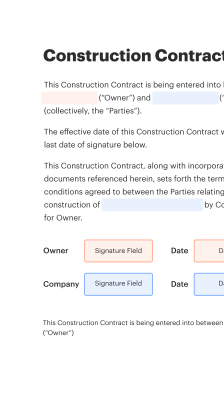
Testing a signature request reduces human error, verifies authentication and field placement, and confirms integration mapping before live use, lowering the chance of invalid or incomplete agreements.

A compliance manager uses test signature requests to verify that electronic signature workflows meet internal audit requirements and legal standards like ESIGN and UETA, checking authentication methods, retention settings, and audit trail completeness before authorizing production deployment.
Sales operations professionals run test signature requests to validate template field mapping, bulk send performance, and CRM integrations so that high-volume contract processes complete correctly and customer records update reliably after live sends.
Teams that prepare legally binding documents and automated workflows typically run test signature requests to validate configuration before going live.
Running periodic test signature requests helps maintain accuracy as templates, integrations, or regulations change over time.
Validate reusable templates with conditional fields and role assignments to reduce template errors and ensure correct field visibility for each signer in multi-party transactions.
Test bulk send workflows to confirm CSV field mapping, per-recipient personalization, and system performance when sending hundreds or thousands of envelopes.
Exercise multi-role sequential and parallel routing to ensure each signer receives the document in the correct order and that routing logic advances reliably after signatures.
Verify email, SMS, knowledge-based verification, and third-party identity providers to ensure each signer can authenticate with the required assurance level.
Check for complete, tamper-evident audit logs that record timestamps, IP addresses, actions taken, and authentication steps for every test transaction.
Use API calls to create test envelopes and confirm response payloads, webhook events, and integration error handling behave as expected before production calls.
Test signature requests should verify that documents opened or created in Google Docs and Drive preserve field placement, that completed PDFs save back to the correct Drive folder, and that metadata syncs with file names and drive locations consistently.
Validate that completed agreements push signer data, dates, and custom fields into the correct CRM objects, that status updates trigger workflows, and that duplicate records are not created during automated syncs.
Ensure that signed documents and audit trails save to the intended cloud folder with correct naming conventions, access permissions, and retention policies enforced by the connected storage provider.
Confirm test requests correctly pass payment metadata and amounts to gateways, that success/failure callbacks are handled, and that transactions record in the agreement history without exposing real payment details.
| Workflow Setting Name and Purpose | Configuration values used by the workflow for verification |
|---|---|
| Reminder Frequency for Signers per envelope | 48 hours, repeat twice |
| Expiration period for test envelopes | 90 days expiry for test records |
| Authentication method for signers | Email or SMS as applicable |
| Webhook event notifications configuration | Send completion and decline events |
| Document retention and archival policy | Retain test copies for 30 days |
Ensure test recipients use supported browsers and up-to-date mobile apps so signature capture and authentication work consistently.
For reliable testing, confirm browser versions, disable extensions that alter page behavior, and use sample data; repeat tests on mobile and desktop to validate responsive layouts and authentication flows across devices.
A hospital uses a test signature request to confirm patient consent forms render correctly on tablets
Resulting in accurate, auditable patient consent without exposing real patient information.
A software vendor runs test signature requests to check bulk send mappings into CRM
Leading to faster deal closes and fewer contract amendments after signing.
| Feature Criteria for Signature Platforms | signNow (Recommended) | DocuSign | Adobe Sign |
|---|---|---|---|
| Remote signing availability across platforms | |||
| Bulk Send support and limits | |||
| Native Google Drive integration availability | |||
| HIPAA compliance option availability in US plans | Available | Available | Available |
| Entry-level plan pricing | signNow (Recommended) from $8/user/month billed annually | DocuSign individual plans from $10/month | Adobe Sign included with Acrobat Pro subscriptions | Dropbox Sign starting at about $15/user/month | PandaDoc free tier; paid from $19/user/month |
|---|---|---|---|---|---|
| Monthly billing option availability | Monthly available on paid plans | Monthly available | Annual focus but monthly available | Monthly available | Monthly available |
| Per-user fee structure notes | Per-user licensing common | Per-user licensing | Included with other Adobe subs | Per-seat pricing | Per-user and team tiers |
| Free tier or trial availability | Limited free trial available | Free trial available | Free trial with Acrobat | Free tier and trial available | Free tier available |
| Enterprise and custom pricing | Custom enterprise quotes offered | Enterprise plans available | Enterprise agreements available | Enterprise offerings available | Enterprise pricing offered |
| Support and SLA overview | Standard email support; paid options | Standard support; premium SLA options | Adobe enterprise support tiers | Support via Dropbox plans | Priority support for paid tiers |
Create, perform, and manage workflows of any intricacy, digitally from virtually anywhere. Scalable electronic signature features ensure you can share contracts with the right users the proper sequence and assign roles for every recipient. Perform document workflows faster and simpler than ever before.
Enhance sophisticated signing tasks with airSlate SignNow�s effective capabilities to enhance your company. Control your automatic eSignature workflows to ensure they're operating at maximum functionality with immediate notices and reminders.
Get teams together in a protected, shared environment. Handle paperwork, use form templates and notifications to create more effective cross-company communication. Relieve your workers from having to spend time on repetitive actions to enable them to give attention to beneficial, business-vital projects.
Work your jobs with industry-leading integration. Collect Salesforce, Microsoft Teams, and SharePoint in one business flow. Connect your applications to a single unit for endless opportunities and higher efficiency.
Feel safe knowing that your data remains secure by the most recent in encryption security. airSlate SignNow is GDPR and eIDAS certified and offers you visibility into your eSigning process with court-admissible audit trails. Set up user access permissions and roles to regulate who has access to what.