Template Library
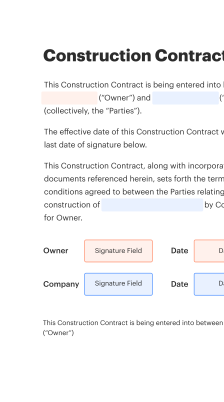
Centralized templates let HR store standardized resignation letter formats with pre-placed signature and date fields, reducing repetitive setup and ensuring consistent layout and required information across cases.





A signed template standardizes resignation documentation, reduces administrative friction, and produces consistent, auditable records suitable for HR processing and legal retention policies.

HR managers prepare the standardized resignation template, manage permissions for who can send and archive signed letters, and ensure that completed documents are routed to payroll and legal systems for processing and retention.
Employees use the template to submit a formal resignation with a verified signature; the signed document provides a clear record of notice, last day, and any agreed terms, and is stored in their personnel file.
Small HR teams and enterprise HR departments both use uploaded resignation letter templates to standardize offboarding steps and reduce administrative overhead.
Consistent templates and signed records streamline coordination between HR, payroll, and legal while preserving needed audit trails for internal reviews and regulatory compliance.
Centralized templates let HR store standardized resignation letter formats with pre-placed signature and date fields, reducing repetitive setup and ensuring consistent layout and required information across cases.
Drag-and-drop fields for name, title, last day, and signature reduce manual entry, speed completion, and minimize errors when creating many resignation letters from the same template.
Multiple signer authentication methods verify identity before signing, enabling HR to choose appropriate assurance levels for employee-initiated or employer-requested resignation processes.
Immutable timestamps, IP address records, and event logs create a verifiable history for each signed resignation letter, useful for compliance and internal recordkeeping purposes.
Role-based permissions restrict who can upload, edit, send, or view signed resignation templates, helping preserve confidentiality and meet internal governance rules.
Connectors for HR systems, cloud storage, and document management automate record updates and archival of signed resignation letters into employee files or corporate repositories.
Create or import resignation letters from Google Docs, populate fields dynamically with directory data, and push signed PDFs back to Drive for consistent file management across HR workflows.
Save signed resignation letters automatically to designated Dropbox folders with naming conventions and retention tags to keep personnel records organized and compliant with retention policies.
Map signed resignation documents to employee records in HRIS systems or CRM contact profiles so final status and dates update automatically without manual file transfers or duplicate entry.
Add structured fields such as last day, reason code, and payroll clearance checkboxes to templates to capture consistent metadata for reporting and downstream processing.
| Setting Name | Configuration |
|---|---|
| Reminder Frequency | 48 hours |
| Signing Order | Single signer |
| Default Expiration | 30 days |
| Audit Trail Retention | 7 years |
| Archive Destination | HR folder |
Use any modern desktop or mobile browser; supported file formats typically include PDF and DOCX and mobile apps provide equivalent functionality.
Check file size limits and confirm the platform preserves layout and signature placement; scanning at 300 DPI or exporting to PDF ensures consistent results across devices.
An employee submits a resignation letter through an HR portal that uploads a company template with required fields filled
Resulting in a consistent, verifiable record that simplifies offboarding and archival.
A manager requests a signed resignation acknowledgement using a standardized template sent to the departing employee
Leading to faster final payroll processing and a clear compliance trail.
| Feature | signNow (Recommended) | DocuSign | Adobe Acrobat Sign |
|---|---|---|---|
| Legally binding in US | |||
| Bulk Send capacity | 500 envelopes | 1,000 envelopes | 500 envelopes |
| HIPAA support | |||
| API availability |
Sign within 7 days of submission
Complete signatures before final payroll cutoff
Archive signed file within 14 days
Retain personnel records for required years
Keep logs available for audits for 7 years
| Plan | signNow (Recommended) | DocuSign | Adobe Acrobat Sign | Dropbox Sign | PandaDoc |
|---|---|---|---|---|---|
| Monthly cost (approx.) | $8 / user | $10 / user | $14.99 / user | $15 / user | $19 / user |
| Template reuse | Yes | Yes | Yes | Yes | Yes |
| API access | Included | Limited | Included | Available | Available |
| Bulk send support | Available | Available | Available | Limited | Available |
| HIPAA option | Available | Available | Available | No | Available |
Create, execute, and manage workflows of any complexity, electronically from virtually anywhere. Scalable eSignature capabilities allow you to share documents with the right people in the correct order and define roles for each recipient. Execute document workflows faster and easier than ever before.
Optimize complex signing processes with airSlate SignNow’s powerful features to enhance your business. Control your automated eSignature workflows to ensure they're running at peak performance with instant notifications and reminders.
Bring teams together in a secure, shared environment. Manage documents, use form templates and notifications to create more efficient cross-organization collaboration. Free your employees from having to spend time on repetitive activities so that they can focus on valuable, business-critical tasks.
Run your projects with industry-leading integration. Collect Salesforce, Microsoft Teams, and SharePoint all in one business flow. Connect your software to a single system for endless possibilities and more efficiency.
Feel confident with the knowledge that your data is protected by the most up-to-date in encryption security. airSlate SignNow is GDPR and eIDAS certified and gives you visibility into your eSigning process with court-admissible audit trails. Set up user access permissions and rights to regulate who has access to what.