Use Advanced Options for Your Teams with SignNow

Make working with your team easy by using airSlate SignNow's advanced options for teams. Keep track of a user’s documents, add a team admin and remove users or transfer ownership.

Award-winning eSignature solution

Overview of using advanced options for your teams

Using advanced options for your teams refers to configuring role-based controls, templates, automation, and security settings to align electronic signature workflows with organizational needs. For team administrators this includes establishing permission tiers, shared templates, group libraries, delegated signing, bulk send capabilities, and audit and retention policies. Advanced settings also cover authentication strength, conditional fields, and integration scopes with CRM or document storage. Proper configuration reduces repetitive work, improves traceability, and ensures that each team member only accesses the features and documents required for their role.

Why adopt advanced team options

Advanced options let organizations standardize workflows, protect sensitive documents, and reduce manual errors by applying consistent templates, permissions, and authentication across teams.

Why adopt advanced team options

Common challenges when enabling advanced team options

  • Aligning permissions across departments can be complex and delays rollout without clear role definitions and governance.
  • Maintaining secure access while enabling collaboration requires careful selection of authentication and sharing policies.
  • Configuring automation and templates incorrectly can lead to routing errors or missing required fields in documents.
  • Integrating with legacy systems or CRM platforms often needs mapping and testing to avoid data mismatches.

Representative team roles and responsibilities

Team Administrator

Team Administrators configure permissions, manage templates, assign roles, and oversee audit logs across team workspaces. They ensure group settings match organizational policy and coordinate integrations with identity providers and document repositories.

Compliance Officer

Compliance Officers review audit trails, retention rules, and authentication settings. They validate that eSignature processes meet ESIGN and UETA requirements and coordinate data handling policies for regulated records.

Teams and roles that benefit from advanced options

Legal, HR, sales, and procurement teams commonly use advanced options to enforce consistent processes and reduce compliance risk.

  • Legal teams use centralized templates and role-based signing to ensure contractual consistency and auditability.
  • Sales teams rely on bulk send and team templates to speed repetitive customer agreements and reduce turnaround time.
  • HR and finance teams use conditional fields and delegated signing to streamline onboarding and payment approvals.

Administrators and compliance officers also use audit capabilities and permissions to monitor activity and maintain governance.

Additional advanced options teams commonly use

Beyond core templates and permissions, teams frequently adopt conditional logic, delegated signing, group libraries, branding controls, retention settings, and API scopes to refine workflows.

Conditional Logic

Apply field visibility and validation rules based on signer input to collect only relevant information and enforce correct form completion.


Delegated Signing

Permit authorized users to sign on behalf of others when appropriate, with clear audit records showing delegation events and approvals.

Group Libraries

Maintain central repositories of templates, clauses, and resources accessible to team members with configured read or edit permissions.

Branding Control

Customize email templates, signing pages, and document headers to maintain consistent corporate branding in external communications.

Retention Policies

Automate document archival and deletion according to regulatory or company retention schedules to reduce storage risk.

API Scopes

Limit API permissions to required actions for integrations, reducing exposure and following least-privilege principles.

be ready to get more

Choose a better solution

Principal advanced features for teams

When teams use advanced options they typically rely on shared templates, role-based permissions, automation, and integrations to scale secure signing processes.

Shared Templates

Team templates centralize document structure and required fields so senders use standardized forms; this reduces errors and ensures required clauses and compliance elements are always included.

Role Permissions

Granular permissions let administrators restrict who can create, edit, send, or archive documents within team folders, preserving control over sensitive templates and signed records.

Automation Rules

Automation enables scheduled reminders, conditional routing based on field values, and bulk sending for repetitive tasks, which reduces manual follow-up and shortens cycle time.

Third-party Integrations

Integrations with CRM, cloud storage, and identity providers automate data population, centralize storage, and align authentication to corporate identity management practices for teams.
How advanced team options operate in practice

Advanced options coordinate templates, permissions, authentication, and automation to create predictable team workflows while preserving security and auditability.

  • Template library: Shared team templates reduce variance.
  • Permission tiers: Control who edits, sends, or manages templates.
  • Authentication: Choose appropriate signer verification methods.
  • Automation: Use triggers to route and remind signers.
Collect signatures
24x
faster
Reduce costs by
$30
per document
Save up to
40h
per employee / month

Step-by-step: enable advanced options for a team

Follow these steps to configure advanced team features, set permissions, and activate automation for consistent workflows.

  • 01
    Define roles: Identify required permissions and responsibilities.
  • 02
    Create templates: Build reusable documents and fields for teams.
  • 03
    Set permissions: Assign role-based access to templates and folders.
  • 04
    Enable automation: Configure reminders, routing, and bulk send.

Quick checklist to finalize team advanced options

Use this checklist to confirm core items are configured before rolling out advanced options to a team.

01

Verify roles:

Confirm role mappings
02

Test templates:

Validate all fields
03

Enable MFA:

Activate for admins
04

Integrate CRM:

Test data flow
05

Set retention:

Apply policies
06

Train users:

Provide documentation
be ready to get more

Why choose airSlate SignNow

  • Free 7-day trial. Choose the plan you need and try it risk-free.
  • Honest pricing for full-featured plans. airSlate SignNow offers subscription plans with no overages or hidden fees at renewal.
  • Enterprise-grade security. airSlate SignNow helps you comply with global security standards.
illustrations signature

Default workflow settings to configure for teams

These settings represent common configuration choices for team-level workflows; adjust values based on security, compliance, and operational needs.

Feature Configuration
Reminder Frequency 48 hours
Template Sharing Scope Group-only
Authentication Requirement Email or SMS
Audit Log Retention 7 years
Bulk Send Limit 500 recipients

Supported platforms and device considerations

Advanced team features are typically available across web, mobile, and tablet interfaces but may require updated apps or specific browser capabilities.

  • Web browsers: Chrome, Edge, Safari
  • Mobile apps: iOS and Android
  • API access: RESTful endpoints

Confirm local device policies and browser versions for features like advanced authentication, document previews, and integrations to ensure consistent behavior across your team.

Security controls relevant to team settings

Role-based access: Limit feature access by role
Two-factor authentication: Optional or mandatory MFA
Document encryption: Encryption at rest and transit
Audit logging: Comprehensive transaction logs
Access expiration: Time-limited document links
Conditional fields: Protect data visibility

Industry examples of advanced team configurations

These case narratives show how teams configure advanced options to meet common operational and compliance needs.

Healthcare credentialing

A hospital credentialing team standardized role-based templates for provider contracts to ensure consistent data capture and HIPAA controls.

  • Use of conditional fields and mandatory identity verification reduced missing information.
  • Centralized retention rules enforced secure storage and audit logs for each signature.

Resulting in faster onboarding and clearer compliance evidence during audits.

Sales bulk agreements

A national sales group used Bulk Send with shared team templates to distribute standard licensing agreements to many customers simultaneously.

  • They applied delegated signing and automatic reminders to accelerate execution.
  • Integration with CRM populated customer fields and tracked status in pipeline stages.

Leading to shorter sales cycles and measurable reduction in manual document handling.

Best practices for secure and accurate team setups

Apply disciplined governance and documentation when enabling advanced options so teams remain efficient while meeting legal and security obligations.

Establish documented role definitions and permission policies
Create a written matrix that maps roles to specific permissions, review it regularly, and align changes with HR and IT to prevent privilege creep and ensure accountability.
Use templates with required and conditional fields only
Limit optional fields where possible, enforce required fields for critical data, and apply conditional logic to reduce incomplete submissions and downstream processing errors.
Align authentication strength with document sensitivity
Require stronger signer verification, such as two-factor authentication or ID verification, for high-value or regulated documents while using email verification for low-risk workflows.
Monitor audits and rotate access periodically
Regularly review audit logs, revoke unused accounts, and rotate administrative roles to limit exposure and detect anomalous activity quickly within team environments.

FAQs about using advanced options for your teams

Answers to frequently asked questions cover setup, permissions, templates, integrations, and compliance for team configurations.

Comparison: team features between signNow and DocuSign

This table highlights common team-level capabilities and whether they are available or how they differ between signNow and DocuSign.

Team feature availability across vendors signNow (Recommended) DocuSign
Role-based permissions
Bulk Send capability
Shared team templates
Audit trails and logs
be ready to get more

Get legally-binding signatures now!

Risks and penalties for misconfigured team options

Compliance fines: Regulatory penalties
Data breaches: Unauthorized disclosure
Contract disputes: Enforceability issues
Operational delays: Workflow interruptions
Audit failures: Noncompliant records
Reputational harm: Loss of trust

Pricing snapshot for team-focused plans

The table gives a concise view of starting monthly costs and common plan differences for team or business-level eSignature plans among major vendors.

Monthly plan comparison signNow (Featured) DocuSign Adobe Sign HelloSign PandaDoc
Starting price per user $8 per user $10 per user $14 per user $15 per user $19 per user
Team templates included Unlimited templates Unlimited templates Unlimited templates Limited templates Unlimited templates
Bulk send support Included Add-on or higher tier Included Add-on Included
Advanced permissions Yes Yes Yes Limited Yes
API access Included Limited by plan Included Limited Included

How to manage teams with airSlate SignNow

Use the simple team management menu to review your team members, add new users to your team, access shared documents and templates, and assign team admins or owners.

Access your teams in one click

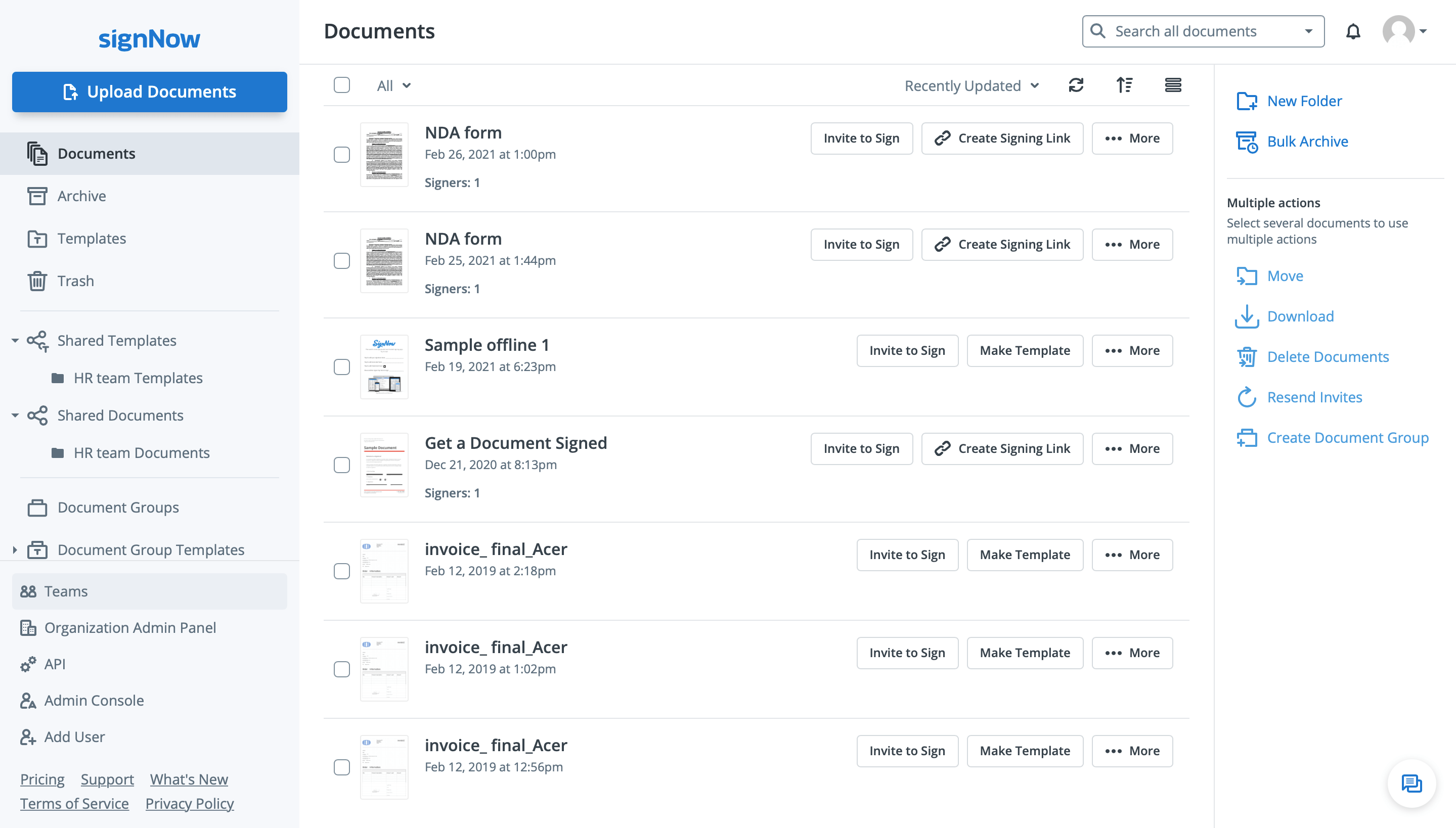
Click Teams toward the bottom of the left-hand sidebar in the airSlate SignNow web app.
fill-guide-illustration

Review your team and its shared assets

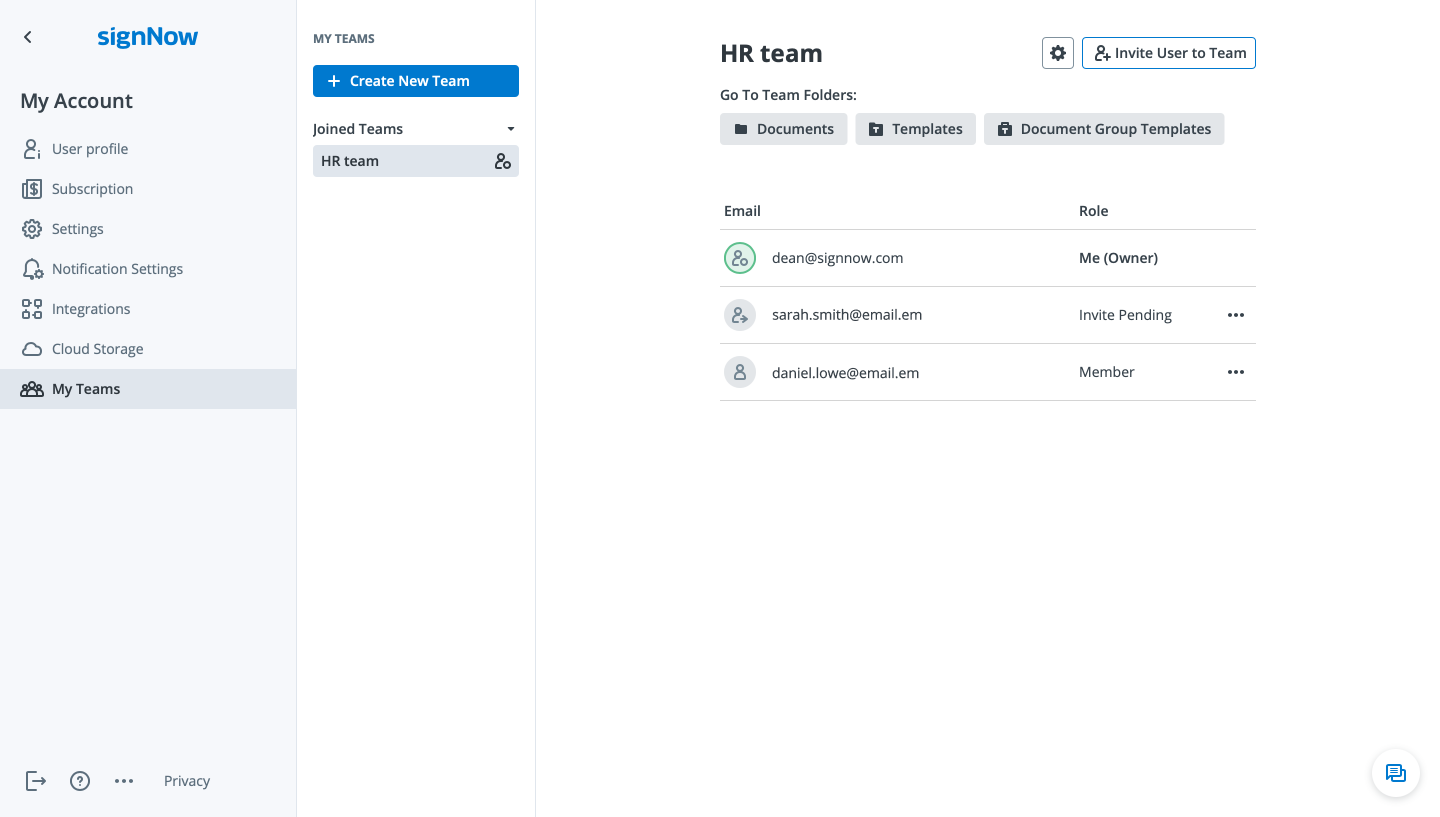
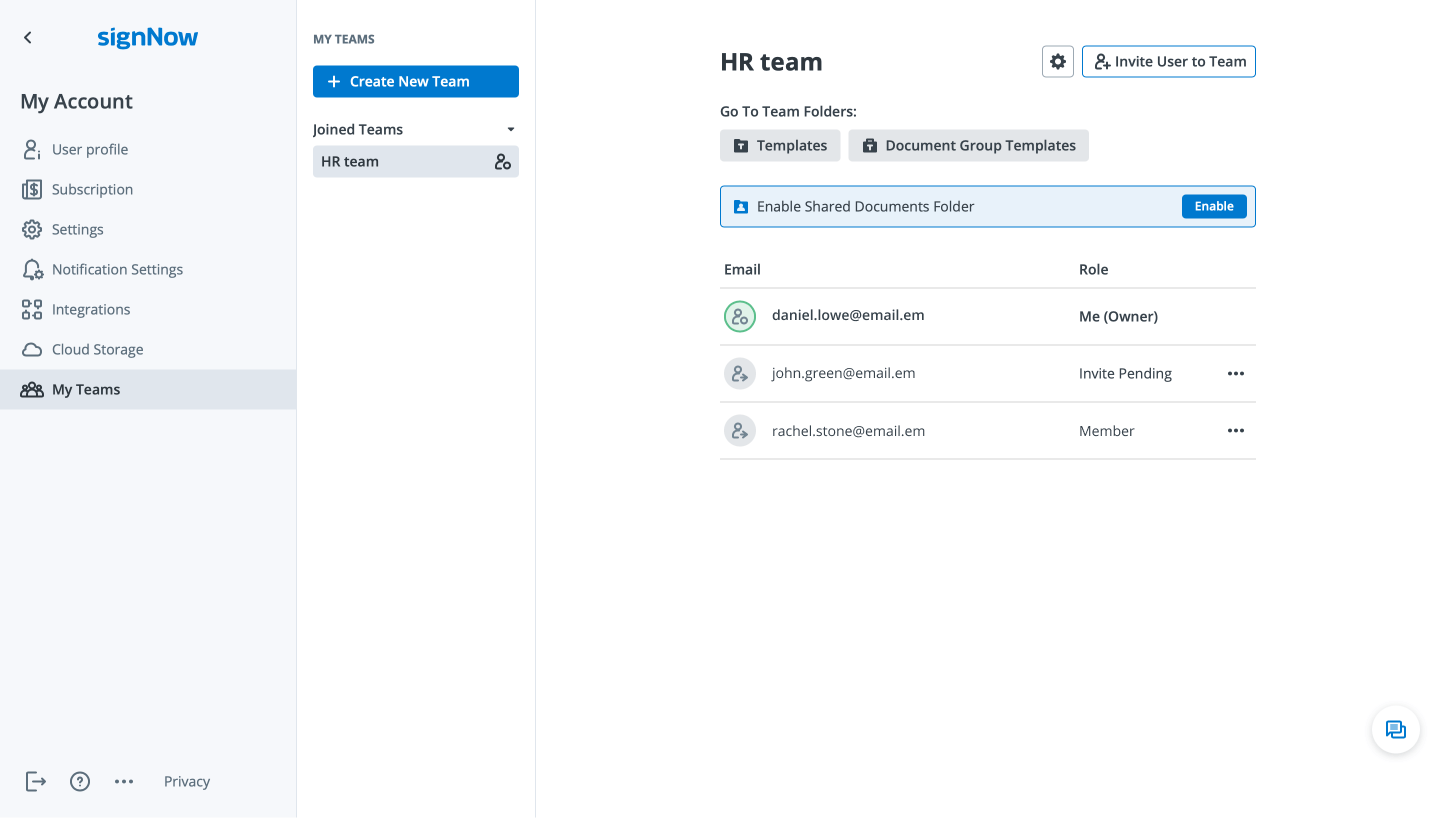
If you have already created at least one team, you will see it in the My Teams column. Select a team to view its members in the column to the right. You can see each member’s role and status next to their email address.

Above your teammate list, you will find folders with the team’s shared documents and templates. Click on any folder to open it and get instant access to the shared assets.
fill-guide-illustration

If you don’t yet have a shared folder, create one by clicking the Enable button in the Enable Shared Documents Folder box.
fill-guide-illustration

Manage your team with ease

To add a new member to a team, click the Invite User to Team button toward the top right corner of the screen and enter the user’s email address in the new dialog box.

To manage a specific team member, click on the ellipsis button next to their email address and select one of the following options:
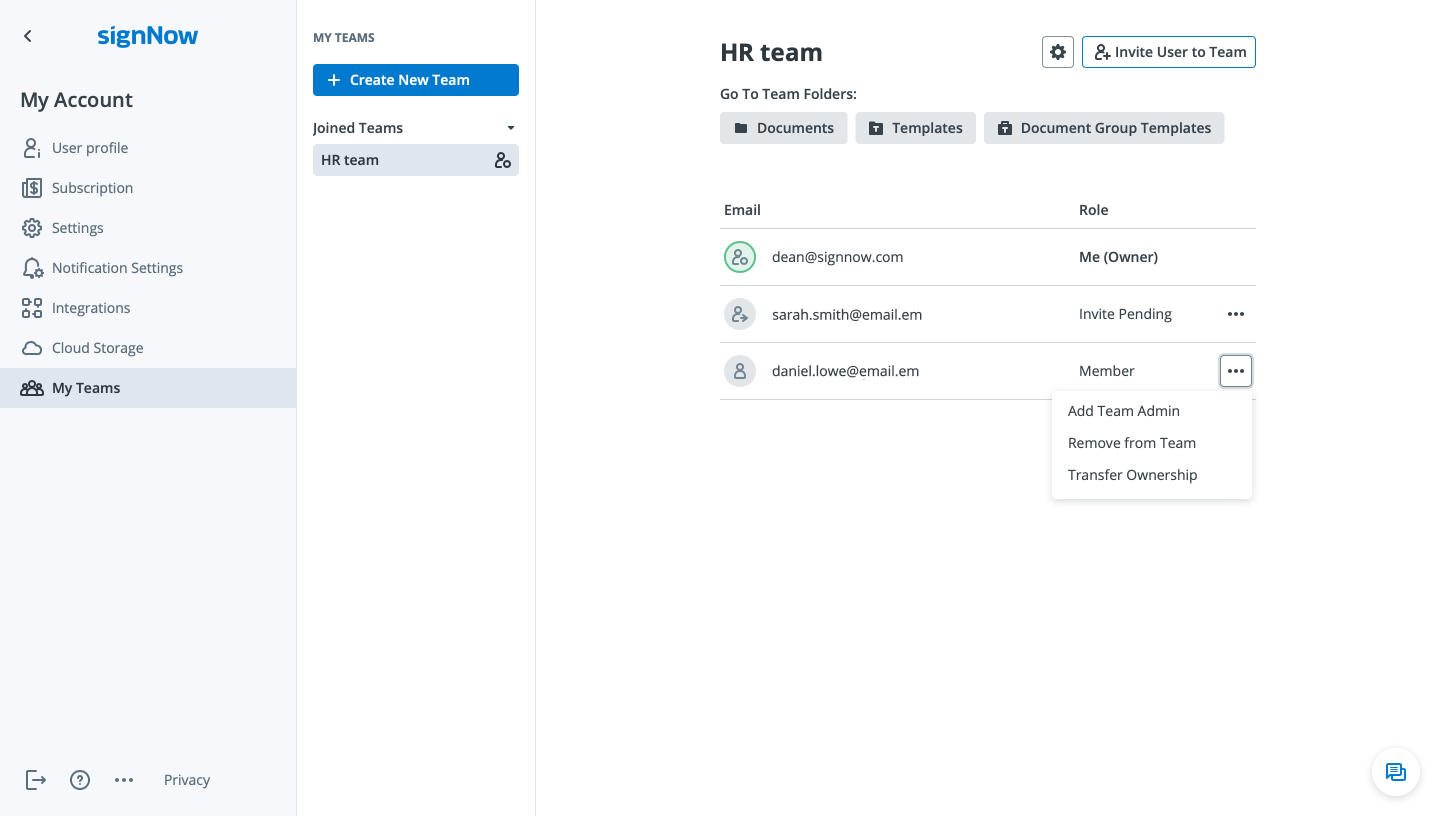

  • Add Team Admin: Promote a member to team administrator, who can add other users to the team (and to the owner’s airSlate SignNow subscription) as well as view all the documents of their team members.
  • Remove from Team: Revoke access to a team for a specific member.
  • Transfer Ownership: Turn a regular member into a team owner. Team owners are fully authorized to manage their team and the airSlate SignNow subscription, as well as edit shared templates.
fill-guide-illustration
walmart logo
exonMobil logo
apple logo
comcast logo
facebook logo
FedEx logo
be ready to get more

Get legally-binding signatures now!