Validate Email Signature with SignNow

Eliminate paperwork and automate digital document processing for more efficiency and endless opportunities. Explore a greater strategy for doing business with airSlate SignNow.

Award-winning eSignature solution

What it means to validate email signature

Validating an email signature is the process of confirming that a signature delivered by email is authentic, linked to the intended signer, and that the transmitted document has not been altered. For electronic transactions, validation typically includes verifying signer identity, checking cryptographic signatures or audit records, confirming email header integrity, and ensuring the signing environment meets legal and organizational requirements. In regulated U.S. contexts this work supports ESIGN and UETA compliance and preserves evidentiary value for dispute resolution and recordkeeping purposes.

Why validate email signature matters

Validating email signatures reduces legal risk, preserves evidentiary value, and protects against forgery or tampering while maintaining reliable records for audits and internal compliance.

Why validate email signature matters

Common challenges when validating email signatures

  • Email headers can be altered or stripped by forwarding, making source verification difficult without header-level checks.
  • Signatures sent as images lack cryptographic binding to the signer and are harder to verify for tampering.
  • Multiple signing platforms and formats complicate a consistent validation workflow across documents and recipients.
  • Regulatory requirements differ by industry; healthcare and education introduce additional controls and documentation needs.

Representative user roles

Compliance Officer

A Compliance Officer manages regulatory obligations, documents validation procedures for ESIGN and UETA adherence, and reviews audit trails to confirm signatures are authentic and records meet internal and external reporting standards.

IT Administrator

An IT Administrator implements technical controls for signature validation, configures secure transmission and storage, integrates signing platforms with identity providers, and enforces encryption and access controls across systems.

Who typically validates email signatures

Teams across compliance, legal, and operations validate email signatures to confirm authenticity and maintain defensible records.

  • Compliance officers who document evidence for audits and regulatory reviews.
  • Legal teams that need admissible records for dispute resolution or contract enforcement.
  • Operations and HR professionals who process signed agreements and maintain retention schedules.

Validation responsibilities often shift between roles depending on document sensitivity and organizational policies.

Key tools that support validating email signatures

Use these features to build a validation workflow that captures identity, integrity, and provenance for email-delivered signatures.

Audit Trail

An immutable event history that records each action, timestamp, IP address, and verification step to prove the signing sequence and document integrity during validation checks.


Signer Authentication

Multiple authentication methods such as email verification, SMS codes, and SSO integration strengthen identity confirmation and reduce impersonation risk when validating signatures.

Email Header Capture

Automatic capture and storage of full email headers to preserve routing metadata, supporting forensic verification of message origin and detection of intermediary modifications.

Document Hashing

Cryptographic hashing binds the signed document to the signing event and enables integrity checks to detect any post-signature changes to the file.

Certificate Signatures

Support for certificate-based signatures provides stronger cryptographic binding and long-term validation capabilities when required by policy or regulation.

Bulk Validation

Batch processing tools validate multiple email-delivered signatures and generate consolidated reports for efficiency and audit readiness.

be ready to get more

Choose a better solution

Integrations that support validate email signature workflows

Integrations streamline validation by embedding signing and verification into document sources and business systems for consistent evidence capture.

Google Docs

Direct integration allows documents to be prepared in Google Docs, sent for signature, and returned with audit data preserved. This reduces file conversions and retains version history linked to the validated signature.

Customer CRMs

CRM connectors attach signed agreements and validation metadata to customer records automatically, ensuring contract evidence is available alongside contact and account data for audits and renewals.

Cloud storage

Integration with cloud storage providers stores final signed documents and associated audit logs in designated folders with retention and access controls enforced by policy.

Identity providers

Single sign-on and identity provider integration centralize authentication, enabling stronger signer verification and consistent access control across validation workflows.
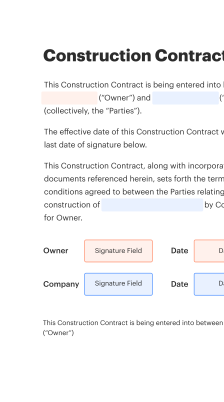
How to create and use validated email signatures online

An online validation flow combines signer authentication, secure signing, and verification steps to create defensible records for email-delivered signatures.

  • Initiate signing: Sender uploads document and designates signers
  • Authenticate signer: Use email link plus secondary verification
  • Sign document: Signer applies electronic signature in session
  • Validate receipt: System records header and audit data
Collect signatures
24x
faster
Reduce costs by
$30
per document
Save up to
40h
per employee / month

Quick setup: validate email signature workflow

Follow these core steps to establish a repeatable process for validating email-delivered signatures within your organization.

  • 01
    Collect headers: Capture full email headers on receipt
  • 02
    Check identity: Verify signer via MFA or ID
  • 03
    Inspect audit trail: Confirm timestamps and events
  • 04
    Archive securely: Store signed file and metadata

How to review an audit trail to validate an email signature

A systematic audit review confirms signer identity, signing context, and document integrity using recorded events and metadata.

01

Open record:

Access the stored signed file
02

Review headers:

Inspect captured email header metadata
03

Check timestamps:

Verify signing and event times
04

Confirm identity:

Match authentication method used
05

Verify hash:

Confirm document hash matches
06

Export evidence:

Generate an exportable audit package
be ready to get more

Why choose airSlate SignNow

  • Free 7-day trial. Choose the plan you need and try it risk-free.
  • Honest pricing for full-featured plans. airSlate SignNow offers subscription plans with no overages or hidden fees at renewal.
  • Enterprise-grade security. airSlate SignNow helps you comply with global security standards.
illustrations signature

Workflow and API settings for validate email signature automation

Configure these settings when automating validation steps through workflow rules or API integration to ensure consistent evidence capture.

Setting Name Configuration
API Authentication OAuth 2.0 with scoped access tokens
Reminder Frequency 48 hours between reminders
Audit Export Format PDF and JSON bundle
Header Capture Store full raw headers
Retention Policy Apply organization retention rules

Validating email signatures across devices

Validation workflows should support common desktop and mobile environments to ensure signatures remain verifiable regardless of device.

  • Desktop browsers: Chrome, Edge, Safari supported
  • Mobile platforms: iOS and Android app support
  • File formats: PDF and common document types

Ensure device-level security such as OS updates and application patching, and prefer native apps for stronger preservation of metadata and reliable capture of audit information when validating email-delivered signatures.

Security controls relevant to email signature validation

Encryption at rest: AES-256 encryption
TLS in transit: TLS 1.2+ enforced
Two-factor authentication: MFA for signer access
Document audit trail: Immutable event log
Role-based access: Granular permissions
Data residency options: Regional hosting controls

Industry examples of validating email signatures

Practical cases show how validation preserves compliance and reduces disputes in sector-specific workflows.

Healthcare consent forms

A hospital required signed consent documents for procedures and used email-delivered signatures to collect patient authorization.

  • The process included identity verification and secure storage of signed PDFs.
  • Validation checked audit trails and email headers to confirm signer origin and document integrity.

Resulting in preserved HIPAA records and reduced administrative follow-up while maintaining patient confidentiality.

University enrollment agreements

A university accepted signed enrollment agreements via email during admissions.

  • Admissions verified student identity with institution credentials and recorded the signing event.
  • Validation included timestamp verification and retention according to FERPA guidance.

Ensures enforceable agreements and consistent archival, reducing disputes and supporting accreditation audits.

Best practices for secure and accurate validate email signature processes

Adopt consistent policies and technical controls to make validation repeatable, auditable, and defensible across teams and systems.

Maintain complete email headers when storing evidence
Store full email headers along with the signed document and audit trail. Headers provide source routing and origin metadata that help verify the sender and detect forwarding or intermediary changes, supporting forensic review if authenticity is questioned.
Use multi-factor signer authentication
Require a secondary verification step such as SMS code, knowledge-based questions, or SSO to strengthen signer identity and reduce the risk of impersonation when validating email-delivered signatures.
Preserve immutable audit logs for every transaction
Record signing events, timestamps, IP addresses, and verification steps in an unalterable audit trail to demonstrate the sequence of actions and support legal admissibility under ESIGN and UETA.
Apply consistent retention and access policies
Define retention periods aligned with regulatory requirements, enforce role-based access to signed records, and regularly review retention rules to ensure records are available for required compliance windows.

FAQs About validate email signature

Answers to common questions about validating signatures delivered via email, covering legal, technical, and procedural concerns.

Comparison: digital validation capabilities across providers

A brief feature comparison showing whether common providers support key validation capabilities for email-delivered signatures.

Feature signNow (Recommended) DocuSign Adobe Acrobat Sign
Validate Email Signatures
Capture Full Email Headers
Certificate-based Signatures Optional Optional
Exportable Audit Package
be ready to get more

Get legally-binding signatures now!

Cloud storage and document retention guidelines

Retention schedules and backup policies ensure validated signatures remain retrievable and intact for required compliance periods.

Retention period for contracts:

Typically seven years for many commercial agreements

Healthcare records retention:

Follow state-specific HIPAA guidelines and local laws

Education records retention:

Apply FERPA-aligned retention and access controls

Backup frequency and type:

Daily incremental backups with weekly full snapshots

Document disposal policy:

Secure deletion after retention period ends

Risks and penalties from insufficient validation

Legal challenges: Evidence rejection
Regulatory fines: Monetary penalties
Contract disputes: Enforceability issues
Data breaches: Notification obligations
HIPAA violations: Significant fines
Reputational harm: Lost trust

Pricing and plan overview for signature validation features

High-level plan comparisons that reflect starting tiers and typical capabilities relevant to validating email-delivered signatures.

Plan / Vendor signNow (Recommended) DocuSign Adobe Acrobat Sign HelloSign PandaDoc
Starting monthly price (typical) $8 per user per month $10 per user per month $14.99 per user per month $15 per user per month $19 per user per month
Audit and export features Included in most plans Included in most plans Included in most plans Included in paid plans Included in paid plans
Identity verification options Email, SMS, SSO Email, SMS, IDV Email, certificate, IDV Email, SMS Email, SMS, SSO
Integration availability Google, CRM, API Extensive ecosystem Adobe ecosystem Google, Dropbox CRM and templates
Enterprise features Advanced admin and SSO available Advanced controls available Enterprise deployment options Team plans available Enterprise workflows available

Streamline complicated workflows

Prepare, deliver, and control workflows of any complexness, electronically from virtually anywhere. Scalable eSignature features enable you to share contracts with the right users the right order and assign roles for every signee. Stream document workflows faster and simpler than ever before.

Automate document management

Enhance intricate signing tasks with airSlate SignNow�s effective capabilities to improve your business. Control your automated eSignature workflows to guarantee they're operating at top performance with instant notifications and reminders.

Optimize in team collaboration

Bring teams together in a protected, shared environment. Handle paperwork, use form templates and notifications to produce better cross-company interaction. Relieve your staff from having to spend time on recurring actions to enable them to focus on beneficial, business-essential projects.

Integrate into your existing systems

Manage your projects with market-leading integration. Collect Salesforce, Microsoft Teams, and SharePoint in multi functional business thread. Link your software to a single unit for endless opportunities and more efficiency.

Remain compliant with industry-leading data security

Feel safe with the knowledge that your data remains secure by the most recent in encryption security. airSlate SignNow is GDPR and eIDAS compliant and provides you visibility into your eSigning process with court-admissible audit trails. Set up user authorization and roles to control who has access to what.


walmart logo
exonMobil logo
apple logo
comcast logo
facebook logo
FedEx logo
be ready to get more

Get legally-binding signatures now!