Attachment fields
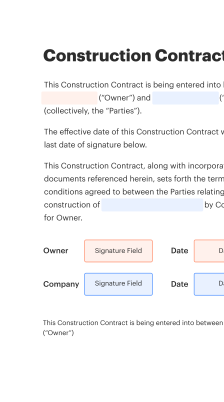
Signer-specific upload fields permit collection of files directly in the signing session and are configurable for required or optional status, labeling, and placement within the document.





Requiring and validating attachments at signing reduces downstream manual processing, preserves evidence of what the endorser submitted, and supports regulatory and internal requirements by linking submitted files to the electronic signature record.

An individual required to upload a supporting document during the signing session. The platform captures identity metadata and ties the uploaded file to the signer, helping ensure that the attachment is attributable and defensible as part of the electronic record.
A staff member who reviews uploaded attachments for completeness and regulatory adequacy. Reviewers access audit logs and stored files, flagging issues or requesting re-submission when documents do not meet validation or policy requirements.
Signer-specific upload fields permit collection of files directly in the signing session and are configurable for required or optional status, labeling, and placement within the document.
Validation rules enforce permitted file types, maximum sizes, and basic scanning to reduce the risk of unsupported or potentially harmful uploads during the signing process.
Uploaded attachments are stored in encrypted cloud storage with access controls that align with account permissions and retention policies to protect sensitive data.
Each attachment is logged with timestamps, uploader identity, IP address, and file hash to create a verifiable record tied to the signed transaction.
Assign attachment permissions by role so only designated endorsers can upload, while reviewers and approvers have read-only or restricted access as needed.
APIs allow programmatic enforcement and retrieval of attachments, enabling integrations that validate file content or move files into downstream systems after signing.
Link attachments to Google Drive folders automatically after signing, enabling centralized storage with folder-level permissions and audit visibility across organizational documents.
Map uploaded attachments to CRM records so supporting files are stored alongside customer data, reducing manual uploads and improving case history completeness for sales and service teams.
Route completed attachments to Dropbox destinations to maintain a parallel archive outside the signing platform while preserving file hashes and metadata for verification.
Create templates that include pre-positioned attachment fields and validation rules so teams can quickly launch consistent signing sessions requiring the same supporting documents.
| Setting Name | Configuration |
|---|---|
| Reminder Frequency | 48 hours |
| Allowed File Types | PDF, JPG, PNG |
| Maximum File Size | 25 MB |
| Post-sign Action | Move to S3 |
| Validation Mode | Basic scan |
Verify endorser attachment works across modern browsers and native mobile apps with consistent behavior for requesting and uploading files during signing.
For best results, use up-to-date browser versions and the signNow mobile app for offline capture, image optimization, and automatic metadata collection when endorsers upload attachments, ensuring consistent verification behavior.
Lenders require borrowers to upload ID and proof of income before signing
Resulting in clearer underwriting evidence and reduced post-close remediation.
Universities request supporting transcripts or consent forms from endorsers during approval flows
Leading to auditable consent records and simplified FERPA-compliant retention.
| Feature | signNow Recommended | DocuSign | Adobe Sign |
|---|---|---|---|
| Mobile app availability for signing | |||
| ESIGN and UETA compliance status | |||
| REST API support and SDKs | |||
| Attachment field validation options | Advanced | Advanced | Moderate |
30 days
7 years
As required by law
After retention period
90 days for bulk export
| Plan | signNow Recommended | DocuSign | Adobe Sign | HelloSign | PandaDoc |
|---|---|---|---|---|---|
| Free tier availability | Limited trial features | No permanent free tier | No permanent free tier | Free tier with limits | Free tier with limits |
| Starting monthly price (per user) | $8 per user | $10 per user | $14 per user | $15 per user | $19 per user |
| API access included | Included in Business plans | Included on certain plans | Enterprise only | Limited API | Enterprise/API add-on |
| Bulk send and templates | Available on higher tiers | Available on higher tiers | Available on higher tiers | Available on paid plans | Available on paid plans |
| Storage and retention controls | Configurable retention | Enterprise controls | Admin retention policies | Basic retention | Admin controls |
| Enterprise support options | Dedicated support available | Enterprise SLAs | Enterprise SLAs | Priority support | Enterprise packages |
Create, execute, and manage workflows of any complexity, electronically from virtually anywhere. Scalable eSignature capabilities allow you to share documents with the right people in the correct order and define roles for each recipient. Execute document workflows faster and easier than ever before.
Optimize complex signing processes with airSlate SignNow’s powerful features to enhance your business. Control your automated eSignature workflows to ensure they're running at peak performance with instant notifications and reminders.
Bring teams together in a secure, shared environment. Manage documents, use form templates and notifications to create more efficient cross-organization collaboration. Free your employees from having to spend time on repetitive activities so that they can focus on valuable, business-critical tasks.
Run your projects with industry-leading integration. Collect Salesforce, Microsoft Teams, and SharePoint all in one business flow. Connect your software to a single system for endless possibilities and more productiveness.
Feel confident understanding that your data is protected by the newest in encryption security. airSlate SignNow is GDPR and eIDAS compliant and gives you transparence into your signing procedure with court-admissible audit trails. Configure user authorization and rights to control who has access to what.