Verify Signature Authentication with SignNow

Eliminate paperwork and automate document management for higher performance and countless opportunities. eSign any papers from a comfort of your home, quick and feature-rich. Discover the perfect strategy for doing business with airSlate SignNow.

Award-winning eSignature solution

What verify signature authentication means for documents

Verify signature authentication refers to the processes and technical controls used to confirm that an electronic signature was made by the claimed signer and that the signed document has not been altered since signing. It typically combines signer identity checks, cryptographic proof, and a timestamped audit trail to establish integrity and non-repudiation. In U.S. contexts these methods support compliance with ESIGN and UETA by demonstrating intent and association. Platforms such as signNow implement multiple verification layers to produce a verifiable signature record for business, legal, and regulated workflows.

Why verify signature authentication is important for organizations

Using robust verify signature authentication reduces legal risk, protects against tampering, and helps establish reliable chain-of-custody for agreements. It improves trust in remote transactions and supports regulatory and recordkeeping obligations across business functions.

Why verify signature authentication is important for organizations

Common challenges when implementing signature verification

  • Inconsistent identity checks across signers create uneven legal defensibility and process gaps.
  • Poorly configured authentication methods can annoy users and reduce completion rates on critical forms.
  • Lack of standardized audit trails makes it harder to prove authenticity during disputes or audits.
  • Integrating verification into legacy workflows often requires mapping security to existing access controls.

Representative user profiles and their verification needs

Legal Counsel

Corporate legal teams review signed agreements, require comprehensive audit logs, and often need authentication methods that will hold up in litigation or regulatory review. They prioritize tamper-evident records, timestamp accuracy, and clear identity evidence that links signers to actions taken on documents.

Healthcare Administrator

Administrators in healthcare manage patient consent and billing forms where HIPAA applies. They require authenticated signing that supports access controls, limited disclosure, and retention policies while ensuring signers can complete forms on mobile devices or kiosks with validated identity.

Teams and roles that commonly use verify signature authentication

Organizations that require documented consent, identity verification, and tamper-evident records rely on signature authentication across many departments.

  • Human resources teams for onboarding and employment agreements requiring identity checks and signed consent.
  • Legal and compliance units needing provable execution records and chain-of-custody for contracts.
  • Healthcare and education administrators handling protected records under HIPAA or FERPA obligations.

These groups balance verification strength with signer convenience to meet regulatory, operational, and customer experience requirements.

Key tools that improve verify signature authentication outcomes

A robust verification suite combines authentication options, audit capabilities, and administrative controls to meet enterprise and regulated use cases.

Multi-factor options

Support for SMS, email, authenticator apps, and knowledge-based verification provides layered identity checks that balance security and signer convenience.


Digital certificates

Certificate-based signatures using PKI provide a cryptographic level of assurance suitable for high-assurance transactions and integration with trust services.

Comprehensive audit trails

Detailed logs capture events such as authentication attempts, IP addresses, timestamps, and document state to support forensics and legal defensibility.

Role-based access

Administrative controls let organizations assign permission levels for sending, viewing, or exporting verified documents and associated audit data.

Tamper detection

Mechanisms that detect and report changes after signing help maintain document integrity and signal when records have been altered.

Reporting and export

Exportable evidence packages and reporting tools let teams produce organized proof for audits, legal review, or regulatory submission.

be ready to get more

Choose a better solution

Integrations and templates that streamline verification

Integration with common content and CRM tools plus reusable templates ensures verification is consistent and embedded into existing workflows across teams.

Google Docs

Attach verification-enabled templates directly from Google Docs to maintain document formatting while applying signer authentication and audit logging before sending for signature.

CRM integrations

Connect verification workflows to CRM records so authentication requirements and audit data map to contact and opportunity records for clearer transaction histories.

Dropbox and Drive

Store and retrieve documents from cloud storage with verification metadata preserved, enabling secure archival and retrieval with linked audit trails.

Custom templates

Create templates that include pre-configured authentication steps, signer roles, and automated reminders so verification is consistent across repeated processes.
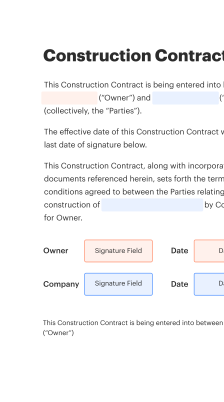
How verify signature authentication typically works in practice

A standard authentication flow includes identifying the signer, capturing the signature, creating cryptographic evidence, and storing a tamper-evident audit trail linked to the document.

  • Signer identification: Verify identity via email, SMS, government ID, or MFA.
  • Signature capture: Collect typed, drawn, or certificate-based electronic signatures.
  • Cryptographic binding: Hashing and digital certificates bind signature to document.
  • Audit generation: Record timestamps, IPs, and verification events for proof.
Collect signatures
24x
faster
Reduce costs by
$30
per document
Save up to
40h
per employee / month

Quick setup: implement verify signature authentication with signNow

Follow these core steps to configure verification methods, apply them to templates, and ensure audit trails are enabled for signed documents.

  • 01
    Choose authentication: Select email, SMS, knowledge-based, or certificate-based methods.
  • 02
    Apply to template: Assign authentication requirements to fields or signer roles.
  • 03
    Enable audit logs: Turn on detailed logging and timestamping for transactions.
  • 04
    Test workflow: Run sample signings to verify settings before production.

Audit trail essentials: what to capture and why

An effective audit trail collects evidence items that together support proof of signature origin and document integrity.

01

Event timestamps:

Record all signing and verification times.
02

IP addresses:

Log network origin for each action.
03

Authentication events:

Capture MFA and ID check results.
04

Signature type:

Indicate typed, drawn, or certificate-based.
05

Document hash:

Store cryptographic digest for integrity.
06

User metadata:

Attach signer contact and role details.
be ready to get more

Why choose airSlate SignNow

  • Free 7-day trial. Choose the plan you need and try it risk-free.
  • Honest pricing for full-featured plans. airSlate SignNow offers subscription plans with no overages or hidden fees at renewal.
  • Enterprise-grade security. airSlate SignNow helps you comply with global security standards.
illustrations signature

Typical configuration options for verification workflows

Below are common workflow settings to consider when enabling verify signature authentication within an eSignature platform.

Feature Configuration
Reminder Frequency 48 hours
Signer Authentication Method Email/SMS/MFA
Document Retention Period 7 years
Template Enforcement Required
Bulk Send Limit 250 per batch

Supported platforms and device considerations

Verify signature authentication should work consistently across web, mobile, and tablet devices but can require specific capabilities for some methods.

  • Desktop browsers: Modern Chromium, Firefox, Safari
  • Mobile apps: iOS and Android supported
  • Offline signing: Limited or not available

Test authentication flows on targeted devices to confirm SMS receipt, ID photo capture, and certificate handling behave as expected; plan alternative paths for signers who cannot access a primary verification channel.

Core security features that support verification

Multi-factor Authentication: Optional per signer
Audit Logging: For every transaction
Data Encryption: In transit and at rest
Access Controls: Role-based permissions
Certificate IDs: X.509 support available
Tamper Evidence: Detects document changes

Industry scenarios where verification matters

Concrete examples show how verify signature authentication reduces risk and supports operational needs across sectors.

Healthcare consent flow

A hospital collects patient consent for a procedure using an electronic form that requires identity proof and audit logging

  • SMS and email verification used for initial identity confirmation
  • Reduces administrative overhead and provides a timestamped audit trail for compliance

Resulting in clearer records for audits and fewer consent disputes during care delivery.

Real estate closing

A title company coordinates multiple signers across states for a property closing using verified eSignatures

  • Signers authenticate using government ID verification and a recorded IP/timestamp
  • Centralized audit trail matches each signature to an identity and shows document integrity

Leading to faster closings, transparent records for escrow, and reduced in-person appointment needs.

Best practices for secure and accurate verification

Follow operational and technical practices to make verify signature authentication reliable, auditable, and minimally intrusive for signers.

Use tiered authentication based on risk
Apply stronger authentication (certificate-based or MFA) to high-value or regulated documents, while using lighter methods (email or SMS) for low-risk forms to preserve user experience and completion rates.
Consistently enable audit logging
Ensure audit trails are enabled for all verified transactions, including signer identity events, timestamps, and IP addresses so that each signed document has an unbroken record for review.
Standardize templates and signer roles
Create and maintain templates with predefined authentication requirements and explicit signer roles to reduce configuration errors and ensure repeatable, compliant signing processes.
Train staff and document instructions
Provide clear guidance for internal users and external signers about authentication steps, acceptable ID types, and how to resolve verification issues to reduce friction and failed signatures.

FAQs About verify signature authentication

Answers to common questions about implementing and troubleshooting verification in eSignature workflows.

Feature availability: signNow compared to other major providers

This concise comparison highlights how common verification capabilities are offered across three well-known eSignature platforms.

Criteria signNow (Featured) DocuSign Adobe Acrobat Sign
API access
Audit trail Full Full Full
Mobile apps iOS/Android iOS/Android iOS/Android
Bulk Send
be ready to get more

Get legally-binding signatures now!

Risks of weak verification or poor practices

Contract disputes: Extended litigation risk
Regulatory fines: Compliance penalties possible
Reputational harm: Loss of customer trust
Data breaches: Exposure of sensitive records
Operational delays: Slower closing cycles
Invalid agreements: Enforceability challenges

Capabilities matrix across popular eSignature vendors

A feature-first comparison across leading platforms highlights common verification and enterprise capabilities; signNow is listed first as a featured option.

Feature signNow (Featured) DocuSign Adobe Acrobat Sign Dropbox Sign PandaDoc
Free plan availability Free trial, limited options Free trial only Trial with Acrobat Free limited plan Free eSign plan
API availability REST API with SDKs Comprehensive REST API REST API & SDKs REST API REST API
SSO support SAML SSO (enterprise) SAML SSO (enterprise) SAML SSO (enterprise) SAML SSO (enterprise) SAML SSO (enterprise)
HIPAA support Available (BAs) Available (BAs) Available (enterprise) Available (enterprise) Available (enterprise)
Advanced workflows Conditional routing, templates Workflows, templates Workflows via Adobe Basic routing Document automation

Simplify complex workflows

Create, execute, and manage workflows of any complexity, electronically from virtually anywhere. Scalable eSignature capabilities allow you to share documents with the right people in the correct order and define roles for each recipient. Execute document workflows faster and easier than ever before.

Automate document management

Optimize complex signing processes with airSlate SignNow’s powerful features to enhance your business. Control your automated eSignature workflows to ensure they're running at peak performance with instant notifications and reminders.

Optimize in team collaboration

Bring teams together in a secure, shared environment. Manage documents, use form templates and notifications to create more efficient cross-organization collaboration. Free your employees from having to spend time on repetitive activities so that they can focus on valuable, business-critical tasks.

Integrate into your existing systems

Run your projects with industry-leading integration. Collect Salesforce, Microsoft Teams, and SharePoint all in one business flow. Connect your software to a single system for endless possibilities and more efficiency.

Stay compliant with industry-leading data security

Feel confident knowing that your information remains secure by the newest in encryption security. airSlate SignNow is GDPR and eIDAS compliant and provides you awareness into your eSigning experience with court-admissible audit trails. Set up user authorization and rights to manage who has access to what.


walmart logo
exonMobil logo
apple logo
comcast logo
facebook logo
FedEx logo
be ready to get more

Get legally-binding signatures now!