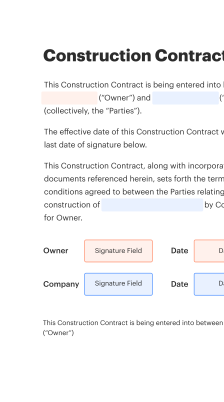
Verify Signature Certificate with SignNow
What verify signature certificate means and why it matters
Why verifying signature certificates improves trust in signed records
Verifying a signature certificate reduces signature disputes by proving who signed and when, helps meet regulatory requirements, and preserves a verifiable audit trail for legal or compliance reviews. Using certificate verification supports consistent recordkeeping and stronger evidentiary value.
Common operational challenges when working with certificates
- Managing certificate lifecycles across many users can be complex and requires automated renewal and revocation processes to avoid expired credentials.
- Ensuring signer identity before issuing certificates needs robust identity proofing to reduce fraud and liability in regulated sectors.
- Interoperability between different PKI providers and signature formats can complicate validation across external partners and legacy systems.
- Maintaining long-term validation requires trusted timestamping and secure storage to preserve certificate chains for future legal evidence.
Representative user roles and how they use verification
Contract Manager
Responsible for routing agreements for signature, the contract manager uses verify signature certificate outputs to confirm signer identity and timestamp evidence for each executed contract. They maintain signed record copies and reference certificate details during renewals, amendments, or disputes to show when and how signatures were validated.
IT Compliance Lead
Overseeing PKI and integrations, the IT compliance lead configures certificate issuance, revocation checks, and automated validation within the signing platform. They ensure that verification settings meet internal policies and external regulations, and they generate audit reports for internal or external review.
Teams that rely on certificate verification
Legal, compliance, and operations groups commonly require certificate verification to reduce risk and support auditable records.
- Legal teams managing contract evidence and dispute resolution need cryptographic proof of signature authenticity.
- Compliance officers in finance and healthcare require verifiable signatures to meet regulatory reporting and retention policies.
- IT and security teams administer certificate issuance, revocation, and integrate verification into enterprise workflows.
These groups coordinate procedures and technical controls to ensure certificates remain valid, traceable, and legally defensible.
Choose a better solution
Primary tools that support verify signature certificate workflows
Certificate Issuance
Integrated certificate issuance lets organizations request, provision, and manage digital credentials for users, including automated renewals and revocation handling to maintain continuous validity across signing events and minimize manual intervention.
Verification Reports
Detailed verification reports summarize certificate chain status, timestamp information, signer identity attributes, and revocation checks, producing human-readable evidence that supports legal review and internal compliance audits.
Audit Trail
A comprehensive audit trail records every verification action, signer interactions, and cryptographic events so administrators can reconstruct the signing event and demonstrate adherence to internal controls and external regulations.
Platform Integrations
Prebuilt integrations with document storage, identity providers, and enterprise systems let verification data flow into existing workflows and preserve certificates alongside signed records for consistent lifecycle management.
How certificate-backed signatures are created and validated
-
Generate CSR: Create certificate signing request
-
Issue Certificate: CA signs and issues credential
-
Attach to Signature: Embed cert data with signed document
-
Verify Chain: Validate certificate chain and timestamps
Step-by-step: completing a verify signature certificate workflow
-
01Request Certificate: Initiate certificate issuance for the signer
-
02Verify Identity: Perform identity proofing or KBA checks
-
03Sign Document: Signer applies signature tied to certificate
-
04Validate Certificate: Verify chain, timestamp, and revocation status
Managing audit trails and certificate evidence
Capture Metadata:
Store Artifacts:
Preserve Chains:
Enable Timestamps:
Log Access:
Periodic Validation:
Why choose airSlate SignNow
-
Free 7-day trial. Choose the plan you need and try it risk-free.
-
Honest pricing for full-featured plans. airSlate SignNow offers subscription plans with no overages or hidden fees at renewal.
-
Enterprise-grade security. airSlate SignNow helps you comply with global security standards.
Recommended workflow settings for certificate verification
| Setting Name | Configuration |
|---|---|
| Certificate Issuance Mode | Automated |
| Reminder Frequency | 48 hours |
| Identity Verification | Two-factor |
| Retention Period | 7 years |
| Signature Verification Mode | PKI chain |
Platforms and device considerations for verification
Verify signature certificate workflows work across common desktop and mobile platforms but require certain browser and OS capabilities for cryptographic operations.
- Supported Browsers: Chrome, Edge, Firefox
- Mobile Platforms: iOS and Android apps
- Minimum OS Versions: Modern releases only
Ensure users run up-to-date browsers or the official mobile app and that administrators enable secure transport and storage settings to reliably capture certificate metadata during signing.
Real-world examples of verify signature certificate use
Healthcare Consent Forms
Patients sign consent forms remotely, and a verify signature certificate records signer identity and timestamp using PKI-based credentials
- Enables clinicians to prove the signature and signing time for treatment authorization
- Reduces administrative follow-ups and supports HIPAA-compliant documentation
Resulting in clear, auditable patient consent records that stand up in clinical or regulatory review.
Real Estate Closings
During property closings, agents capture signatures with certificate-backed verification to establish signer authenticity and document integrity
- Certificates include chain of trust and timestamping
- Facilitates mortgage and title workflows requiring verifiable signatures
Leading to faster closings and clearer evidence for lenders, escrow, and record filings.
Practical best practices for secure and reliable verification
FAQs About verify signature certificate
- Why can't I validate a signature certificate?
Validation fails when the certificate chain is incomplete, a root CA is untrusted, or the timestamping information is missing. Confirm the full certificate chain is present, check revocation status with CRL/OCSP, and ensure your validation tool trusts the issuing CA.
- What if a certificate is expired or revoked?
An expired or revoked certificate will show as invalid for new validations. Use recorded timestamps and archived verification reports to demonstrate the signature was valid at signing time; consult your revocation logs and legal counsel for dispute handling.
- How do I handle signer identity mismatches?
If signer attributes in the certificate differ from expected identity, review identity proofing records and issuance logs. Confirm whether a secondary identity check occurred and reconcile with the organization’s identity verification policy before accepting the signed record.
- Why is my audit trail missing verification details?
Missing details usually result from configuration that does not capture certificate metadata or timestamps. Verify platform settings to ensure verification artifacts are stored with the signed document and enable detailed logging for future events.
- Can I verify signatures from mobile devices reliably?
Mobile validation is possible but depends on app-level capture of certificate metadata and secure transmission. Ensure the mobile client records certificate chain and timestamp and uses secure channels to upload verification artifacts to central storage.
- How long should I retain certificates and verification reports?
Retention depends on sector regulations and contract terms; common practices range from seven years to indefinite retention for critical records. Align retention with legal counsel, regulatory requirements such as HIPAA for healthcare, and internal governance.
Feature comparison: verify signature certificate capabilities
| Feature | signNow (Recommended) | DocuSign | Adobe Sign |
|---|---|---|---|
| PKI-based certificates | |||
| Audit trail detail | Extensive | Extensive | Moderate |
| Native Google Docs integration | Partial | ||
| HIPAA support options | Supported | Supported | Supported |
Get legally-binding signatures now!
Regulatory and operational risks from poor verification
Representative pricing and capabilities across providers
| Plan | signNow (Featured) | DocuSign | Adobe Sign | Dropbox Sign | OneSpan Sign |
|---|---|---|---|---|---|
| Starting Price (per user/month) | Approx. $8 per user per month billed annually | Approx. $10 per user per month billed annually | Approx. $14 per user per month billed annually | Approx. $15 per user per month billed annually | Approx. $20 per user per month billed annually |
| Free Trial Availability | Free trial available for new users | Trial available with limited features | Trial available with limited features | Free tier with limited sends | Contact sales for trial |
| Enterprise Controls | Advanced admin controls, SSO, audit logs on enterprise plans | Enterprise controls, SSO, integrations | Enterprise admin, SSO, DLP support | Admin controls and SSO on business plans | Enterprise-grade controls and compliance focus |
| HIPAA/BAA Support | Optional BAA available on enterprise plans | BAA available for eligible plans | BAA available for eligible enterprise customers | BAA available on higher tier plans | BAA available on enterprise agreements |
| API and Developer Access | REST API and developer keys with certificate features | REST API and comprehensive SDKs | REST API with developer resources | REST API via Dropbox developer platform | REST API with enterprise SDKs and security features |
Simplify complex workflows
Create, execute, and manage workflows of any complexity, electronically from virtually anywhere. Scalable eSignature capabilities allow you to share documents with the right people in the correct order and define roles for each recipient. Execute document workflows faster and easier than ever before.
Automate document management
Optimize complex signing processes with airSlate SignNow’s powerful features to enhance your business. Control your automated eSignature workflows to ensure they're running at peak performance with instant notifications and reminders.
Optimize in team collaboration
Bring teams together in a secure, shared environment. Manage documents, use form templates and notifications to create more efficient cross-organization collaboration. Free your employees from having to spend time on repetitive activities so that they can focus on valuable, business-critical tasks.
Integrate into your existing systems
Run your projects with industry-leading integration. Collect Salesforce, Microsoft Teams, and SharePoint all in one business flow. Connect your software to a single system for endless possibilities and more productivity.
Stay compliant with market-leading data security
Feel safe with the knowledge that your information remains secure by the latest in encryption security. airSlate SignNow is GDPR and eIDAS compliant and gives you visibility into your signing experience with court-admissible audit trails. Configure user access permissions and roles to control who has access to what.