Virtual Machine Signature with SignNow

Get rid of paperwork and automate digital document managing for more efficiency and unlimited possibilities. Sign anything from your home, fast and professional. Enjoy the best way of running your business with airSlate SignNow.

Award-winning eSignature solution

What a virtual machine signature is and why it matters

A virtual machine signature is an electronic signing method that binds a signer identity to a document or transaction executed inside a virtualized environment. It combines cryptographic proof with metadata about the virtual machine instance, such as host identifiers, session timestamps, and certificate attributes, to create evidence of origin and integrity. This approach addresses scenarios where signing occurs inside cloud-hosted or containerized systems, enabling auditable, reproducible signatures that align with enterprise security policies and automated workflows while preserving non-repudiation and tamper-detection.

When virtual machine signatures are most useful

Virtual machine signatures are appropriate when signers or signing processes run inside virtualized systems and organizations need cryptographic proof tied to that runtime environment for compliance or operational integrity.

When virtual machine signatures are most useful

Common implementation challenges

  • Ensuring the virtual environment's identity is reliably recorded and linked to the signature without exposure of sensitive host data.
  • Managing cryptographic keys securely across ephemeral instances and preventing unauthorized extraction or reuse.
  • Integrating VM-level metadata into standard audit trails and signature certificates for legal admissibility.
  • Coordinating certificate authority trust, timestamping services, and compatible signature formats across systems.

Representative user profiles

IT Admin

An IT administrator configures VM identity services, installs signing agents, and manages keys and certificates across cloud instances. They maintain secure key storage policies and ensure signing components adhere to organizational security baselines and patching schedules.

Compliance Officer

A compliance officer defines retention, logging, and verification requirements for signatures created inside virtual machines. They work with legal and IT teams to validate that audit trails, timestamping, and authentication mechanisms meet ESIGN and UETA requirements for admissibility.

Typical users and organizational roles

Organizations adopt virtual machine signatures where signing workflows are automated, cloud-native, or require machine-attested execution contexts.

  • DevOps teams automating approvals and deployments from CI/CD pipelines.
  • Compliance teams ensuring signatures include environment attestations.
  • Legal and contract teams needing increased evidentiary detail for cloud-signed agreements.

These roles work together to ensure operational controls, technical attestations, and legal requirements are met when documents are signed from virtualized systems.

Expanded feature checklist for enterprise VM signatures

Enterprises should evaluate a broader set of capabilities to support scale, security, and regulatory needs for virtual machine signatures.

Audit Trail

Comprehensive, tamper-evident logs with signer, VM metadata, and timestamps for each transaction to support investigations and compliance reviews.


Multi-factor Auth

Support for MFA and strong authentication for human actors initiating VM signing operations to reduce account compromise risk.

Templates

Reusable document templates and field mapping to standardize signed artifacts created by automated VM processes across departments.

Bulk Send

Capabilities to initiate large-volume signing jobs from cloud instances with tracking and parallel processing controls for throughput management.

API Access

Stable REST APIs with SDKs, webhooks, and retry semantics for integrating signing into CI/CD and cloud-native automation pipelines.

Mobile Support

Optional mobile signing flows and verification tools for tasks that involve mobile device interactions alongside VM-based processes.

be ready to get more

Choose a better solution

Core capabilities to look for with virtual machine signature

Effective solutions combine secure key management, detailed audit trails, environment attestation, and integration into existing document workflows for reliable VM-based signing.

Key Management

Support for HSMs and cloud KMS with role separation, export controls, and rotation policies to protect private signing keys used by virtual instances.

VM Attestation

Mechanisms to capture and include cryptographic attestations of the virtual machine's identity, image, and runtime context as part of the signature metadata.

Audit Trail

Immutable logs that record signer identity, VM attributes, timestamps, and transaction events to support compliance and forensic review.

Workflow Integration

APIs and connectors that let signing triggers be initiated from CI/CD pipelines, cloud functions, or document management systems without manual intervention.
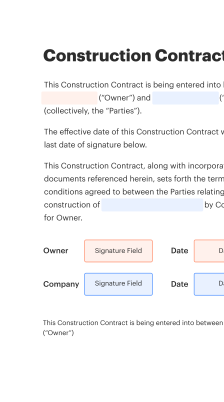
How VM-bound signing works in practice

A typical VM signature flow combines environmental attestation with traditional eSignature steps to produce a verifiable signature package.

  • Request: Application requests signature from agent.
  • Attest: Agent gathers VM identity assertions.
  • Sign: Private key signs document and metadata.
  • Record: System stores signed file with audit trail.
Collect signatures
24x
faster
Reduce costs by
$30
per document
Save up to
40h
per employee / month

Quick setup: signing from a virtual machine

Follow these four high-level steps to enable virtual machine signature capabilities in a controlled environment.

  • 01
    Install agent: Deploy the signing agent into the VM.
  • 02
    Provision keys: Register keys in HSM or KMS.
  • 03
    Attach metadata: Configure VM attestation attributes.
  • 04
    Execute signing: Trigger signing with audit record creation.

Managing audit trails for virtual machine signatures

Audit trail management ensures each VM-based signature is traceable from request to storage; follow these practical steps.

01

Capture event:

Record signing request metadata.
02

Log VM data:

Store attestation tokens and image hash.
03

Sign document:

Apply cryptographic signature with metadata.
04

Timestamp:

Apply RFC 3161 timestamping service.
05

Store artifacts:

Save signed file and logs in immutable storage.
06

Verify periodically:

Run verification checks on samples.
be ready to get more

Why choose airSlate SignNow

  • Free 7-day trial. Choose the plan you need and try it risk-free.
  • Honest pricing for full-featured plans. airSlate SignNow offers subscription plans with no overages or hidden fees at renewal.
  • Enterprise-grade security. airSlate SignNow helps you comply with global security standards.
illustrations signature

Recommended workflow settings for automated VM signing

These configuration entries illustrate practical defaults for integrating VM-based signatures into automated document workflows.

Setting Name Configuration
Reminder Frequency 48 hours
Signature Format PAdES or CAdES
Timestamp Authority External RFC3161
Key Storage Method HSM / KMS
Audit Retention Period 7 years

Supported platforms and device considerations

Virtual machine signatures are typically supported on cloud VMs, on-prem virtualized hosts, and containerized environments with a signing agent or API integration.

  • Cloud VMs: AWS, Azure, GCP supported
  • On-prem virtualization: VMware and Hyper-V compatible
  • Containers: Container signing via sidecar

Plan for secure key access patterns, ensure agent compatibility with the chosen hypervisor or container runtime, and validate integration testing across target platforms before production rollout.

Security controls and data points to capture

Encryption at rest: AES-256 key storage
Transport encryption: TLS 1.2+ connections
Key management: HSM-backed keys
Instance identity: VM attestation token
Timestamping: RFC 3161 timestamps
Access logs: Immutable audit records

Industry examples of virtual machine signature use

Case examples illustrate how virtual machine signatures support regulated operations and automated systems.

Healthcare

A hospital uses VM-based signing for automated release-of-information processes to ensure a documented runtime produced the signature

  • Attested VM metadata is embedded into the signature
  • This reduces manual steps and provides a machine-origin chain-of-custody

Resulting in clearer audit evidence for HIPAA compliance and internal review.

Financial Services

A mortgage servicer signs batch documents from cloud-based processing systems with VM attestation included in the signature

  • Short automated checks confirm instance identity before signing
  • That reduces reconciliation time and supports auditability

Leading to faster, reproducible workflows and improved regulatory documentation.

Practical best practices for accurate VM-based signatures

Adopt operational controls and policies that ensure signatures created in virtual environments are consistent, auditable, and legally defensible.

Maintain centralized key control and rotation
Keep private keys in a central HSM or managed KMS with strict access controls, automated rotation, and auditable key usage logs to reduce risk of compromise.
Record immutable VM metadata at signing
Capture VM identifiers, image hashes, and runtime attestations at the moment of signing and embed those details in the signature package for traceability.
Align signing processes with legal requirements
Work with legal and compliance teams to ensure that signature evidence satisfies ESIGN and UETA standards for intent, consent, and record retention in the US.
Test end-to-end verification regularly
Periodically validate signature verification using preserved keys and attestation data to confirm signatures remain verifiable and audit logs are complete.

FAQs About virtual machine signature

Answers to common questions about legal status, security, setup, and troubleshooting for virtual machine signature deployments.

Quick feature comparison for VM-capable eSignature platforms

Compare essential VM-signing capabilities across platforms to identify fit for cloud-native and automated environments.

Criteria signNow (Recommended) DocuSign
VM attestation support Limited
HSM integration
API-first workflow
Bulk VM signing
be ready to get more

Get legally-binding signatures now!

Operational timelines and retention points

Document and system timelines help ensure signatures remain verifiable and meet retention obligations under relevant regulations.

Retention policy review:

Annual review recommended

Key rotation schedule:

Rotate keys every 12 months

Audit log archiving:

Archive logs quarterly

Timestamp validation window:

Verify within 10 years

Compliance audit readiness:

Prepare evidence on demand

Risks and potential compliance penalties

Invalid execution: Contract unenforceable
Data breach: Regulatory fines
Audit failure: Remediation costs
Key compromise: Legal exposure
Retention lapses: Compliance citations
Misattribution: Dispute risk

Pricing and plan highlights for VM signature use

High-level plan differences and enterprise features that affect virtual machine signature deployments and costs.

Plan signNow (Recommended) DocuSign Adobe Acrobat Sign HelloSign (Dropbox Sign) PandaDoc
Free tier availability Limited free plan available No free plan for business use Trial only Limited free tier Free trial available
Entry price estimate Starting around $8 per user/month Starting around $10 per user/month Starting around $14 per user/month Starting around $15 per user/month Starting around $19 per user/month
API access included Yes, with select plans Paid API plans Paid API plans Paid API plans Paid API plans
Bulk Send support Included on team plans Available on business plans Available on enterprise Available on business plans Available on higher tiers
Enterprise features SSO, HSM/KMS options, compliance add-ons SSO, advanced compliance SSO, Adobe Enterprise SSO, enterprise controls SSO, workflows and templates

Simplify complex workflows

Create, execute, and manage workflows of any complexity, electronically from virtually anywhere. Scalable eSignature capabilities allow you to share documents with the right people in the correct order and define roles for each recipient. Execute document workflows faster and easier than ever before.

Automate document management

Optimize complex signing processes with airSlate SignNow’s powerful features to enhance your business. Control your automated eSignature workflows to ensure they're running at peak performance with instant notifications and reminders.

Optimize in team collaboration

Bring teams together in a secure, shared environment. Manage documents, use form templates and notifications to create more efficient cross-organization collaboration. Free your employees from having to spend time on repetitive activities so that they can focus on valuable, business-critical tasks.

Integrate into your existing systems

Run your projects with industry-leading integration. Collect Salesforce, Microsoft Teams, and SharePoint all in one business flow. Connect your software to a single system for endless possibilities and more performance.

Stay compliant with best-in-class data safety

Feel safe understanding that your data is protected by the most recent in encryption security. airSlate SignNow is GDPR and eIDAS certified and provides you visibility into your signing experience with court-admissible audit trails. Set up user access permissions and roles to manage who has access to what.


walmart logo
exonMobil logo
apple logo
comcast logo
facebook logo
FedEx logo
be ready to get more

Get legally-binding signatures now!