Witness Autograph for Secure eSignatures

Get rid of paper and improve digital document managing for more efficiency and countless possibilities. Enjoy a greater manner of doing business with airSlate SignNow.

Award-winning eSignature solution

What witness autograph means and how it works

A witness autograph is a designated signature or signature field placed by a witness to attest to the authenticity of a signer’s execution of a document. In digital workflows, witness autograph captures the witness’s name, signature image or drawn signature, timestamp, and context metadata. Proper implementation links the witness action to the signer’s electronic signature through role assignment, required fields, and an audit record. This approach supports chain-of-custody, improves traceability, and fits into broader eSignature processes while preserving evidentiary details important for legal and administrative use.

Why include a witness autograph in electronic signing

Adding a witness autograph strengthens document integrity by providing an independent attestation of identity and signature observance, which can help meet procedural or statutory witness requirements in many U.S. contexts.

Why include a witness autograph in electronic signing

Common challenges when implementing witness autograph

  • Ensuring the witness identity meets statutory or organizational standards without overstepping privacy or authentication needs.
  • Coordinating witness presence for in-person or remote signing when multiple parties must sign at different times or locations.
  • Capturing sufficient metadata for evidentiary value while avoiding unnecessary personal data collection that could raise compliance issues.
  • Configuring signer and witness roles in templates so that execution order and required fields are enforced consistently.

Representative users and their responsibilities

Legal Counsel

Legal counsel configures witness autograph requirements in templates, reviews the wording that requires witness attestation, and ensures that recorded metadata will support admissibility in dispute situations. They also coordinate retention policies and verify compliance with state and federal rules.

Notary Clerk

A notary clerk or signing agent oversees the physical or remote signing session, confirms identity documents, records the witness autograph event details in the log, and ensures that the witness signs in the correct order with all required fields completed.

Who typically uses witness autograph and where it fits

Legal teams, HR departments, and notary or closing agents often use witness autograph to validate execution and support recordkeeping.

  • Real estate closings and escrow teams for attesting to borrower or seller signatures.
  • Corporate governance and board secretaries for minutes, resolutions, and attestations requiring witness presence.
  • Healthcare intake or authorization forms when witness verification is part of clinical or consent processes.

Organizations that require reliable provenance for signatures integrate witness autograph into templates, role permissions, and audit trails to reduce post-execution disputes.

Core features to support reliable witness autograph

Effective witness autograph depends on a set of features that ensure correct role handling, secure capture, and verifiable records within the signing lifecycle.

Role enforcement

Ability to create distinct signer and witness roles, enforce execution order, and require specific fields to be completed before the document is considered executed.


Template management

Reusable templates that include predefined witness autograph fields, execution sequence, and embedded instructions to reduce setup errors and ensure consistent application of witness requirements.

Authentication options

Configurable identity verification methods for witnesses, including email verification, SMS one-time passcodes, and higher-assurance authentication where policy requires stronger identity proof.

Tamper evidence

Document sealing and checksum features that render any post-execution modification evident, preserving the integrity of the witness autograph and associated metadata.

Audit reporting

Comprehensive logs capturing timestamp, actor identity, IP address, and sequence of actions, packaged for export to support legal review or regulatory audits.

Access controls

Role-based permissions to restrict who can create templates, assign witness roles, or view sensitive document details, aligning operations with organizational governance.
be ready to get more

Choose a better solution

How witness autograph works in electronic flows

The process links role assignment, identity checks, signature capture, and audit logging to create a cohesive witness autograph record.

  • Role assignment: Define witness and signer roles in the document.
  • Identity check: Authenticate witness according to policy.
  • Signature capture: Collect witness autograph with timestamp and IP.
  • Audit trail: Store an immutable log of the witness action.
Collect signatures
24x
faster
Reduce costs by
$30
per document
Save up to
40h
per employee / month

Step-by-step: adding a witness autograph to a document

A typical setup involves assigning roles, placing the witness field, and enforcing execution order to capture a valid witness autograph.

  • 01
    Assign roles: Define signer and witness roles in the template.
  • 02
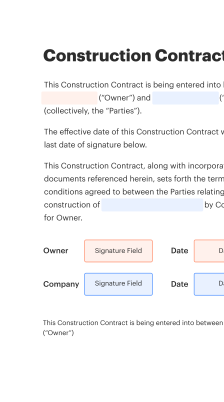
    Place witness field: Insert witness signature and name fields on the document.
  • 03
    Set signing order: Require signer to complete first, then witness signs.
  • 04
    Verify and save: Confirm required fields and save the template.
be ready to get more

Why choose airSlate SignNow

  • Free 7-day trial. Choose the plan you need and try it risk-free.
  • Honest pricing for full-featured plans. airSlate SignNow offers subscription plans with no overages or hidden fees at renewal.
  • Enterprise-grade security. airSlate SignNow helps you comply with global security standards.
illustrations signature

Recommended workflow settings for witness autograph

Use consistent workflow defaults to reduce execution errors and ensure witness autograph data is captured reliably across documents.

Workflow Automation Setting Identifier Label Default configuration values used in witness autograph flows
Reminder Frequency for Witness Signing 48 hours
Signing Order Enforcement Setting Sequential only
Identity Verification Requirement Email or SMS OTP
Audit Trail Retention Period 7 years
Document Access Expiration 90 days

Platform and device considerations for witness autograph

Confirm device capabilities and browser compatibility before enabling witness autograph in production workflows.

  • Supported browsers: Chrome, Edge, Safari
  • Mobile platforms: iOS and Android support
  • Minimum bandwidth: Stable 3G/4G connection

Ensure witness participants have access to a supported browser or native mobile app, stable connectivity, and any required authentication methods to complete the autograph without interruption.

Security controls relevant to witness autograph

Encryption: Encryption at rest and transit
Access controls: Role-based permissions
Authentication: Multi-factor options available
Audit logging: Immutable execution records
Data residency: U.S.-based storage options
Document integrity: Tamper-evident sealing

Industry examples of witness autograph use

Below are two concise case narratives showing how witness autograph fits real workflows in different sectors.

Real Estate Closing

A closing agent requires a witness autograph to confirm a seller’s signature on transfer documents.

  • Witness signs after identity verification at closing.
  • Provides independent attestation for lender and title company.

Resulting in a clearer chain of custody and reduced post-closing disputes.

Healthcare Consent

A clinic adds a witness autograph field to consent forms when a patient lacks capacity or when state rules require an attesting witness.

  • Witness observes patient signing and records their own signature.
  • Adds extra verification to support clinical governance and auditing.

Ensures consent records are defensible and meet internal compliance checks.

Best practices for accurate and secure witness autograph

Adopt consistent procedures and platform settings to maintain legal defensibility and operational efficiency when using witness autograph.

Standardize witness role and template usage
Create and enforce standardized templates that include explicit witness fields, clear instructions, and mandatory execution order so every document requiring a witness autograph is processed identically and reduces configuration errors.
Use appropriate identity verification methods
Select an identity verification level for witnesses that aligns with legal or policy requirements; document the method used and retain verification logs to support later review or disputes.
Limit collected witness data to essentials
Collect only necessary witness information to fulfill legal and administrative needs, minimizing exposure of personal data and reducing compliance burdens under privacy regulations or organizational policies.
Maintain clear retention and export policies
Define retention times for completed, witnessed documents and associated audit trails; ensure secure backups and an export process to produce evidentiary packages when required for legal or regulatory requests.

FAQs and troubleshooting for witness autograph

Common user questions and operational issues related to witness autograph are addressed below with practical explanations and remedies.

Quick comparison: witness autograph capabilities across vendors

A concise feature availability comparison shows common capabilities for witness autograph across leading eSignature providers, with signNow listed first as Featured.

Feature Comparison Across eSignature Vendors signNow Recommended DocuSign Adobe Sign
Support for witness autograph signatures
API access for witness autograph automation
HIPAA compliance available
Native mobile signing apps
be ready to get more

Get legally-binding signatures now!

Risks and consequences of improper witness autograph use

Invalid execution: Legal challenges
Data exposure: Privacy breach
Noncompliance fines: Regulatory penalties
Disputed documents: Enforceability issues
Operational delays: Signing backlogs
Reputational harm: Client trust loss

Streamline challenging workflows

Prepare, perform, and manage workflows of any complexness, electronically from almost anywhere. Scalable electronic signature capabilities let you exchange papers with the right users the right sequence and set up roles for every signee. Execute document workflows faster and easier than ever before.

Automate document management

Enhance sophisticated signing processes with airSlate SignNow�s highly effective features to boost your operation. Take control of your automated eSignature workflows to make sure they're operating at maximum performance with quick notifications and reminders.

Enhance in team collaboration

Bring teammates together in a protected, shared workplace. Handle documents, use form templates and notifications to deliver more effective cross-company communication. Relieve your workers from having to hang out on repeating routines so that they can give attention to beneficial, business-vital duties.

Integrate into your current network

Work your jobs with market-leading integration. Assemble Salesforce, Microsoft Teams, and SharePoint all in one business flow. Link your software to a single environment for countless possibilities and higher productivity.

Stay compliant with market-leading data safety

Feel confident with the knowledge that your information is protected by the latest in encryption security. airSlate SignNow is GDPR and eIDAS compliant and gives you transparence into your signing process with court-admissible audit trails. Configure user authorization and rights to control who has access to what.


walmart logo
exonMobil logo
apple logo
comcast logo
facebook logo
FedEx logo
be ready to get more

Get legally-binding signatures now!