Write Teller Countersignature with SignNow

Get rid of paper and automate digital document management for more productivity and unlimited opportunities. eSign any papers from your home, quick and feature-rich. Explore the perfect strategy for doing business with airSlate SignNow.

Award-winning eSignature solution

What write teller countersignature means in digital workflows

Write teller countersignature refers to a workflow where a teller or front-line staff member captures a primary signature and a second authorized party provides a countersignature to validate the transaction. In digital systems this is implemented as a sequential signing flow with identity checks, field-level controls, and an immutable audit trail. For banks and financial services it replaces paper handoffs, preserves time-stamped evidence of each action, and supports legal admissibility when the underlying eSignature provider meets ESIGN and UETA requirements while maintaining secure storage and logging.

Why implement write teller countersignature

A digital write teller countersignature reduces manual handoffs, enforces signing order, and creates a verifiable audit trail that supports compliance reviews and dispute resolution.

Why implement write teller countersignature

Common operational challenges with countersignatures

  • Coordinating simultaneous signer availability across branches increases turnaround time and customer wait.
  • Verifying teller identity without interrupting service can complicate branch workflows and slow processing.
  • Paper-based countersignatures create filing, scanning, and retrieval overhead that increases errors and cost.
  • Maintaining consistent retention policies and audit trails across channels is difficult without automation.

Representative user profiles

Branch Teller

A teller handles customer transactions and initiates documents requiring countersignature. Typical duties include capturing customer identity details, completing required fields, and forwarding the document for supervisor countersignature, often within a regulated branch environment that requires quick resolution and clear audit logs.

Compliance Manager

A compliance manager defines countersignature policies, reviews audit trails, and enforces retention schedules. They use countersignature metadata to verify adherence to ESIGN, UETA, and internal controls, and review exceptions or disputes arising from teller transactions.

Primary users and stakeholders for teller countersignatures

  • Branch tellers and customer-facing staff who initiate signature steps during transactions.
  • Branch managers or authorized signatories who provide required countersignatures and approvals.
  • Compliance and records teams who audit, retain, and review signed records for regulatory purposes.

Defining responsibilities and access controls for each role reduces processing delays and helps maintain a reliable record of who signed and when.

Essential features and configuration options

A robust countersignature solution combines signing controls, automation, and developer tools to meet branch, regional, and enterprise needs.

Countersignature Workflow

Sequential signing ensures the teller signs first and a designated approver countersigns, locking fields after each step to prevent alterations and preserving approval order.


Conditional Fields

Fields appear or become required based on prior entries, reducing errors and ensuring approvers only see relevant data during countersignature.

Bulk Send

Send identical teller-authorized documents to multiple recipients or branches for countersignature in a single operation to streamline repetitive processes.

API and Webhooks

Developer APIs allow embedding countersignature flows into branch systems while webhooks notify internal systems when signer events occur for downstream automation.

Role-Based Permissions

Control who can initiate, approve, or view countersigned documents by assigning granular permissions to teller, manager, and compliance roles.

Retention Controls

Apply document retention rules and automated archival to maintain compliance with internal policies and regulatory requirements.

be ready to get more

Choose a better solution

Integrations and tools that support countersignatures

Effective countersignature workflows use integrations and document controls to streamline processing while preserving security and compliance.

Identity Verification

Integration with ID verification services and SSO providers enables stronger signer authentication, reducing fraud risk while meeting regulatory identity requirements for sensitive teller transactions.

Template Library

Reusable templates for teller interactions standardize fields and signing order, speeding document preparation and ensuring consistent countersignature placement across branches.

Audit Trail

Comprehensive, tamper-evident logs capture timestamps, user agents, and IP addresses for each signer action, providing the evidence needed for compliance and dispute resolution.

CRM and Storage

Pre-built connectors to CRM systems and cloud storage keep signed records linked to customer files and enforce retention policies without manual transfers.
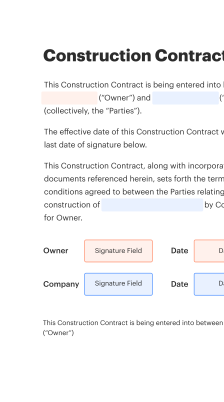
How the online countersignature flow operates

A digital countersignature flow routes documents in sequence, verifies signer identity, and finalizes the document once all parties complete their actions.

  • Initiation: Teller starts the document and fills fields.
  • Identity Check: System verifies teller via credentials.
  • Countersign: Approver receives and signs in order.
  • Completion: System finalizes document and logs events.
Collect signatures
24x
faster
Reduce costs by
$30
per document
Save up to
40h
per employee / month

Quick setup: enabling a countersignature workflow

Follow these concise steps to configure a teller countersignature flow that enforces signing order and captures signer identity.

  • 01
    Create Template: Upload form and define fields.
  • 02
    Assign Roles: Set teller and approver roles.
  • 03
    Set Order: Enable sequential signing.
  • 04
    Activate Audit: Turn on detailed logging.

Operational steps to complete a countersignature transaction

Follow these operational steps each time a teller initiates a countersignature transaction to keep processing consistent and auditable.

01

Open Template:

Select the preconfigured countersign template.
02

Fill Required Fields:

Enter customer and transaction details.
03

Teller Signature:

Teller signs and submits the document.
04

Notify Approver:

System notifies assigned approver automatically.
05

Approver Countersign:

Approver reviews fields and signs.
06

Finalize Record:

System seals document and logs events.
be ready to get more

Why choose airSlate SignNow

  • Free 7-day trial. Choose the plan you need and try it risk-free.
  • Honest pricing for full-featured plans. airSlate SignNow offers subscription plans with no overages or hidden fees at renewal.
  • Enterprise-grade security. airSlate SignNow helps you comply with global security standards.
illustrations signature

Recommended workflow settings for teller countersignature

These configuration items reflect common defaults and controls for secure teller countersignature workflows; adjust values to match your compliance and operational policies.

Workflow Setting Name Header Row Configuration and default values for each setting
Default document signing order for countersignatures Sequential signing: teller then approver
Reminder frequency for pending signatures 48 hours between reminders
Primary authentication methods required for signers Email verification plus optional SMS OTP
Document retention and archival policy Apply 7-year retention by default
Audit trail and event logging settings Full event logging enabled

Supported devices and platform requirements

Write teller countersignature can be performed on common desktop browsers and up-to-date mobile devices; confirm minimum versions before deployment.

  • iOS support: iOS 13 or later
  • Android support: Android 8 or later
  • Browser compatibility: Chrome, Edge, Safari, Firefox

For in-branch deployments validate network firewall rules, enable secure TLS connections, and test mobile devices for camera and touch input behavior to ensure signatures and identity checks perform reliably.

Security controls and protections

Encryption at rest: AES-256 encryption
Transport security: TLS 1.2+ encryption
Access controls: Role-based permissions
Authentication options: Email, SMS, SSO
Audit logging: Immutable event records
Document integrity: Tamper-evident hashing

Real-world scenarios using write teller countersignature

Practical examples show how countersignature workflows reduce friction and provide verifiable records across retail and lending operations.

Retail Bank Branch

A teller completes a cash withdrawal authorization and routes the file to a branch manager for countersignature, using identity-verified signatures to confirm signer identities

  • Sequential signing enforces teller then manager approval
  • Immediate audit entries capture timestamps and IP metadata

Resulting in a complete, time-stamped record that simplifies audits and dispute resolution while keeping the branch transaction flow efficient.

Mortgage Closing

A loan officer uploads closing documents and requires a notary-equivalent countersignature from a certified closing agent via a secure signing flow

  • Templates pre-populate borrower and property fields to reduce errors
  • Document-level controls ensure required signatures are present before completion

Leading to auditable closings with consistent records and fewer post-closing amendments or compliance exceptions.

Best practices for secure and accurate countersignatures

Adopt standards and controls that minimize risk, reduce processing time, and produce clear audit evidence for every countersignature transaction.

Define clear role responsibilities and signing order
Document which roles may initiate versus countersign, and enforce a sequential signing order in templates so the teller’s signature always precedes the manager’s countersignature, preventing out-of-order completions and preserving process integrity.
Use templates to reduce manual entry errors
Create pre-approved templates with required fields, conditional logic, and standardized language to reduce variability across branches and lower the risk of missing signatures or inconsistent document content during countersignature flows.
Enable strong authentication for high-risk transactions
Require multi-factor authentication or identity verification for transactions above defined thresholds, and log authentication events to link signer identity with specific signature actions for compliance audits.
Regularly review audit logs and retention policies
Schedule periodic audits of signing logs and retention schedules to ensure records are complete, accessible for regulatory requests, and stored in accordance with legal and internal policy requirements.

FAQs and troubleshooting for write teller countersignature

Answers to common questions and steps to resolve frequent issues encountered during teller countersignature workflows.

How signNow compares for teller countersignature features

Feature availability across common eSignature providers for teller countersignature workflows; signNow is listed first as Recommended to reflect suitability for sequential signing and branch use cases.

Criteria signNow (Recommended) DocuSign Adobe Sign
Countersignature Support
Mobile App
Advanced Authentication
API Access
be ready to get more

Get legally-binding signatures now!

Retention and archival timeline recommendations

Establish retention deadlines that match regulatory obligations and operational needs; automate archival to avoid manual oversights.

Immediate archival after final signature:

Store finalized document within 24 hours

Short-term access window for branch teams:

90 days active access

Long-term retention for regulatory review:

7 years retention

Periodic audit schedule:

Annual audit review

Secure deletion procedures:

Purge after retention expiry

Operational and legal risks to consider

Non-compliance fines: Regulatory penalties
Fraud exposure: Unauthorized signatures
Data breaches: Confidential data loss
Retention failures: Evidence gaps
Process inconsistencies: Disputed transactions
Operational delays: Customer dissatisfaction

Simplify complex workflows

Create, execute, and manage workflows of any complexity, electronically from virtually anywhere. Scalable eSignature capabilities allow you to share documents with the right people in the correct order and define roles for each recipient. Execute document workflows faster and easier than ever before.

Automate document management

Optimize complex signing processes with airSlate SignNow’s powerful features to enhance your business. Control your automated eSignature workflows to ensure they're running at peak performance with instant notifications and reminders.

Optimize in team collaboration

Bring teams together in a secure, shared environment. Manage documents, use form templates and notifications to create more efficient cross-organization collaboration. Free your employees from having to spend time on repetitive activities so that they can focus on valuable, business-critical tasks.

Integrate into your existing systems

Run your projects with industry-leading integration. Collect Salesforce, Microsoft Teams, and SharePoint all in one business flow. Connect your software to a single system for endless possibilities and more productiveness.

Stay compliant with best-in-class data security

Feel safe knowing that your information is protected by the most recent in encryption security. airSlate SignNow is GDPR and eIDAS compliant and offers you awareness into your eSigning process with court-admissible audit trails. Set up user authorization and rights to manage who has access to what.


walmart logo
exonMobil logo
apple logo
comcast logo
facebook logo
FedEx logo
be ready to get more

Get legally-binding signatures now!