Write Viewer Conditional with SignNow

Get rid of paper and automate digital document processing for higher performance and countless opportunities. eSign anything from a comfort of your home, fast and professional. Experience the perfect strategy for running your business with airSlate SignNow.

Award-winning eSignature solution

What write viewer conditional means and why it matters

Write viewer conditional refers to a document configuration that shows or hides fields, text, or actions based on who is viewing the document or their attributes. In eSignature platforms this capability lets administrators present only relevant inputs to specific recipients, reduce clutter, and protect sensitive content. For compliance-sensitive workflows it ensures that reviewers, signers, and auditors see the correct fields without exposing unrelated data. Implemented correctly, viewer conditional logic improves accuracy, streamlines signing sequences, and reduces the need for multiple document versions across an organization.

Why use write viewer conditional in your workflows

Applying viewer conditional logic reduces errors by showing relevant fields to the right participants, simplifies complex forms, and limits exposure of sensitive content.

Why use write viewer conditional in your workflows

Common implementation challenges with conditional viewer rules

  • Overly complex conditions can make templates hard to maintain and increase configuration errors during updates.
  • Incorrect role or attribute mapping may hide required fields from signers, delaying approvals and requiring rework.
  • Testing gaps across device types can produce inconsistent visibility for mobile or tablet viewers.
  • Failure to document conditional rules risks compliance audits and makes troubleshooting time-consuming for admins.

Typical user profiles for write viewer conditional

HR Manager

An HR Manager configures conditional fields to hide salary and benefit details from candidates while showing them to internal approvers. They test rules across templates and coordinate with IT for role-based access.

Sales Director

A Sales Director sets viewer conditions to expose negotiated pricing or approval buttons only to authorized managers, reducing accidental disclosure to external customers while preserving streamlined signing.

Teams and roles that commonly rely on viewer-based conditional logic

Legal, HR, sales, and compliance teams frequently use viewer conditional rules to control what each recipient sees during signing.

  • HR teams restrict compensation fields to authorized reviewers only.
  • Sales teams present optional discount fields only to managers or approvers.
  • Compliance teams show audit-only sections to internal auditors and redact them for external signers.

Proper role mapping and documentation ensure these teams maintain consistent behavior and pass internal audits.

Additional tools that support effective viewer conditional setups

Beyond basic visibility, complementary features help manage lifecycle, notification, and integration needs for conditional documents.

Field locking

Lock fields after input to prevent edits

Conditional autofill

Populate fields based on previous inputs or attributes

Role mapping

Map signers to organizational roles automatically

Bulk Send

Apply viewer conditions at scale for mass distribution

API hooks

Trigger condition changes programmatically from other systems

Audit trail

Record visibility, render, and access events

be ready to get more

Choose a better solution

Core write viewer conditional tools to configure

Key tools let admins define conditions, reuse rules across templates, and test visibility without changing the base document layout.

Conditional Logic

Create boolean or attribute-based expressions to control visibility, using recipient role, email domain, or custom metadata for precise targeting and automated branching.

Viewer Roles

Define role groups and map recipient addresses to roles; apply rules to roles to avoid per-user rule creation and simplify large workflows.

Template Library

Save templates with embedded viewer conditional configurations so teams reuse consistent rules and reduce manual setup for recurring document types.

Preview & Test

Simulate different viewer contexts to verify which fields render for each role and capture screenshots or logs during testing for approval documentation.
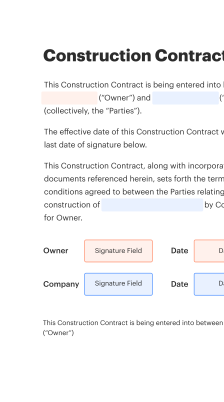
How viewer conditional logic operates in a signing session

Conditional rules evaluate recipient attributes at render time and adjust the document UI accordingly, ensuring each viewer sees the appropriate content.

  • Identify viewer: Platform maps the current user's role or attribute
  • Evaluate rules: System checks conditions tied to fields
  • Render fields: Fields are shown, hidden, or locked accordingly
  • Log result: Visibility decisions are recorded in the audit trail
Collect signatures
24x
faster
Reduce costs by
$30
per document
Save up to
40h
per employee / month

Quick setup: create a write viewer conditional rule

Follow these core steps to add a viewer conditional rule to a template and test visibility before deployment.

  • 01
    Open template: Select the document template to edit
  • 02
    Add condition: Attach a visibility rule to a field
  • 03
    Define audience: Choose roles or attributes for the rule
  • 04
    Test behavior: Preview as different viewers to validate

Audit trail steps when using write viewer conditional

Maintaining a clear audit trail ensures visibility decisions and access events are traceable for compliance and dispute resolution.

01

Record render:

Log which fields rendered for each viewer
02

Record decisions:

Save rule evaluation outcomes
03

User actions:

Log field edits and submissions
04

Timestamping:

Apply accurate time and timezone stamps
05

Export logs:

Provide downloadable audit reports
06

Secure storage:

Retention with access controls
be ready to get more

Why choose airSlate SignNow

  • Free 7-day trial. Choose the plan you need and try it risk-free.
  • Honest pricing for full-featured plans. airSlate SignNow offers subscription plans with no overages or hidden fees at renewal.
  • Enterprise-grade security. airSlate SignNow helps you comply with global security standards.
illustrations signature

Configuring write viewer conditional in your workflow settings

Recommended workflow settings clarify when conditions apply, how reminders behave, and how visibility actions are logged for audit purposes.

Feature Configuration
Reminder Frequency 48 hours
Role Mapping Source Directory attribute
Condition Evaluation On render
Audit Logging Level Full events
API Notification Webhook enabled

Supported platforms and device considerations for write viewer conditional

Viewer conditional rules typically execute at render time and are supported across modern desktop and mobile web environments, and on native apps where available.

  • Windows/macOS: Modern browsers supported
  • iOS/Android apps: Native app support varies by vendor
  • APIs and webhooks: Server-side control available

When implementing, verify the target signNow or partner app version supports the required conditional features and test real-world recipient scenarios to ensure consistent behavior across devices.

Security controls relevant to write viewer conditional

Role-based access: Limits field visibility by user role
Encryption: Protects document data at rest
TLS transport: Secures data in transit
Audit logging: Records visibility changes and events
Access tokens: Controls API-based visibility changes
Session timeouts: Reduces unauthorized access risk

Industry scenarios using write viewer conditional

Representative examples show how conditional viewer rules reduce document complexity while protecting sensitive fields in regulated environments.

Healthcare release forms

A hospital configures viewer conditional fields to show insurance details only to billing staff

  • field-level masking for clinical data
  • reduces inadvertent PHI exposure and simplifies patient views

Resulting in better privacy controls and clearer signing experiences.

Sales contract approvals

A technology reseller uses viewer conditional rules to display discount fields only for internal approvers

  • enforce manager approval before discounts apply
  • keeps customer-facing copies focused on agreed terms

Leading to fewer pricing errors and faster order processing.

Best practices for reliable write viewer conditional rules

Follow these operational and configuration practices to keep conditional rules maintainable, auditable, and aligned with compliance requirements.

Use role-based conditions rather than per-user rules
Prefer role or attribute-based conditions to simplify testing, reduce duplicate rules, and make templates easier to update when staff change.
Document and version conditional logic
Maintain clear documentation and version history for conditional rules so auditors and administrators can trace why visibility decisions were implemented.
Test across device types and locales
Validate conditional behavior on mobile, tablet, and desktop, and verify localization or format differences do not affect required inputs.
Limit complexity and reuse rules
Break complex conditions into named reusable rules where supported to improve clarity and reduce error surface during edits.

FAQs about write viewer conditional

Answers to common questions about implementing, testing, and auditing viewer conditional logic in eSignature workflows.

Availability of viewer conditional features across eSignature vendors

A concise feature availability comparison shows which vendors support viewer-based conditions and where capabilities differ in scope or limit.

Criteria signNow (Recommended) DocuSign Adobe Sign
Viewer conditional rules
Role-based mapping
Conditional templates
API rule control
be ready to get more

Get legally-binding signatures now!

Document retention and conditional visibility timelines

Retention policies should align with legal and organizational requirements while accounting for conditional content visibility during the document lifecycle.

Standard retention period:

7 years for most transactional records

HIPAA-related retention:

Follow healthcare-specific retention schedules

Audit log retention:

Minimum 3 years for compliance reviews

Template change history:

Retain versions for 2 years

Legacy document policy:

Migrate or archive after retention period

Regulatory risks if conditional visibility is misconfigured

Data exposure: Unauthorized disclosure
Noncompliance: Breach of legal rules
Invalid consent: Missing signer inputs
Audit failures: Incomplete logs
Contract disputes: Ambiguous records
Operational delays: Approval bottlenecks

High-level vendor comparison for conditional visibility capabilities

This table highlights which mainstream eSignature vendors include conditional visibility features in common plans and where advanced capabilities are reserved for higher tiers.

Capability signNow (Recommended) DocuSign Adobe Sign PandaDoc HelloSign
Entry-level plan Business Personal Individual Free eSign Essentials
API access availability Business Premium and up Developer plan Business/Enterprise Business plan Business plan
Bulk Send support Available Available Available Available Available
SSO options Enterprise-level Business Pro and up Enterprise Enterprise Enterprise
Advanced conditional rules Business Premium/Enterprise Advanced solutions Enterprise Business Enterprise

Simplify complex workflows

Create, execute, and manage workflows of any complexity, electronically from virtually anywhere. Scalable eSignature capabilities allow you to share documents with the right people in the correct order and define roles for each recipient. Execute document workflows faster and easier than ever before.

Automate document management

Optimize complex signing processes with airSlate SignNow’s powerful features to enhance your business. Control your automated eSignature workflows to ensure they're running at peak performance with instant notifications and reminders.

Optimize in team collaboration

Bring teams together in a secure, shared environment. Manage documents, use form templates and notifications to create more efficient cross-organization collaboration. Free your employees from having to spend time on repetitive activities so that they can focus on valuable, business-critical tasks.

Integrate into your existing systems

Run your projects with industry-leading integration. Collect Salesforce, Microsoft Teams, and SharePoint all in one business flow. Connect your software to a single system for endless possibilities and more productiveness.

Stay compliant with best-in-class data protection

Feel confident knowing that your information remains secure by the latest in encryption security. airSlate SignNow is GDPR and eIDAS certified and offers you visibility into your signing process with court-admissible audit trails. Set up user authorization and rights to regulate who has access to what.


walmart logo
exonMobil logo
apple logo
comcast logo
facebook logo
FedEx logo
be ready to get more

Get legally-binding signatures now!