Ajouter Des étiquettes à Un PDF Pour Signer

Facilitez la tâche aux destinataires en leur fournissant des instructions. Ajoutez des étiquettes à un PDF pour des champs spécifiques, saisissez votre texte et c'est terminé.

Solution eSignature primée

What it means to add labels to a PDF

Adding labels to a PDF refers to applying visible or metadata tags to document elements so they can be located, filtered, and processed consistently. Labels may identify signature fields, form data, sections, or internal categorizations used in document workflows. In eSignature contexts, labels help place and lock signing fields, trigger routing logic, and support automation. Organizations use labeling to reduce manual errors, improve accessibility, and maintain clear records of where signature and data capture points exist within a PDF managed through an eSignature platform.

Benefits of labeling PDFs for accurate eSignature workflows

Consistent labels make document processing faster, reduce placement errors, and enable automation across signing steps, templates, and integrations.

Benefits of labeling PDFs for accurate eSignature workflows

Common challenges when adding labels to PDFs

  • Manual labeling is time-consuming and prone to inconsistent naming and placement across similar documents.
  • Poorly formatted labels can break integration mappings with CRMs, storage systems, or automation rules.
  • Labels placed on flattened or image-based PDFs may not align with underlying fields or allow data extraction.
  • Insufficient auditing of label changes can create compliance gaps and make it hard to track edits.

Representative user roles and responsibilities

HR Manager

An HR Manager sets up labeled onboarding documents and templates used repeatedly for new hires. They ensure label consistency across job offers, tax forms, and benefit enrollments so automated routing and signature placement work reliably for each cohort.

Legal Counsel

Legal Counsel defines label naming, placement, and locking rules for contracts and NDAs. They document label policies to preserve evidentiary trails and to support audits, ensuring labeling aligns with regulatory and internal controls.

Who typically adds labels to PDFs

Teams across legal, HR, finance, and operations add labels to PDFs to standardize signing fields and data capture.

  • Legal and compliance teams that enforce clause-level labeling for auditability.
  • HR and recruiting teams labeling offer letters, onboarding forms, and consent fields.
  • Sales and account teams preparing contracts and signature-ready proposals for customers.

Labeling practices vary by role but share the objective of improving accuracy, enabling automation, and preserving an auditable record.

Advanced capabilities that support labeling at scale

Large teams benefit from automation, API access, and enterprise controls to manage labels across thousands of PDFs reliably.

Bulk Labeling

Apply a labeling template or batch process to multiple documents at once, reducing manual repetition when preparing many similar PDFs for signature.

API Access

Programmatic endpoints allow automated creation, placement, and retrieval of labeled fields during document generation and submission workflows.

Single Sign-On

SSO integration centralizes user authentication so label creation and template management follow enterprise access controls and audit policies.

Role Permissions

Granular user roles define who can create, edit, or lock labels, suited to governance requirements in regulated environments.

Audit Export

Exportable audit trails capture label placement, edits, and signer activity for compliance reporting and legal defensibility.

Integration Catalog

Pre-built connectors for common systems reduce mapping work when labeled fields must feed CRMs, storage, and HR systems.

soyez prêt à en obtenir plus

Choisissez une meilleure solution

Essential features for effective PDF labeling

Choose tools that offer field labeling, templates, and integration hooks so labels support automation, auditing, and integrations.

Field Labeling

Declarative field labels allow exact mapping of signature and data fields to variables used across templates and integrations, enabling consistent placement and automated data extraction during the signing process.

Templates

Reusable templates preserve label names and positions so organizations can apply the same labeled structure to multiple documents without re-labeling, reducing setup time and error rates.

Integration Hooks

Connectors and API endpoints map labeled fields to external systems such as CRMs, HRIS, or document stores so labeled data flows directly into business systems after signature.

Field Locking

Lock or restrict labeled fields to prevent accidental edits after placement, ensuring the integrity of signature locations and critical data fields during execution.

How online PDF labeling integrates into workflows

Labeling connects document preparation, automated routing, and data extraction so processes run without manual intervention.

  • Prepare: Upload document and enable labeling mode
  • Annotate: Place labels on form fields and signature blocks
  • Automate: Link labels to routing and data maps
  • Execute: Send for signatures with locked fields
Collecter les signatures
24x
plus rapide
Réduire les coûts de
$30
par document
Économisez jusqu'à
40h
par employé / mois

Step-by-step: add labels to a PDF

A straightforward sequence helps add reliable labels so PDFs are ready for signing and automation.

  • 01
    Upload: Open the PDF in the eSignature tool
  • 02
    Identify: Locate fields that need labels
  • 03
    Label: Assign consistent, descriptive label names
  • 04
    Save: Save template or apply to workflows

Managing audit trails for labeled PDF transactions

Maintain transparent records of label placement and signing events so each labeled PDF has a clear, defensible history.

01

Enable logging:

Turn on detailed event capture
02

Record label edits:

Track who changed labels and when
03

Preserve signed copies:

Store final signed PDFs immutably
04

Export audit reports:

Provide downloadable event histories
05

Retain metadata:

Keep label-to-field mapping records
06

Legal hold:

Suspend deletion for disputes
soyez prêt à en obtenir plus

Pourquoi choisir airSlate SignNow

  • Essai gratuit de 7 jours. Choisissez le forfait dont vous avez besoin et essayez-le sans risque.
  • Tarification honnête pour des forfaits complets. airSlate SignNow propose des abonnements sans frais supplémentaires ni frais cachés lors du renouvellement.
  • Sécurité de niveau entreprise. airSlate SignNow vous aide à respecter les normes de sécurité mondiales.
illustrations signature

Typical workflow settings when automating labeled PDFs

Configure a small set of workflow settings to ensure labels are applied, routed, and logged consistently across automated processes.

Setting Name Configuration
Labeling Template Default template
Reminder Frequency 48 hours
Signature Order Sequential
Audit Log Retention 7 years
Automatic Archival Enabled

Supported devices and platform requirements for labeling

Adding labels to PDFs is supported on modern desktop browsers and native mobile apps, with some feature differences between platforms.

  • Desktop browsers: Chrome, Edge, Safari
  • Mobile apps: iOS and Android native apps
  • Offline support: Limited in mobile apps

For consistent placement and template creation use a desktop browser, and use mobile apps for quick field checks, signing, and light edits when working remotely.

Security and compliance controls relevant to PDF labeling

Encryption at rest: AES-256 encryption for stored documents
Encryption in transit: TLS 1.2 or higher during transfer
Access controls: Role-based permissions and SSO
Audit logs: Immutable event trail for changes
Regulatory support: ESIGN and UETA compliance
Data residency options: US-based storage choices

Real-world ways teams use labeled PDFs

Labels support repeatable, auditable processes across departments, including contract execution, onboarding, and permit issuance.

Employee Onboarding

A company standardizes an offer letter template for hires with embedded labels for signature, date, and tax data capture

  • Labels identify fields for automatic population
  • This reduces manual entry and routing delays

Resulting in faster, auditable new-hire completion and accurate data transfer to HRIS systems.

Contract Execution

A sales operations team prepares contracts with labeled signature blocks and initial fields for countersignatures

  • Labels enforce placement and signer roles
  • That ensures extraction of key contract terms for CRM updates

Leading to consistent contract records and fewer post-signature disputes.

Best practices when you add labels to a PDF

Follow consistent naming, version control, and access rules to maintain clarity and defensible audit trails.

Use consistent label naming conventions
Adopt a standard prefix and descriptive names for labels that reflect form purpose, field role, and data type so templates remain clear across teams and integrations.
Version-control labeled templates
Record template changes and maintain a changelog whenever labels or placements change to ensure historical documents remain interpretable during audits.
Limit edit permissions on labeled fields
Assign role-based permissions to control who can create or change labels, reducing collision risks and preserving a reliable audit trail for signed PDFs.
Document label-to-data mappings
Maintain a central mapping document that links label names to CRM fields, API payload keys, or spreadsheet columns to prevent misrouting of captured data.

FAQs About add labels to a pdf

Answers to common questions about placing labels, fixing placement issues, and ensuring labeled PDFs remain compliant and usable.

Feature comparison: labeling and template capabilities

Quick comparison of core labeling capabilities and limits across popular eSignature services focused on PDF labeling and template automation.

Criteria signNow (Recommended) DocuSign Adobe Acrobat Sign
Bulk labeling support
API field mapping Full Full Full
Template versioning
HIPAA compliance option Available Available Available
soyez prêt à en obtenir plus

Obtenez des signatures juridiquement contraignantes dès maintenant !

Retention and recordkeeping for labeled PDFs

Define retention periods, archival methods, and deletion schedules that match legal and business requirements for labeled documents.

Employment records retention:

Retain signed onboarding for seven years

Contract archival schedule:

Archive executed contracts for minimum six years

HIPAA document retention:

Follow healthcare-specific retention rules

Student records rules:

Comply with FERPA timelines

Automated purge schedules:

Apply scheduled deletion after retention ends

Risks from improper labeling

Regulatory fines: Potential monetary penalties
Contract disputes: Signature placement ambiguity
Data breaches: Unauthorized access risk
Operational delays: Workflow exceptions increase
Document loss: Misfiled or unsearchable files
Noncompliance: Failed audit outcomes

Cost and plan feature comparison for labeled PDF workflows

Plan features vary; compare free options, entry-level plans, API access, enterprise support, and compliance options across vendors.

Pricing Feature signNow (Recommended) DocuSign Adobe Acrobat Sign Dropbox Sign PandaDoc
Free or trial options Trial available Free trial Free trial Free trial Free trial
Entry-level plan Per-user plan available Personal and Standard tiers Individual and Business tiers Individual plan Individual plan
API availability Available on paid tiers Available on paid tiers Available on paid tiers Available Available
Enterprise support Dedicated options Enterprise plans Enterprise plans Business plans Enterprise options
Compliance-ready offerings HIPAA, ESIGN, UETA options HIPAA available HIPAA available HIPAA via Dropbox HIPAA available

Comment ajouter des étiquettes de champ avec airSlate SignNow

Les étiquettes sont de courtes descriptions ou astuces pour remplir les champs. Elles aident les destinataires à comprendre quelles informations ils doivent fournir dans chaque champ. Les étiquettes permettent également aux signataires de remplir automatiquement les formulaires.

Commencez par ajouter des champs remplissables

Ouvrez votre document dans l'éditeur et insérez des champs remplissables. Choisissez parmi différents types de champs dans la barre d'outils à gauche. Veuillez noter que les étiquettes ne sont disponibles que pour les champs Texte, Date/Heure et Liste déroulante.
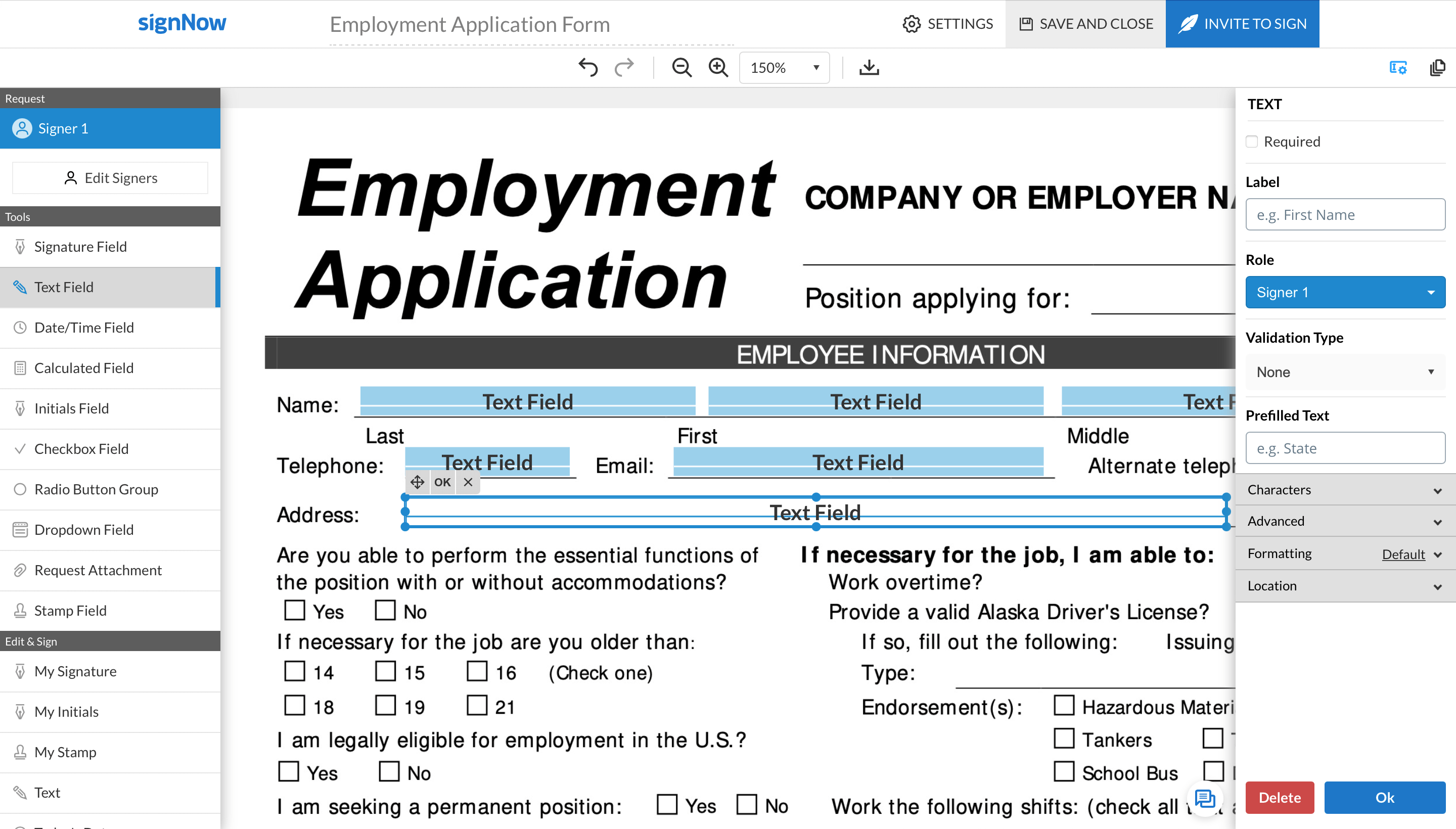
illustration-guide-remplissage

Définissez les étiquettes de champ

Sélectionnez un champ Texte, Date/Heure ou Liste déroulante dans votre document et saisissez une étiquette de texte dans le champ Étiquette, qui apparaît dans la barre latérale des paramètres à droite. Cliquez sur OK pour enregistrer votre étiquette.

Remarque : Pensez à l’étiquette la plus précise et concise possible (par exemple, Prénom/First, MI, Nom, Date d’aujourd’hui, Sélectionnez une réponse, etc.). Votre étiquette doit communiquer de manière univoque les données à fournir dans un champ et dans quel format.
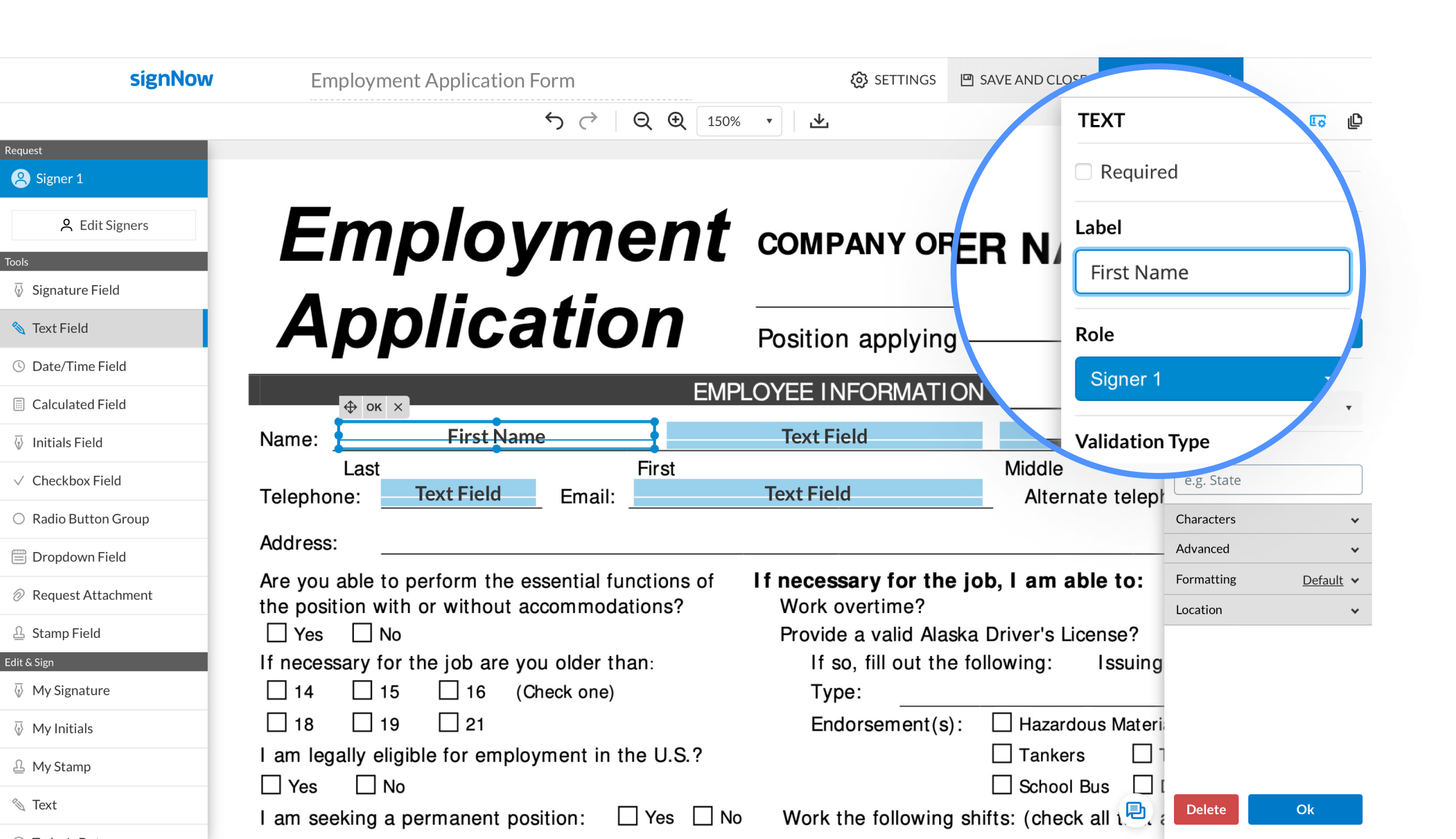
illustration-guide-remplissage

Définissez des étiquettes pour tous les champs remplissables de votre document.

Veuillez noter que les signataires pourront remplir automatiquement les champs identiquement étiquetés d’un seul clic dans tout le document.


walmart logo
exonMobil logo
apple logo
comcast logo
facebook logo
FedEx logo
être prêt à en obtenir plus

Obtenez dès maintenant des signatures juridiquement contraignantes !








