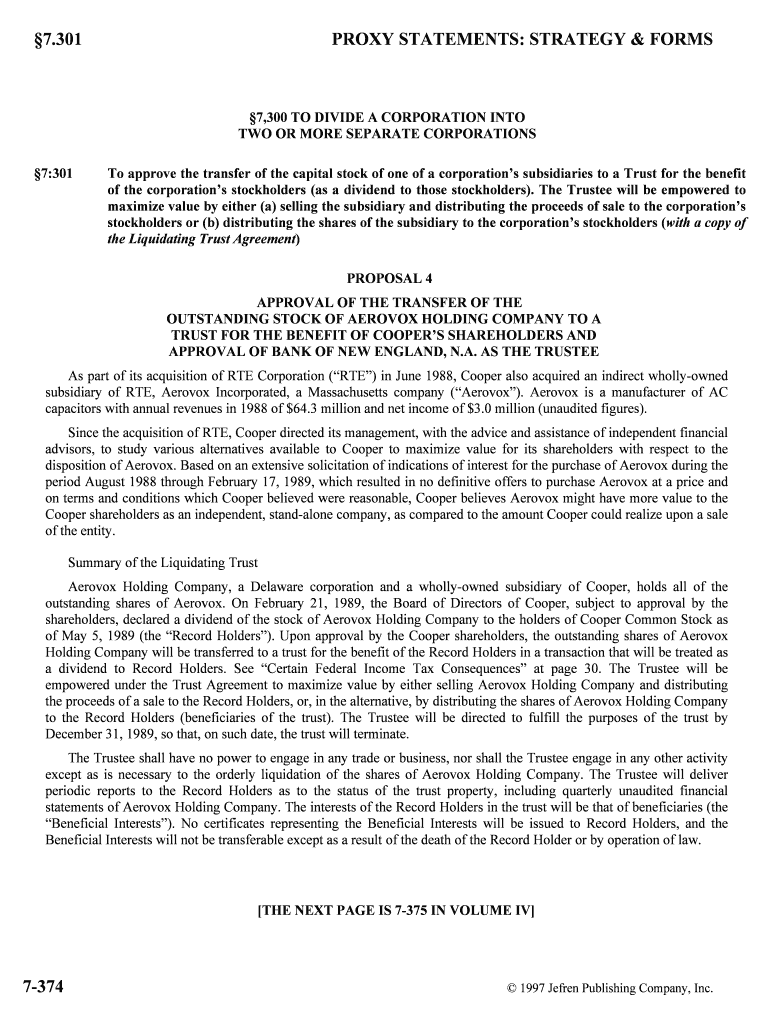
§7.301 PROXY STATEMENTS: STRATEGY & FORMS
7-374© 1997 Jefren Publishing Company, Inc.
§7,300 TO DIVIDE A CORPORATION INTO
TWO OR MORE SEPARATE CORPORATIONS
§7:301 To approve the transfer of the capital stock of one of a corporation’s subsidiaries to a Trust for the benefi t
of the corporation’s stockholders (as a dividend to those stockholders). The Trustee will be empowered to
maximize value by either (a) selling the subsidiary and distributing the proceeds of sale to the cor poration’s
stockholders or (b) distributing the shares of the subsidiary to the corporation’s stockholders ( with a copy of
the Liquidating Trust Agreement )
PROPOSAL 4
APPROVAL OF THE TRANSFER OF THE
OUTSTANDING STOCK OF AEROVOX HOLDING COMPANY TO A
TRUST FOR THE BENEFIT OF COOPER’S SHAREHOLDERS AND
APPROVAL OF BANK OF NEW ENGLAND, N.A. AS THE TRUSTEE
As part of its acquisition of RTE Corporation (“RTE”) in June 1988, Cooper also acquired an indirect wholly-owned
subsidiary of RTE, Aerovox Incorporated, a Massachusetts company (“Aerovox”). Aerovox is a manufacturer of AC
capacitors with annual revenues in 1988 of $64.3 million and net income of $3.0 million (unaudited figures).
Since the acquisition of RTE, Cooper directed its management, with the advice and assistance of independent financial
advisors, to study various alternatives available to Cooper to maximize value for its shareholders with respect to the
disposition of Aerovox. Based on an extensive solicitation of indications of interest for the purchase of Aerovox during the
period August 1988 through February 17, 1989, which resulted in no definitive offers to purchase Aerovox at a price a nd
on terms and conditions which Cooper believed were reasonable, Cooper believes Aerovox might have more value to the
Cooper shareholders as an independent, stand-alone company, as compared to the amount Cooper c ould realize upon a sale
of the entity.
Summary of the Liquidating Trust
Aerovox Holding Company, a Delaware corporation and a wholly-owned subsidiary of Cooper, holds all of the
outstanding shares of Aerovox. On February 21, 1989, the Board of Directors of Cooper, subject to approval by the
shareholders, declared a dividend of the stock of Aerovox Holding Company to the holders of Cooper Comm on Stock as
of May 5, 1989 (the “Record Holders”). Upon approval by the Cooper shareholders, the outstanding shares of Aerovox
Holding Company will be transferred to a trust for the benefit of the Record Holders in a transaction that will be treated as
a dividend to Record Holders. See “Certain Federal Income Tax Consequences” at page 30. The Trustee will be
empowered under the Trust Agreement to maximize value by either selling Aerovox Holding Com pany and distributing
the proceeds of a sale to the Record Holders, or, in the alternative, by distributing the shares of Aerovox Holding Company
to the Record Holders (beneficiaries of the trust). The Trustee will be directed t o fulfill the purposes of the trust by
December 31, 1989, so that, on such date, the trust will terminate.
The Trustee shall have no power to engage in any trade or business, nor shall the Trustee engage in any other activity
except as is necessary to the orderly liquidation of the shares of Aerovox Holding Company. T he Trustee will deliver
periodic reports to the Record Holders as to the status of the trust property, including quarte rly unaudited financial
statements of Aerovox Holding Company. The interests of the Record Holders in the trust will be that of beneficiaries (the
“Beneficial Interests”). No certificates representing the Beneficial Interests will be issued to Record Holders, and the
Beneficial Interests will not be transferable except as a result of the death of the Record Holder or by operation of la w.
[THE NEXT PAGE IS 7-375 IN VOLUME IV]
CORPORATE RESTRUCTURING§7.301
January 1992 7-375
Information about Aerovox
Aerovox Corporation began in 1922 with its operations in the New York City area. In 1938, the headquarters were
moved to New Bedford, Massachusetts shortly after acquiring a Canadian capacitor company. In 1973, a leveraged buy-
out headed by Clifford Tuttle, the current president, purchased the New Bedford plant, the Canadian operation, which had
been relocated to Amherst, Nova Scotia, and the Aerovox name from what is now AVX Corporation. The new company,
Aerovox Industries, Inc., grew rapidly in those first five years and sold its assets in 1978 to Aerovox Inc orporated. Today,
Aerovox has a strong position in its primary domestic markets. In addition, the Canadian compa ny holds the dominant
share of the AC capacitor market in that country and expects to continue its leadership position.
In addition to its capacitor line, five years ago, Aerovox developed and introduced a li ne of power line filters that are
sold to manufacturers of electronic equipment.
Over the last five years, Aerovox has invested $14 million in facilities and equipment to add capacity and reduce
costs, primarily through automation. Plans for the next five years call for additional invest ment of $14 million, similarly
for facilities and automation. A least-cost approach to production, new product development a nd fine tuning internal
controls will be management’s continued focus for future growth.
In recent years, Aerovox has introduced a stream of new products and product innovations. Most of the Com pany’s
1988 sales volume can be attributed to products introduced since the late 1970’s.
Approval of the Trustee
Subject to approval of the Cooper shareholders, Bank of New England, N.A. has agreed to act as Trust ee. A copy of
the trust agreement is attached hereto as Annex C.
Potential Environmental Liabilities
Aerovox is a defendant in litigation commenced on December 10, 1983, by the United State s and the Commonwealth
of Massachusetts under the Comprehensive Environmental Response, Compensation, and Liability Act of 1980,
commonly referred to as the “Superfund” legislation. The court action also named five other companies, including RTE,
as defendants, but RTE has been dismissed as a defendant for lack of jurisdiction. The governments seek a judgment
against all defendants for the costs of cleanup and for damages to natural resources allege dly resulting from the disposal
of polychlorinated biphenyls (“PCBs”) into the Acushnet River and New Bedford Harbor. They have i ndicated that they
seek approximately $70 million for damages to natural resources.
The governments’ estimates of the costs of remedial action, or cleanup costs, with respec t to the Acushnet River and
New Bedford Harbor, are very tentative and encompass a wide variety of potential cleanup alternatives. These range from
proposals that would cost approximately $10 million to suggestions of remedial activitie s costing as much as $800
million. Until the governments’ remedial investigation and feasibility study (including pi lot studies as to the feasibility of
certain dredging options) has been completed, and an actual remedy has been select ed, it is difficult to determine which
option is most likely to be selected. The governments also estimate that a dministrative expenses and costs incurred as a
result of studying the site to date total approximately $15 million.
The governments allege that Aerovox has liability in this matter based on it s own activity and that of its predecessor,
Aerovox Industries, Inc. In a preliminary ruling, the court has ruled that Aerovox is liable for any unsatisfied judgment
against Aerovox Industries, Inc. When Aerovox purchased the plant site from Aerovox Industries, the seller indemnified
Aerovox and RTE against any liability that may arise out of the use or disposal of PCB s by Aerovox Industries or its
predecessor. Ten percent of the purchase price was put into escrow to collateralize t his indemnification agreement. There
is an action which seeks a declaratory judgment that Aerovox Industries is liable to RTE and Aerovox for any action
against it because of Aerovox Industries’ disposal of PCBs. The court has held that Aerovox Industries and its former
stockholders are obliged to indemnify RTE and Aerovox, but since the escrow has expired, any such re covery will have to
come from Aerovox Industries’ insurers or its former stockholders.
§7.301 PROXY STATEMENTS: STRATEGY & FORMS
7-376© 1997 Jefren Publishing Company, Inc.
There has been extensive pre-trial discovery in the governments’ Superfund case and, as noted above , the defendants
are awaiting a trial date on the natural resource damages issue. Aerovox’s insurers are pa ying the cost of its defense
pursuant to a court order, but they have reserved their rights to contest payments of both costs of defense and any ultimate
judgment against Aerovox on the cleanup and natural resource damages claims.
In a separate proceeding, Aerovox’s insurance carriers have initiated a declaratory judgment against Aerovox for a
determination that the carriers are not responsible for any Superfund cleanup cost, natural resource damages or related
defense costs. This matter is also pending before the United States District Court for t he District of Massachusetts, and the
Court has expressed its intent to hear the issues arising in connection with this sui t as part of the trial of the underlying
Superfund litigation.
The Superfund Act is a new law, and there are few judicial decisions which can provide gui dance as to the likely
result of litigation of several issues, such as the factors that will be considered by a court in allocating liability among
responsible parties, and the extent to which the federal government must follow tradit ional rules of causation. However,
Aerovox has asserted a number of defenses, which it intends to assert in the litigation if necessary. These include the
following:
First, the discharge from the facility while owned by Aerovox Industries or Aerovox was small in c omparison to
discharges from the original owner of the plant, AVX. Second, government chemists have not atte mpted to distinguish
one form of PCB from another, and may well have difficulty proving that particular PCBs in the Harbor emanated from
Aerovox Industries or Aerovox and contributed to the contamination. Third, both Aerovox Industries and Aerovox hel d
permits under the federal Clean Water Act allowing the discharge of small am ounts of PCBs. Under the Superfund Act
“federally permitted releases” cannot provide the basis for recovery. Aerovox has asserted that the plaintiffs have the
responsibility to distinguish between permitted and unpermitted releases.
In addition to the foregoing, there must be proof that discharges of PCBs from the Aerovox facili ty caused injury,
destruction or loss of natural resources. There is considerable evidence to indicate tha t there has been no actual injury to
any natural resource; in addition, a 1987 Report of the Massachusetts Department of Public He alth found no perceptible
adverse health effects in residents of the New Bedford area resulting from the PCB contamination.
Aerovox contends that several of the possible alternative cleanup proposals do not meet the tests of cost effectiveness
set out in the National Contingency Plan established under the Superfund Act. Aerovox will, if necessary, assert that
position in any government cost recovery action if one of these disputed remedial alternatives is chosen.
Aerovox intends to pursue a negotiated settlement in this action. To date, Aerovox has bee n open and cooperative
with everyone including EPA; in addition it has good relationships with local government, st ate government, and the
Massachusetts representatives in Congress. It is hoped that the culmination of working wit h all of these people will result
in a negotiated settlement that is reasonable, and both politically and fiscally responsible.
In addition to the cost of cleanup in connection with the Acushnet River and New Bedford Ha rbor, there are also two
Superfund administrative proceedings in which Aerovox has been named a potentially responsible party. In a Superfund
proceeding to recover the cost of cleanup of the ReSolve site in Massachusetts, a sett lement in principle has been
negotiated with the Environmental Protection Agency. Under this proposed settlement, Aerovox will pay $954,000, with
$650,000 of that amount to be reimbursed to Aerovox by its insurers. In the other relating to Sullivan’s Ledge, Aerovox
Industries and Aerovox both deny liability on the ground that they never used the site for waste disposal. Although the
evidence indicates the site was closed in the late 1960’s, the EPA, which has sel ected a $10 million remedy, has persisted
in its claim against Aerovox along with some forty other entities.
Aerovox has executed administrative consent decrees with the EPA and the Department of Environmental Quality
Engineering of the Commonwealth of Massachusetts (“DEQE”) requiring certain testing and rem edial action at the
Aerovox plant. The remedial plan has been implemented except for ongoing monitoring require ments. Also, the EPA is
seeking to reduce the quantity of PCBs that may be discharged
CORPORATE RESTRUCTURING§7.301
January 1992 7-377
pursuant to a Water Act permit from 10 ppb to 1 ppb, including stormwater runoff. The City sewer system is alleged to be
contaminated with PCBs, and that may result in a claim against Aerovox.
In settlement of alleged Clean Air Act violations, Aerovox entered into a consent de cree in late 1987, committing to
compliance with the Act. It is not clear whether Aerovox will be able to com ply. Failure to do so may result in an
enforcement action by the EPA.
Also traces of fuel oil and PCBs have been discovered in soil in an area near t he boiler house where underground fuel
oil tanks were formerly located. The tanks and contaminated soil have been removed. The DEQE issued a Notice of
Responsibility requiring Aerovox to study the site for possible further remediation. Aerovox is awa iting a cleanup plan
from its consultants, and the plan will be submitted to the DEQE for approval.
Certain Federal Income Tax Consequences
The following is a general description of certain of the federal income tax conseque nces to Record Holders of the
transfer of Aerovox Holding Company shares to the trust. The discussion is addressed to United States persons within the
meaning of Section 7701(a)(30) of the Internal Revenue Code of 1986 (i.e., citizens and residents of the United States,
domestic corporations, and certain other entities) who hold their shares as capital a ssets. This description may not be
applicable to Record Holders who acquired their shares pursuant to the exercise of employee stock options or otherwise as
compensation, or to Record Holders which are tax-exempt organizations, financial institutions, broker-dealers, or to
Record Holders subject to the alternative minimum tax. All Record Holders are urged to consult their own tax advisors
with respect to the federal, state, local, foreign and other tax consequences to the m of the transfer of Aerovox Holding
Company shares to the trust.
The transfer by Cooper of the outstanding shares of Aerovox Holding Company to the trust will constit ute a
distribution to the Record Holders and will be taxable to Record Holders as a divide nd at ordinary income rates. With
respect to each Record Holder, the amount of the dividend will equal such Record Hol der’s pro rata share of the fair
market value of the shares of Aerovox Holding Company. Based on opinions of value from independent financi al
advisors, Cooper believes that the fair market value of Aerovox Holding Company is $15 milli on, or $.148*
per share of
Cooper held by a Record Holder on the record date. Because the determination of fair market value is a difficult factual
matter, however, it is possible that the Internal Revenue Service (the “Service”) might challenge Cooper’s determination
of fair market value. Cooper intends to provide Record Holders with information returns, copies of which will also be
filed with the Service, reporting the amount of the dividend as $.148* per share.
The amount of the distribution which is taxable as a dividend should be eligible for t he 70% dividends received
deduction generally available to corporate Record Holders. However, to the extent a corporat e Record Holder incurs
indebtedness which is considered directly attributable to an investment in shares of C ooper, the amount of the dividends
received deduction will be reduced by a percentage equal, in general, to the amount of such indebtedness divided by the
total adjusted tax basis in the investment. In addition, the dividends received deduct ion will not be available with respect
to dividends paid on stock which is treated as held for 45 days or less.
If a corporation receives an “extraordinary dividend” with respect to stock, the corporation’s ba sis in such stock must
be reduced by the 70% “nontaxed portion” of the extraordinary dividend unless such stock has been held by the
corporation for more than two years before the date the extraordinary dividend was announced or agre ed to. If such
nontaxed portion exceeds the corporation’s basis in its shares, then upon sale or disposition of the sha res the excess will
be treated as gain from the sale or exchange of the shares in addition to any othe r gain recognized. In general, an
“extraordinary dividend” means any dividend which equals or exceeds 10% of the corporate Record Holder’s adjusted
basis in the shares when the dividend is paid. Alternatively, the corporate Record Holde r may elect to use the fair market
value of the shares as of the day before the ex-dividend date, rather than its adjusted ba sis in the shares, to calculate the
threshold amount of an extraordinary dividend. In addition, the aggregation rules might require that other dividends
* Adjusted for two-for-one stock split effective March 20, 1989.
§7.301 PROXY STATEMENTS: STRATEGY & FORMS
7-378© 1997 Jefren Publishing Company, Inc.
received by Record Holders on Cooper shares be included in determining whether such Record Holders have received an
extraordinary dividend. The company believes that it is unlikely the distribution will constitute an extraordinary dividend
with respect to any corporate Record Holder who elects to use fair market value t o determine whether it has received an
extraordinary dividend. Given the complexity of the “extraordinary dividend” rules, taxpayers are urged to consult their
own tax advisors regarding the application of such rules to their own circumstances.
In Cooper’s opinion the trust should qualify as a grantor trust and not as an association taxa ble as a corporation. In
this event, the trust will be ignored for federal income tax purposes and each Record Hol der will be treated as owning a
proportionate share of the trust’s assets. Each Record Holder’s proportionate share of any items of income, deductions and
credits of the trust will be treated as income, deductions and credits of such Record Holder. Each Record Holder will have
a basis in his interest in the trust equal to the fair market value of the dist ribution to such Record Holder. If the trust sells
the Aerovox Holding Company stock prior to December 31, 1989, each Record Holder will be treated a s if he sold his
proportionate share of Aerovox Holding Company stock and depending upon the sales price of Aerovox Holding
Company will recognize a short-term capital gain or loss measured by the difference bet ween the Record Holder’s
proportionate share of the sales price and his basis in his interest in the trust. If the trust liquidates and distributes all the
Aerovox Holding Company stock to the Record Holders, no gain or loss will be recognized and each Record Holder will
have a basis in his Aerovox Holding Company stock received equal to the basis in his inte rest in the trust. A proportionate
share of any fees paid to the Trustee by Cooper or Aerovox Holding Company will likely consti tute a dividend to Record
Holders who hold interests in the trust at the time the fees are paid. Such Record Holders should, however, be entitled to a
deduction for the amount of any such dividend. In the case of Record Holders who are individuals, howeve r, such
deduction will be treated as a “miscellaneous itemized deduction” which i s only allowed to the extent that the aggregate of
such individual’s miscellaneous itemized deductions for his taxable year exceeds two pe rcent of such individual’s
adjusted gross income.
Recommendation and Vote
Cooper’s management believes that the distribution of Aerovox Holding Company to a trust and approva l of Bank of
New England, N.A. as Trustee are in the best interests of Cooper, since such transfer will e ffectively divest Aerovox from
Cooper. Although the transfer and appointment of the Trustee do not require approval of Cooper’s shareholders, Cooper is
requesting the affirmative vote of at least a majority of a quorum represented at t he meeting and voting on the Proposal.
Under the regulations, a quorum is constituted by the presence in person or by proxy of a majority of the voting power of
Cooper. If a majority vote is not obtained, the dividend declaration will be rescinded, and Cooper will sell Aerovox to a
third party.
CORPORATE RESTRUCTURING§7.301
January 1992 7-379
ANNEX C
FORM OF
LIQUIDATING TRUST AGREEMENT
THIS LIQUIDATING TRUST AGREEMENT (the “Trust Agreement”) made as of the day of ............, 1989, by and
between Cooper Industries, Inc., an Ohio corporation (“Cooper”), and Bank of New England, N.A., as trustee and not in
its individual capacity (except as expressly stated otherwise) (the “Trustee”):
WITNESSETH
WHEREAS, at the annual meeting of the stockholders to be held on April 25, 1989, the stockholde rs of Cooper
(collectively, the “Stockholders”) will be asked to approve the contribution by Cooper for the ir benefit of all of the
outstanding capital stock (“Aerovox Stock”) of Aerovox Holding Company (“Aerovox”) to a grantor liquidating trust and
to approve the form of this Trust Agreement and the trust to be hereby created (the “Trust ”), in each case by a majority
vote of the Stockholders at said annual meeting (“Stockholder Approval”);
NOW, THEREFORE, in consideration of the premises and the mutual covenants and agreements contained herein:
ARTICLE I
Transfer to Trustee
1.1 Transfer to Trustee. Effective upon receipt of Stockholder Approval, Cooper, on behalf of the Stockhol ders,
will transfer and assign to the Trustee, and the Trustee will accept, the St ockholders’ entire right, title and interest in and
to the Aerovox Stock made a part hereof and all proceeds and income in respect thereof (together with the Aerovox Stock,
the “Trust Property”), such transfer, assignment and acceptance to be deemed to have occ urred without any further act or
deed of the parties hereto immediately upon certification by Cooper to Trustee of Stoc kholder Approval and delivery to
the Trustee of a certificate or certificates, properly endorsed, representing the Aerovox Stock.
1.2 Intention of Parties. It is the intention of the parties that the Trustee shall acquire title t o the Aerovox Stock so
that the liquidation of the Aerovox Stock shall be completed on or before December 31, 1989. Al though Cooper is
transferring the Aerovox Stock directly to the Trustee, such transfer will be effected at the direction of the Stockholders
and on their behalf, as evidenced by the Stockholder Approval, and the parties intend that, for all purposes, including
Federal income tax purposes, such transfer is to be considered in substance a transfer from C ooper to the “Record
Stockholders” (as hereinafter defined) and from them to the Trustee. The Aerovox Stock will be transferred and assigned
to the Trustee and the Trustee shall hold, sell and/or distribute the Aerovox Stock, in t rust for the sole benefit of the
“Beneficiaries” (as hereinafter defined), on the terms and conditions herein set forth.
ARTICLE II
Beneficiaries
2.1 Stockholders as Beneficiaries. Cooper will cause its transfer agent to submit to the Trustee a certified copy of
the list (the “List”) of Stockholders as of the close of business on May 5, 1989 (the “Record Dat e”) which will be the date
used to determine the Stockholders entitled to become Beneficiaries (collective ly, the “Record Stockholders”). The
Record Stockholders shall be the initial Beneficiaries with the same benefici al interest (“Beneficial Interest”) in the Trust
as shown on the List. For this purpose, the term Beneficial Interest shall mean, for e ach Beneficiary, the percentage
determined by dividing the number of shares of Common Stock of Cooper (the “Stock”) held by the Be neficiary on the
Record Date (as shown on the List) by the total number of shares of Stock (as shown on the Li st) outstanding on such
Record Date. For ease of administration, the Trustee shall express the Beneficial
§7.301 PROXY STATEMENTS: STRATEGY & FORMS
7-380© 1997 Jefren Publishing Company, Inc.
Interest of each Stockholder in terms of units. Each distribution by the Trustee to the Beneficiaries shall be made to the
Record Stockholders, or their legal representatives or successors in interest authorized by Sec tion 2.3 (together with the
Record Stockholders, the “Beneficiaries”), pro rata according to their Beneficial Interest in the Trust.
2.2 Record of Beneficiaries. The Trustee shall maintain at its place of business a record of the names of e ach
Beneficiary and his Beneficial Interest in the Trust.
2.3 Transfer of Interests. No certificates representing units of Beneficial Interests shall be issued. The Bene ficial
Interest of a Beneficiary in the Trust may not be transferred in any manner whatsoever (i ncluding, without limitation, by
sale, exchange, gift, pledge or creation of a security interest) except (a) by bequest or inheritance in the case of an
individual Stockholder or (b) by operation of law. The death of any Beneficiary shall not enti tle his transferee to an
account or valuation for any purpose, but such transferee shall succeed to all rights of the de ceased Beneficiary under this
Trust Agreement upon proper proof of title satisfactory to the Trustee.
2.4 Missing Beneficiaries. A Missing Beneficiary shall be defined as a Stockholder (a) who, on the Record Date,
has failed to give Cooper an effective address or (b) who is described in the next succeedi ng sentence. If a notice or
distribution is mailed by the Trustee to a Beneficiary and either the notice is returned by the United States Postal Service
to the Trustee as undeliverable or any check or draft included in such notice is not c ashed within a reasonable period of
time or any receipt requested for the delivery of property is not given, then in any such c ase such Beneficiary shall
thereafter be a Missing Beneficiary.
2.5 Rights of Beneficiaries. The Beneficiaries shall own pro rata the Beneficial Interests and shall be ent itled to
participate pro rata in the rights and benefits of the Beneficiaries under this Trust Agreement. Each Beneficiary holds the
same subject to all the terms and provisions of this Trust Agreement, which shall be binding upon and inure to the benefit
of the successors, legatees, heirs and personal representatives of the Beneficiary. The B eneficial Interests shall be held and
construed to be in all respects intangible personal property, and upon the death, insolvency or i ncapacity of an individual
Beneficiary, his interest shall pass to his legal representative as intangible personal property, and such death, incapacity or
insolvency shall in no way terminate or affect this Trust Agreement. The sole inte rest of each Beneficiary shall be his
Beneficial Interest and the obligation of the Trustee to hold, manage and dispose of t he Trust Property and to account for
the same as in this Trust Agreement provided. No Beneficiary shall have the right to call for or demand or secure any
partition during the continuance of the Trust.
ARTICLE III
Name, Purpose, Limitations and Distribution to Beneficiaries
3.1 Purpose of Trust. The name of the Trust shall be Aerovox Holding Company Liquidation Trust. This Trust is
established for the sole purpose of holding the Aerovox Stock transferred to it by Cooper on behalf of the Beneficiaries,
enforcing the rights of the Beneficiaries thereto, collecting the income, if any, t herein, disposing of the Aerovox Stock to
another party (or parties acting together as a group (a “Group”))for the benefit of the Benefi ciaries, if appropriate as
hereinafter set forth, distributing the Trust Property to the Beneficiaries, and, subject t o Sections 4.5 and 5.2 hereof, taking
such other action as is necessary to conserve and protect the Trust Property and to provide for the orderly disposition of
any and all of the Aerovox Stock after payment or provision for payment of expenses and liabilit ies of the Trust. The
Trustee shall not be required to obtain the approval of the Beneficiaries before ta king any of the foregoing actions. Under
no circumstances shall the Trust or the Trustee hereunder have any power to engage in any trade or business, nor shall the
Trustee engage in any other activity except as is necessary to the orderly disposition of any and all of the Aerovox Stock. 3.2 Operation of Trust. (a) On or promptly after the date of delivery of the Aerovox Stock to the Trustee, the
Trustee shall engage Wasserstein Perella & Co., unless such firm declines to act i n such capacity (in which case the
Trustee shall engage another financial advisor), to determine whether the Beneficia ries will receive greater value from a
distribution of the Aerovox Stock to the Beneficiaries or from the sale of such stock to a t hird party or Group in
accordance with Subsection (b) below. The Trustee shall exercise its best efforts to arrange for the financial advisor to
render an opinion with respect to such matters on or before June 30, 1989. The Trustee shall inst ruct the financial advisor
to consult with the
CORPORATE RESTRUCTURING§7.301
January 1992 7-381
Board of Directors and senior management of Aerovox in formulating its opinion. Promptly following receipt of the
opinion of the financial advisor, in reliance thereon the Trustee shall either (i) det ermine to sell the Aerovox Stock to a
third party or Group (a “Sale Determination”) or (ii) make a Distribution Determination pursuant to clause (c) of this
Section 3.2.
(b) After making a Sale Determination, the Trustee shall exercise its best efforts t o sell the Aerovox Stock prior to
December 31, 1989. Any sale of the Aerovox Stock to a third party or Group shall be made only on an al l-cash, all-shares,
as-is where-is basis, without any representations or warranties other than representations and warranties by the Trustee as
to its own authority to act as Trustee, and by Aerovox as to corporate organization and good standing and due
authorization and enforceability.
(c) In the event that (i) the financial advisor opines that the Beneficiaries wi ll receive greater value from a
distribution of the Aerovox Stock to the Beneficiaries than they would receive if the Aerovox Stock were sold to a third
party or Group or (ii) the Trustee otherwise determines in its sole discretion that a sa le of the Aerovox Stock to a third
party or Group would not be feasible or would be inadvisable for any reason (including without limit ation reasons of
timing, seller liability, terms of sale or uncertainty of closing) or would result in insuffi cient proceeds being received in
exchange therefor, the Trustee shall determine to distribute the Aerovox Stock to the Be neficiaries (a “Distribution
Determination”). In order to faciliate an orderly distribution to Beneficiaries upon a Distribution Determination, such
Distribution Determination will be irrevocable. Following any such determination, Aerovox sha ll either (i) exercise its
best efforts to cause the Aerovox Stock to be registered pursuant to the Securities Act of 1933, as amended, or the
Securities Exchange Act of 1934, as amended, and any applicable state securities l aws, or (ii) exercise its best efforts to
have delivered to the Trustee an opinion of counsel that such registration is not nece ssary. As soon as practicable
following such registration or the receipt of such opinion, the Trustee shall exercise its best efforts to distribute the
Aerovox Stock to the Beneficiaries.
(d) The Trustee shall pay over to the Beneficiaries any cash which is received as a result of any sale of the Trust
Property. Distributions of any cash received by the Trustee or of the Aerovox Stock shall be made pro rata according to
the Beneficiaries’ respective Beneficial Interests in the Trust. In connection wit h any distribution of the Aerovox Stock,
the Trustee shall pay cash in lieu of fractional shares by retaining such fractiona l shares of Aerovox Stock, aggregating
them and selling them in the public market or in a private sale, as it may determine in its sole discretion, as soon as legally
permissible, and distributing the cash proceeds thereof to the Beneficiaries otherwise entitled to such fracti onal shares.
(e) Prior to any distribution of cash or of the Aerovox Stock, the Trustee shall establish a rese rve for the reasonable
expenses incurred or to be incurred by the Trustee to the extent not provided for by Aerovox. If there are any Missing
Beneficiaries, the Trustee shall establish a reasonable reserve for cash (if any) t o be paid to Missing Beneficiaries or
transfer to Aerovox shares of Aerovox Stock attributable to such Missing Beneficiaries (subject to state escheat and
abandoned property laws). After such transfer, Beneficiaries shall look solely to Aerovox for any distribution hereunder.
(f) The Trustee shall take such action as it in its sole discretion deems appropria te to enforce its rights to the Trust
Property so that Beneficiaries may receive the full benefit thereof.
3.3 No Reversion to Cooper. In no event shall any part of the Trust Property revert to or be distributed to Cooper or
to any other person other than a Beneficiary, except to Aerovox under the circumstances described in Section 3.2(e)
above.
ARTICLE IV
Authority Of Trustee
4.1 Generally. Subject to the limitations set forth in this Trust Agreement, the Trustee is authori zed to take such
action as in its judgment is necessary or advisable to achieve best the purpose of the Trust, including the authority to sell
at any time in the manner set forth in Section 3.2(b) all (but not less than all ) of the Trust Property (that is not cash)
provided that such sale not be unlawful and, in the event the Trustee makes a Distributi on Determination, the Trustee is
further authorized to distribute all of the Trust property in kind to the Beneficiaries (subject to Section 3.2 here of).
§7.301 PROXY STATEMENTS: STRATEGY & FORMS
7-382© 1997 Jefren Publishing Company, Inc.
4.2Limitation of Trustee’s Investment Authority. The Trustee shall not engage in any income-producing activity,
except that (a) to the extent the Trust Property at any time includes cash, the Trustee may, subject to the provision of
Section 5.4 hereof, keep such cash invested in interest-bearing obligations of the United Sta tes of America or of banks or
savings and loan associations, such obligations having a maturity not in excess of three mont hs and (b) the Trustee may
continue to hold the Trust Property and receive income attributable thereto. Any investm ent made pursuant to clause (a)
hereof must be held to maturity and the proceeds thereof not reinvested except in the same kinds of investments maturing
no later than December 31, 1989, unless the term of the Trust Agreement is extended pursuant to Section 9.1.
4.3 Power to Settle Claims. The Trustee is authorized to prosecute or defend, and to settle by arbitration or
otherwise, any claim of or against the Trustee, the Trust or the Trust Property (but not Aerovox), to waive or release rights
in the Trust Property of any kind and to pay or satisfy any debt, tax or claim of or on the Trust Property, upon any
evidence deemed to be sufficient by the Trustee.
4.4 Power to Contract for Services. In the administration of the Trust, the Trustee is empowered to employ or
contract for services with financial advisors, consultants, accountants, attorneys and othe r professionals and experts
(which, in each case may (but need not be) the same ones currently used by Cooper or Aerovox or both) (collectively,
“Professionals”), and to employ or contract for clerical and other administrative assista nce and, unless reimbursed by
Aerovox pursuant to Section 5.5, to make payments from the Trust Property of all fees for services or expenses in any
manner thus incurred.
4.5 Prohibition on Management Authority. Nothing in this Trust Agreement shall be deemed to grant the Trustee
any authority, and the Trustee shall have no authority, to exercise control over the ma nagement of the business of
Aerovox, which authority shall remain with the board of directors and authorized officers of Aerovox, provided, that the
Trustee shall have the rights of the stockholder of record of Aerovox under Delaware law and provi ded, further, that the
Trustee shall be required to act in its role as stockholder of record of Aerovox only where stoc kholder action is required
by Delaware law.
ARTICLE V
The Trustee
5.1 Generally. The Trustee shall perform such duties as are specifically set forth in this Trust Agre ement and shall
have such powers as are necessary for the performance of such duties or are reasonably implie d for the administration of
this Trust.
5.2 Liability of Trustee. No provision of this Trust Agreement shall be construed to relieve the Trustee from liabi lity
for its own grossly negligent action, its own grossly negligent failure to act or its own fraud or willful misconduct, except
that:
(a) the Trustee shall be liable only for the performance of such duties and obligations as are specifically set
forth in this Trust Agreement and no implied covenants or obligations shall be read into this Trust Agreement against
the Trustee;
(b) the Trustee shall not be liable for any error of judgment made in good faith, unless the Trustee is grossly
negligent;
(c) the Trustee shall not be liable with respect to any action taken or omitte d to be taken in good faith upon
advice of Professionals, except if the Trustee itself is grossly negligent or engages in willful misconduct;
(d) the Trustee shall not be liable with respect to any action taken or omitt ed to be taken at the direction of
Beneficiaries holding more than half the Beneficial Interests;
(e) except as expressly described in subsections (a)-(e) of Section 3.2, the Trustee need not take or refrain from
taking any action hereunder unless it shall have been indemnified in a manner and form sa tisfactory to it against any
and all costs, expenses, demands, losses and liabilites which have been or could be asserted against it;
CORPORATE RESTRUCTURING§7.301
January 1992 7-383
(f) the Trustee need not take any action if it shall have been advised in writing by independent counsel that
such action is contrary to law or this Trust Agreement (as same may be from tim e to time amended) or is likely to
result in liability to the Trustee in its individual capacity;
(g) no provision of this Trust Agreement shall require the Trustee to expend or risk its own funds or othe rwise
incur any financial liability in the performance of any of its duties hereunder, or i n the exercise of any of its rights or
powers, unless it has been furnished with indemnity in form and substance satisfactory to the Trustee. 5.3 Reliance by Trustee. Except as otherwise provided in Section 5.2:
(a) the Trustee may rely, and shall be protected in acting or in refraining from act ing in reliance, upon, any
resolution, certificate, statements, instruments, opinion, report, notice, request, consent, orde r or other paper or
document believed by it to be genuine and to have been signed or presented by the proper part y or parties and shall
not be bound to make any investigation into any of the matters contained in any of the foregoing;
(b) the Trustee may consult with Professionals to be selected by it, and the Trustee sha ll not be liable for any
action taken or omitted to be taken by it in accordance with the advice of such Professionals;
(c) persons dealing with the Trustee shall look only to the Trust Property to satisfy any li ability incurred by the
Trustee to such person in carrying out the terms of this Trust, and the Trustee shall have no personal obligation to
satisfy any such liability;
(d) persons dealing with the Trustee shall be fully protected in relying upon the Trustee’s certificate that it has
authority to take any action under this Trust, and any persons dealing with the Trustee sha ll be fully protected in
relying upon the Trustee’s certificate;
(e) the Trustee shall not be responsible in any manner whatsoever for the correctness of the recitals herein
contained; and the Trustee shall not be responsible or accountable in any manner what soever for or with respect to the
insuring or operation of any property owned by Aerovox or any subsidiary thereof, the validity or sufficiency of t his
Trust Agreement or for the value of the Trust Property or the properties of Aerovox or any part thereof, or for title
thereto, and the Trustee makes no representation with respect thereto, except that Trustee in its individual capacity
represents that it has full power and authority to enter into this Trust Agreement and act as Trustee hereunder;
(f) the Trustee shall not be liable for any action taken or omitted to be taken by it in good faith and reasonably
believed by it to be within the discretion or powers conferred upon it, or in good faith omitt ed to be taken by it
because such action is reasonably believed to be beyond the discretion or powers conferred upon it, or taken by it
pursuant to any direction or instruction by which it is governed under this Trust Agreement or omit ted to be taken for
any reason or the lack of direction or instruction required for such action, or be responsibl e for the consequences of
any error of judgment reasonably made by it. The Trustee shall in no event be liable for the application or
misapplication of funds, or for other acts or defaults, by any person, firm or corporation except by i ts own officers and
employees, its liability with respect to acts or defaults of any kind of agent appoint ed by it being limited to liability for
any lack of due care in the appointment of such agent. No recourse shall be had by Cooper, Aerovox or any
Beneficiary for any claim based on this Trust Agreement against any officer, agent or e mployee of the Trustee unless
such claim is based upon fraud or deceit or intentional violation of law by such person.5.4 Safekeeping of Trust Assets. All moneys and other assets received by the Trustee shall, until distributed or paid
over as herein provided, be held in trust for the benefit of the Beneficiaries, but need not be segregated from other trust
assets, unless and to the extent required by law. The Trustee shall be under no liabil ity for interest or for producing
income on any moneys received by the Trustee hereunder and held for distribution or payments to the Beneficiaries,
except as such interest shall actually be received by the Trustee.
§7.301 PROXY STATEMENTS: STRATEGY & FORMS
7-384© 1997 Jefren Publishing Company, Inc.
5.5Expense Reimbursement and Compensation. The Trustee shall be entitled to reimbursement from Aerovox for
all out-of-pocket expenses and to receive from Aerovox reasonable compensation for all services rendered by it in the
execution of the Trust and in the exercise and performance of any of its powers and duties, which compensation shall not
be limited by any provision of law in regard to compensation of a trustee of any express trust but only by the limit of
reasonableness. Reimbursement and compensation due hereunder, if not paid by Aerovox, shall be a fi rst charge on the
Trust Property. The provisions of this Section shall survive termination of the Trust Agreement.
5.6 No Bond. The Trustee shall serve without bond.
5.7 Indemnification of Trustee. The Trustee shall be indemnified, and shall be entitled to reimbursement from
Aerovox against and from any and all loss, liability, expense or damage which the Trust ee may sustain in good faith and
without willful misconduct, gross negligence or fraud in the exercise and performance of any of the powers and duties of
the Trustee under this Trust Agreement. The provisions of this Section shall survive terminat ion of the Trust Agreement
and shall remain available to any former Trustee replaced or resigning under Article VI.
5.8 Trustee as Beneficiary. The Trustee, either individually or in its representative or fiduciary capacities, may be a
Beneficiary to the same extent as if it were not Trustee hereunder and have a ll the rights of a Beneficiary, including,
without limitation, the right to receive distributions to the same extent as if it were not a Benefic iary.
5.9 Determination of Ownership. In the event of any disagreement between persons claiming to be transferees of
any Beneficiary under Section 2.3 hereof, the Trustee shall be entitled at its opt ion to refuse to recognize any such claims
so long as such disagreement shall continue. In so refusing, the Trustee may elect to m ake no payment or distribution in
respect of the Beneficial Interest involved, or any part thereof, and, in so doing, the Trustee shall not be or become liable
to any person for the failure or refusal of the Trustee to comply with such conflicting cla ims, and the Trustee shall be
entitled to continue so to refrain and refuse so to act, until:
(a) the rights of the adverse claimants have been adjudicated by a final judgment of a court assuming and
having jurisdiction of the parties and the interest and money involved; or
(b) all differences have been adjusted by valid agreement between such parties and the Trustee shall have been
notified thereof in writing signed by all of the interested parties.
ARTICLE VI
Successor Trustee
6.1 Resignation and Removal. The Trustee may resign by giving not less than sixty days’ prior written notice
thereof to the Beneficiaries. Such resignation shall become effective on the day specified in such notice or upon the
appointment of a successor and the acceptance by such successor of such appointment, whichever i s earlier. The Trustee
may be removed at any time, with or without cause, by action of Beneficiaries holdi ng more than half of the Beneficial
Interests.
6.2 Appointment of Successor. In the event of the Trustee’s resignation, a successor Trustee shall be selected by the
resigning Trustee, provided that such successor is a financial institution with assets of a t least $50,000,000. In the event of
the removal of the Trustee by action of Beneficiaries holding more than half of the Beneficial Interests, such Beneficiaries
shall concurrently therewith appoint a successor Trustee.
6.3 Acceptance of Appointment by Successor Trustee. Any successor Trustee appointed hereunder shall execute an
instrument accepting such appointment hereunder and shall file such acceptance wit h the trust records. Thereupon, such
successor Trustee shall, without any further act, become vested with all the estate s, properties, rights, powers, trusts and
duties of its predecessor in the Trust with like effect as if originally named herei n; provided, however, that a resigning
Trustee shall, nevertheless, when requested in writing by the successor Trustee, execute and deliver an instrument or
instruments conveying and transferring to such successor Trustee under the Trust all the esta tes, properties, rights, powers
and trusts of such predecessor Trustee.
CORPORATE RESTRUCTURING§7.301
January 1992 7-385
ARTICLE VII
Reports To Beneficiaries
7.1 Reports to Beneficiaries. As soon as practicable after the end of each calendar quarter and upon termination of
the Trust, Aerovox shall furnish to the Trustee unaudited financial statements of Aerovox for the period then ending, and
the Trustee shall submit a written report and account to the Beneficiaries showing (i ) such financial statements; (ii) the
assets and liabilities of the Trust at the end of such calendar quarter or upon such t ermination and the receipts and
disbursements of the Trustee for such period; (iii) any material changes in the Trust Prope rty (excluding any changes in
the business or financial condition of Aerovox) not previously reported and (iv) any action take n by the Trustee in the
performance of its duties which materially affects the Trust.
7.2 Federal Income Tax Reporting. As soon as practicable after December 31, 1989 and after the close of each
other calendar year during which the Trust will have existed (if any), the Trustee shall mail to each Beneficiary a
statement showing on a unit basis (i) the dates and amounts of all distributions made by t he Trustee, (ii) all items of
income, deduction and credit against federal income tax of the Trust for the precedi ng year and (iii) such other
information as is reasonably available to the Trustee which may be helpful in determining the amount of taxable income
from the Trust that such Beneficiary should include in his federal income tax return for such year. In addition, after receipt
of a request in good faith, the Trustee may furnish to any person who has been a Benefic iary at any time during the
preceding year a statement containing such further information as is reasonably availabl e to the Trustee which may be
helpful in determining the amount of taxable income which such person should include in his federal income tax return.
ARTICLE VIIIAerovox Consent
8.1 Aerovox Consent. By its consent attached hereto as Exhibit A, Aerovox is agreeing to pay the obligati ons of
Aerovox set forth in Sections, 3.2, 5.5 and 5.7 hereof by the declaration of a cash dividend on the Aerovox Stock or by
any other method permitted by law, and is also agreeing to perform any or all obligati ons herein contemplated to be
performed by it.
ARTICLE IX
Termination of Trust
9.1 Termination of Trust. This Trust Agreement shall terminate on December 31, 1989 or upon the payment or
distribution to the Beneficiaries of all of the Trust Property (other than reserves retaine d pursuant to Section 3.2(e)
hereof), whichever is earlier, provided that the term of the Trust Agreement will be ext ended to the extent necessary to
permit the completion of the registration of the Aerovox Stock contemplated by Section 3.2 hereto.
9.2 Continuance of Trust for Winding Up. After the termination of this Trust and solely for the purpose of
liquidating and winding up the affairs of this Trust, the Trustee shall continue to act as such until its duties have been fully
performed. Upon distribution of all the Trust Property, the Trustee shall retain the books, records, shareholder lists, share
certificates and files which shall have been delivered to or created by the T rustee. At the Trustee’s discretion, all of such
records and documents may be destroyed at any time after seven years from the distribution of all the Trust Property.
Except as otherwise specifically provided herein, upon the distribution of all the Trust Property, the Trustee shall have no
further duties or obligations hereunder except to the extent, if any, that the Trustee sha ll hold the reserve amounts
described in Section 3.2 hereof.
§7.301 PROXY STATEMENTS: STRATEGY & FORMS
7-386© 1997 Jefren Publishing Company, Inc.
ARTICLE X
Amendments
10.1 Prohibited. No amendment may be made to any provision of the Trust Agreement that would:
(a) create any power in the Trustee, except such, if any, as may be specifically st ated in this Trust Agreement,
to engage in business or investment activities;
(b) create any power in the Beneficiaries, except such, if any, as may be specific ally stated in this Trust
Agreement, respecting the management of the Trust Property or the selection of a successor Trustee; or
(c) alter the rights of the Beneficiaries vis-a-vis each other.
10.2 Permitted. The Trustee may from time to time and at any time make or execute a de claration amending this
Trust Agreement without the consent of Beneficiaries for the purpose of (a) curing any ambiguity or correcting or
supplementing any provision contained herein or in any amendment to this Trust Agreement tha t may be defective or
inconsistent with any other provision contained herein or in any amendment to this Trust Agreement, (b) making such
other provisions or modifications in regard to matters or questions relating to this Trust Agreem ent or any amendment
hereto, provided the same shall not adversely affect the interests of the Beneficia ries hereunder, (c) having the Trust
continue to qualify as a grantor liquidation trust for Federal income tax purposes or (d) obta ining a no-action letter from
the Staff of the Securities and Exchange Commission with respect to the creation and operation of the Trust under the
Federal securities laws.
ARTICLE XI
Miscellaneous Provisions
11.1 Intention of Parties to Establish Trust. This Trust Agreement is not intended to create, and shall not be
interpreted as creating, an association, partnership or joint venture of any kind. It is i ntended as a trust to be governed and
construed in all respects as a trust.
11.2 Laws as to Construction. This Trust Agreement shall be governed by and construed in accordance with the laws
of The Commonwealth of Massachusetts.
11.3 Separability. In the event any provision of this Trust Agreement or the application thereof to any person or
circumstances shall be finally determined by a court of proper jurisdiction to be invali d or unenforceable to any extent, the
remainder of this Trust Agreement, or the application of such provision to persons or circumstances other than those as to
which it is held invalid or unenforceable, shall not be affected thereby, and each provi sion of this Trust Agreement shall
be valid and enforced to the fullest extent permitted by law.
11.4 Notices. Any notice or other communications hereunder shall be deemed to have been sufficientl y given, for all
purposes, if deposited, postage prepaid, in a post office or letter box, addressed to the person for whom such notice is
intended at his address last known to the person giving such notice; provided that notice to the Trustee shall be effective
only upon receipt by the Trustee at its corporate trust department.
11.5 Merger or the Consolidation of Trustee. Neither a change of name of the Trustee nor any merger or
consolidation of its corporate powers with another bank or with a trust company nor the transfer of its trust operations to a
separate corporation shall affect its right or capacity to act hereunder.
11.6 Filing of this Trust Agreement. Neither this Trust Agreement nor any executed copy hereof need be filed in any
county in which any of the Trust Property is located, but the same may be filed for record in any county by the Trustee.
11.7 Counterparts. This Trust Agreement may be executed in counterparts, each of which shall constitute an
original, but such counterparts shall together constitute but one and the same instrument.
CORPORATE RESTRUCTURING§7.302
January 1992 7-387
IN WITNESS WHEREOF, the parties hereto have caused this Trust Agreement to be executed and
acknowledged on their behalf by their duly authorized officers, all as of the date first above written.
BANK OF NEW
ENGLAND, N.A. (as trustee
and not in its individual
capacity except as otherwise
expressly stated herein)
By:______________________________________ Title:__________________________________
COOPER INDUSTRIES, INC.
By:_________________________________ _____ Title:__________________________________
EXHIB
IT I
CONSENT AND ACKNOWLEDGEMENT
The undersigned, Aerovox Holding Company, a Delaware corporation, hereby acknowledges receipt
of, and consents to all of the terms of that certain Trust Agreement dated as of Ma rch .., 1989, including
without limitation the obligation of the undersigned to make payments under the ci rcumstances described
in Sections 5.5 and 5.7 thereof (by the declaration of a cash dividend on the Aerovox Common Stock (as
therein defined) or by any other method permitted by law) and the undersigned further agre es to perform
any and all obligations contemplated in the Trust Agreement to be performed by the undersigned.
AEROVOX HOLDING COMPANY
By:_________________________________ _____
Cooper Industries, Inc. 3/17/89
§7.302 To amend the Articles of Incorporation to authorize 25,000,000 shares of a new class of Common Stock that will reflect the performance of one of the corporation’s business segments
(currently conducted by one division and one wholly-owned subsidiary of the corporation) and
cause the corporation’s existing Common Stock to reflect separately the performance of the
corporation’s remaining two business segments, Shortly after stockholder approval, the
corporation will make a public offering for cash of all of the shares of the new class of Common
Stock (this is a complete Proxy Statement and includes a copy of the Articles of Amendm ent to the
§7.301 PROXY STATEMENTS: STRATEGY & FORMS
7-376© 1997 Jefren Publishing Company, Inc.
Articles of Incorporation)
[THE NEXT PAGE IS 7-1388A]