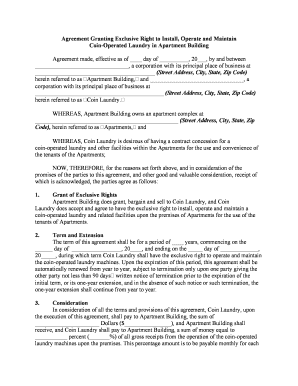
Agreement Granting Exclusive Right to Install Coin-Operated Laundry
What the Agreement Granting Exclusive Right to Install Coin-Operated Laundry Is
Why this Agreement Matters for Owners and Operators
A clear exclusive-installation agreement reduces disputes by fixing rights and obligations: who installs equipment, who pays utilities, how revenue is shared, and how maintenance and termination work. It protects property value and operator investment while setting measurable performance and access terms to avoid later conflict.
Who Typically Uses the Agreement Granting Exclusive Right to Install Coin-Operated Laundry
The agreement suits both single-property arrangements and portfolio-level programs, with clauses adjusted to fit residential, multi-family, or commercial settings.
- Property owners and landlords: document rights, limits, and compensation for equipment on their property.
- Property managers and HOAs: enforce installation standards, access, and maintenance schedules.
- Laundry operators and vendors: secure exclusive territory and define revenue or rental arrangements.
Primary Signers and Their Roles
Property Owner
The owner signs to grant the exclusive right, represents title or authority over the premises, and accepts obligations such as granting access and adhering to insurance and indemnity provisions.
Laundry Operator
The operator signs to accept installation, maintenance, revenue-sharing or rent terms, and to warrant compliance with equipment, utility, and safety standards required by the agreement.
Penalties and Risks of an Incorrect Agreement
Common Mistakes When Preparing this Agreement
- Failing to define the exact installation footprint and access points leads to disputes over where machines may be placed and who controls adjacent space.
- Leaving compensation vague—such as stating 'reasonable share'—creates interpretation disputes and complicates bookkeeping and tax reporting.
- Omitting maintenance response times and repair obligations causes tenant complaints and prolonged equipment downtime without remedies.
- Not specifying permits, electrical upgrades, or utility cost allocation can result in unexpected capital costs and regulatory violations.
Step-by-Step: How to Complete the Agreement Granting Exclusive Right to Install Coin-Operated Laundry
-
01Identify parties: Enter full legal names and contact details for each party.
-
02Describe premises: Specify address, unit numbers, and the exact installation location.
-
03Set financial terms: Document rent, commission, payment schedule, and reporting cadence.
-
04Agree operations: Include maintenance, insurance, access, and termination clauses.
How to Customize and Complete the Agreement Online
| Field | Configuration |
|---|---|
| Signature Block | Assign to specific signer; require date field |
| Initials | Place at clause changes; optional or required |
| Attachment Field | Allow operator to attach equipment spec sheets |
| Conditional Fields | Show permit fields only if installation requires upgrades |
Digital Signing, Integration, and Format Requirements
Use a compliant eSignature provider that supports audit trails, retention, and required integrations for your recordkeeping and workflow needs.
- File formats: PDF, DOCX supported
- Integrations: Salesforce, NetSuite, Google Workspace
- Authentication: Email, SMS, or advanced auth
Where to Send or File the Completed Agreement
-
Owner copy: Retain in landlord’s contract repository
-
Operator copy: Store with vendor operations files
-
Property manager: Provide a copy to onsite management
-
Accounting: Share with parties who handle payments and tax reporting
Key Timeframes and Notice Periods to Include
Effective Date:
MM/DD/YYYY format; marks contractual start
Installation Window:
Specify number of days from effective date for completion
Payment Schedule:
Monthly or quarterly remittance deadlines
Maintenance Response:
Response and repair times (e.g., 48 hours)
Termination Notice:
Notice period (commonly 30–90 days)
Key Milestones and Processing Stages
Negotiation
Agree core terms and exhibits before drafting.
Execution
All authorized signers sign; confirm dates and countersigns.
Installation
Operator installs equipment within agreed window.
Operational Review
First 90-day performance review and report.
Practical Tips for Accurate and Efficient Completion
Illustrative Use Cases for the Agreement
Multi-Family Installation
A landlord grants exclusive laundry rights for a 120-unit complex
- Operator installs five washers and four dryers in the basement
- The parties attach equipment specs, a 5-year term with a 60-day termination clause, and monthly revenue reports to avoid disputes and establish clear upkeep duties.
Commercial Property Program
A property manager negotiates exclusivity for multiple small buildings
- Operator agrees to retrofit electrical panels in exchange for a reduced commission during year one
- The contract includes a capital cost schedule and a performance review after 90 days to ensure uptime targets are met.
eSignature Pricing Comparison for Executing this Agreement
| signNow | DocuSign | Adobe Sign | PandaDoc | HelloSign | |
|---|---|---|---|---|---|
| Starting Price | $8/user/mo | $15/user/mo | $14/user/mo | $19/user/mo | $15/user/mo |
| Free Trial | 7-day free trial | Varies | Varies | Varies | Varies |
| Bulk Send | Yes | Yes | Yes | Yes | No |
| Audit Trail | Yes | Yes | Yes | Yes | Yes |
| HIPAA Compliant | Yes | Yes | Yes | No | No |
| Envelope Cap | No cap | 100 envelopes/user/year | Varies | Varies | Varies |
Frequently Asked Questions about the Agreement and Electronic Execution
-
Is an eSignature legally binding?
Yes. Electronic signatures are legally effective under the ESIGN Act (15 U.S.C. ch. 96) and UETA where adopted; validity requires evidence of intent, consent, signer attribution, and record retention.
-
When is notarization needed?
Most standard installation agreements do not require notarization, but if the agreement creates or transfers interests in real property or requires a recorded instrument, notarization and local recording may be necessary; confirm with county recording office.
-
Can I amend the agreement later?
Yes. Use a written amendment signed by authorized parties and dated. Specify whether amendments require the same signing process and retain prior versions for audit purposes.
-
How should parties authenticate signers?
Authentication options include email link, SMS code, or stronger methods (ID credential analysis) depending on risk; capture an audit trail with IP, timestamp, and signer email to support attribution.
-
What records should I retain?
Keep the fully executed agreement, exhibits, payment records, and audit trail. Retention should follow IRS guidance (3 years) and any industry-specific rules such as HIPAA (6 years) if applicable.
-
How do I cancel or revoke the agreement?
Follow termination provisions in the contract, including notice periods. For unilateral cancellation not covered by the agreement, consult counsel about breach remedies and potential liabilities.