Establishing secure connection…Loading editor…Preparing document…

Agreement Between Arbitrator, Union and Company

This template is fully customizable. Edit the text, fill out the fields, and send it for signature. Give it a try!
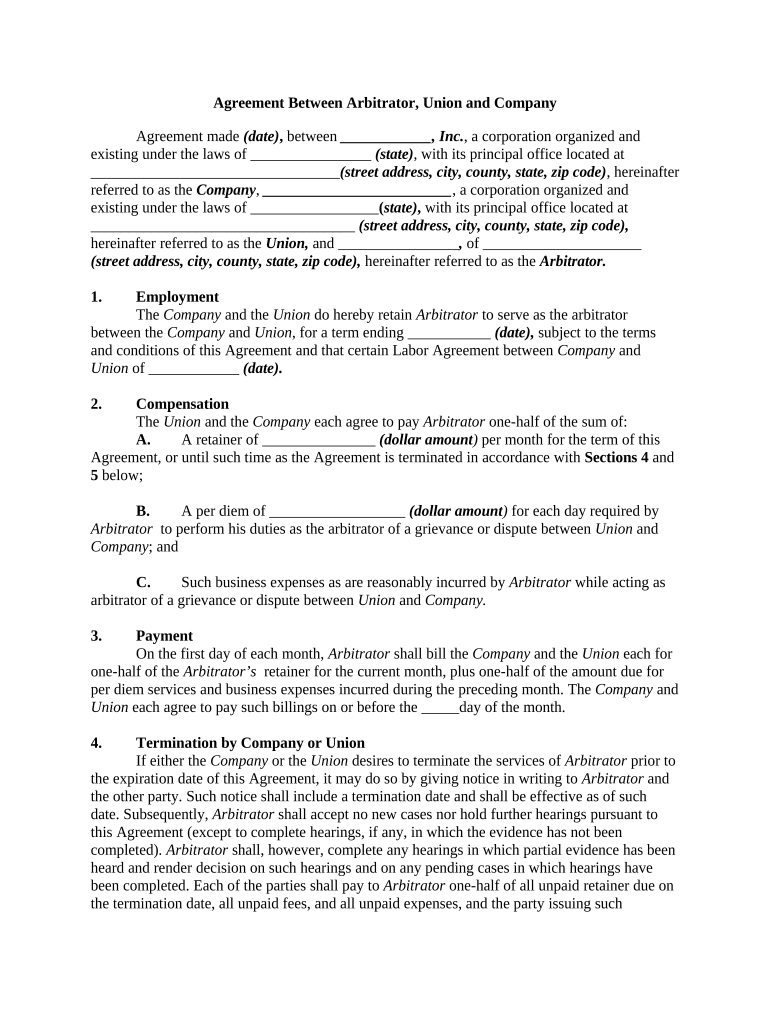
Agreement Between Arbitrator, Union and Company

What the Agreement Between Arbitrator, Union and Company Is

The Agreement Between Arbitrator, Union and Company is a tripartite contract that sets out the selection of an arbitrator, the scope of issues subject to arbitration, procedural rules, and the binding effect of arbitration awards on the union and employer. It typically identifies parties, the arbitrator or selection method, timelines for notices and hearings, confidentiality provisions, allocation of costs, and signature blocks. When executed electronically, the agreement is legally enforceable under the ESIGN Act (15 U.S.C. §7001) and state UETA statutes, subject to statutory exceptions and proper consent and retention of the electronic record.

Why Parties Use This Tripartite Arbitration Agreement

This agreement clarifies dispute resolution roles, shortens time to final decision, and reduces litigation risk by providing a predefined arbitrator selection process and procedural framework accepted by both union and employer.

Why Parties Use This Tripartite Arbitration Agreement

Who Prepares and Signs the Agreement

Typical users prepare and sign the agreement to formalize arbitration procedures agreed during collective bargaining or individual dispute resolution.

  • Union representatives and bargaining committees responsible for protecting member rights and ensuring contract compliance.
  • Company HR leaders or labor relations managers who implement and enforce collective bargaining outcomes and operational policies.
  • Neutral arbitrators and arbitration administrators who confirm acceptance and scheduling under the agreed procedure.

Who Signs and Why Their Role Matters

Union Representative

A designated union officer or bargaining committee member signs to confirm union assent and that the agreement aligns with the collective bargaining agreement and union governance rules. Their signature establishes authority and ensures the membership's rights are represented in arbitration procedures.

Company General Counsel

A company executive or corporate counsel signs to accept arbitration terms on behalf of the employer, confirm internal authority, and bind the company to selected procedures, timelines, and cost allocations described in the agreement.

Core Clauses to Include in a Professional Tripartite Agreement

A complete Agreement Between Arbitrator, Union and Company organizes responsibilities, scope, timing, and enforcement. Below are six essential components to include and tailor to the parties' needs.

Arbitrator Identification

Specify a named arbitrator or a selection method (list, panel, AAA/other administrator). Include acceptance terms, backup procedures, and disqualification grounds to avoid selection disputes during scheduling.
Scope of Arbitration

Define covered disputes (grievances, contract interpretation, discipline). Explicitly exclude matters reserved for courts where statutory exceptions apply so the arbitrator’s jurisdiction is clear and enforceable.

Procedure and Rules

State governing rules (e.g., AAA, custom rules), hearing format (in-person, remote), evidence protocol, discovery limits, timelines for pre-hearing submissions, and transcript requirements to reduce procedural ambiguity.

Costs and Fees

Allocate arbitrator fees, administrative costs, and transcript expenses. Specify when each party pays and how expenses are apportioned to minimize later billing disputes and clarify cost-shifting mechanisms.

Confidentiality

Include confidentiality terms for proceedings, evidence, and awards where permissible. Specify permitted disclosures (regulatory filings, court orders) and remedies for breaches to protect sensitive information.

Signature and Authority

Provide full signature blocks for the union, company, and arbitrator with printed name, title, date, and a declaration of signing authority to prevent later challenges to validity or authority.

Simple Step-by-Step: How to Complete the Agreement

Follow these steps to assemble, review, sign, and exchange the Agreement Between Arbitrator, Union and Company so the document is complete, authorized, and enforceable.

  • 01
    Prepare Draft: Assemble clauses, dates, arbitrator selection, and cost allocation.
  • 02
    Internal Review: Union counsel and company legal review and confirm authority to bind parties.
  • 03
    Execute Signatures: Each authorized signatory signs and dates the final version.
  • 04
    Distribute Copies: Provide signed copies to union, company, and arbitrator; retain originals.

How Electronic Completion and Exchange Typically Works

Electronic completion follows a standard workflow: upload, prepare fields, assign signers, authenticate, sign, and archive the executed agreement with an audit trail.

  • Upload: Upload the final draft to the signing platform in PDF or DOCX format.
  • Prepare: Place name, date, and signature fields and any conditional fields required.
  • Authenticate: Use email, SMS, or stronger authentication per party agreement.
  • Archive: Store executed copy with audit trail and retention metadata.

Typical Digital Workflow Settings for This Agreement

Choose consistent digital workflow settings so every executed agreement contains the same fields, authentication, and retention behavior.

Field Configuration
Signer Order Sequential — union, company, arbitrator
Authentication Email link or SMS code; use stronger methods for high-risk matters
Signature Type Electronic signature with audit trail; PKI optional
Notifications Automated reminders and completed-document delivery

Platform Capabilities to Support the Agreement

Use a signing platform that supports templates, audit trails, role-based signing, and secure document storage.

  • Integrations: Salesforce, Microsoft 365, NetSuite available
  • File Formats: PDF, DOCX, HTML accepted
  • Security: AES-256 at rest; TLS 1.2/1.3

eSignature Pricing Comparison for Agreement Workflows

Common vendor price and capability comparisons for executing agreements electronically; signNow is shown first to align with platform comparison ordering rules.

signNow DocuSign Adobe Sign PandaDoc HelloSign
Starting Price $8/user/mo $15/user/mo $14/user/mo $19/user/mo $15/user/mo
Free Trial 7-day free trial Varies Varies Varies Varies
Bulk Send Yes (Premium) Yes Yes Yes No
Audit Trail Yes Yes Yes Yes Yes
HIPAA Compliant Yes Yes Yes No No

Security and Compliance Essentials for Signed Agreements

In Transit: TLS 1.2/1.3 encryption
At Rest: AES-256 encryption
Certifications: SOC 2 Type II available
HIPAA: BAA available for protected health data
Regulatory: 21 CFR Part 11 support
Legal Acts: ESIGN and UETA compliance

Common Preparation Mistakes to Avoid

  • Using vague arbitrator selection language that invites disputes over appointment and jurisdiction.
  • Omitting authority lines or titles, which can lead a court to question whether signatories could bind their organizations.
  • Failing to specify applicable rules or timelines, producing procedural confusion and potential delays in hearing scheduling.
  • Neglecting to confirm electronic-consent language for consumer-facing matters required under 15 U.S.C. §7001(c).

Key Risks and Potential Consequences

Unenforceable Clause: May be severed by a court
Authority Challenge: Contract voided if signer lacked authority
Procedure Noncompliance: Hearing delayed or procedural remedies
Evidence Exclusion: Improperly described discovery may be barred
Confidentiality Breach: Possible monetary or injunctive remedies
Recordkeeping Failure: Difficulty enforcing award or proving consent

Representative Use Cases for This Agreement

Real-world scenarios show how parties use a tripartite arbitration agreement to reduce uncertainty and expedite dispute resolution without litigation.

Collective Bargaining Dispute

A union and employer agree to a named arbitrator to hear discipline appeals.

  • The panel uses limited discovery.
  • The arrangement reduced litigation costs and produced faster, final resolutions consistent with the collective bargaining framework.

Company Policy Grievance

An employer, union, and neutral arbitrator set a remote hearing process.

  • Hearings proceed virtually.
  • The agreement clarified scheduling, cost allocation, and confidentiality, enabling the parties to resolve multiple similar grievances efficiently.

Practical Tips to Improve Enforceability and Clarity

Adopt clear, specific language and confirm signing authority to reduce post-execution disputes and streamline enforcement of arbitration awards.

Use Clear Arbitrator Selection Language
Specify a named arbitrator or precise selection method, including deadlines and replacement procedures, to avoid disputes over who is empowered to decide the matter.
Confirm Signing Authority
Have each signer state their position and authority line in the signature block; obtain any required internal approvals before final execution to prevent later challenges.
Document Electronic Consent
For electronic execution, include a consent clause and retention statement meeting ESIGN (15 U.S.C. §7001) requirements so the signed record is admissible.
Attach Procedural Rules
Reference established arbitration rules (AAA, JAMS, or custom rules) and attach them as exhibits to avoid ambiguity about processes and evidence handling.

Typical Timing Items to Record in the Agreement

Record timeline items explicitly so each party understands notice periods, filing timelines, and how long certain obligations remain in effect.

Execution Date:

Date the agreement is signed by all parties

Effective Date:

Date obligations and timelines begin

Notice Period:

Time to provide arbitration notice per CBA or agreement

Hearing Scheduling:

Deadlines for selecting hearing dates and exchanging evidence

Record Retention:

Period to retain records for enforcement and audits

Frequently Asked Questions About Execution and Enforceability

Answers to common questions about signing, electronic validity, notarization, amendment, and revocation of the Agreement Between Arbitrator, Union and Company.


Need help? Contact support

be ready to get more
Join over 28 million airSlate SignNow users