Establishing secure connection…Loading editor…Preparing document…

Agreement Between Physicians to Share Offices

This template is fully customizable. Edit the text, fill out the fields, and send it for signature. Give it a try!
Agreement Between Physicians to Share Offices

What this Agreement Between Physicians to Share Offices Is

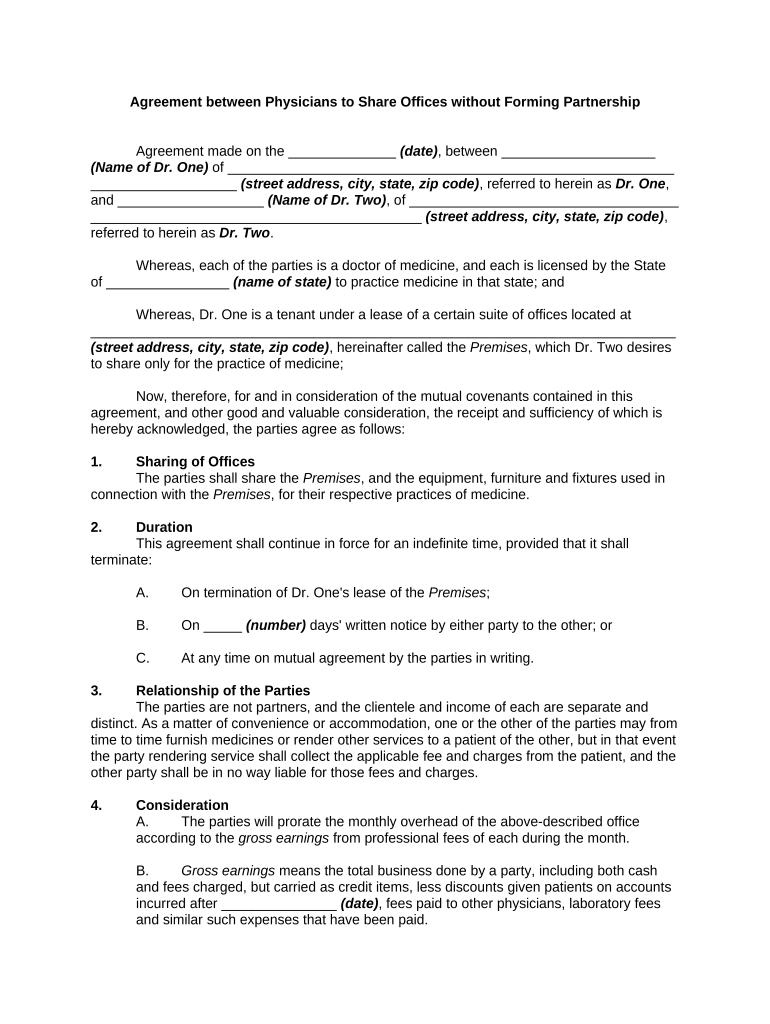
An Agreement Between Physicians to Share Offices is a written contract that sets terms for two or more medical practitioners to share clinic space, front-desk services, utilities, and administrative support while preserving separate professional practices. It defines cost allocation, scheduling rules, patient record stewardship, revenue and expense sharing, indemnification, insurance responsibilities, and termination mechanics. The agreement helps prevent misunderstandings, aligns expectations about use of shared resources, and documents compliance steps for privacy, billing, and licensing obligations. Parties should tailor the agreement to their specialties and applicable state and federal healthcare rules.

Why a Formal Shared-Office Agreement Matters

A clear written agreement reduces operational disputes, clarifies billing and space-use allocation, and provides evidence of arms-length arrangements to satisfy regulatory and payer review. It also documents who controls patient records, how costs are split, and procedures for adding or removing physicians.

Why a Formal Shared-Office Agreement Matters

Who Typically Uses This Agreement and When

Physicians, practice managers, medical groups, and healthcare attorneys use this agreement when two or more clinicians plan to share physical office space or administrative resources.

  • Solo practitioners joining a shared suite for cost savings and flexible scheduling.
  • Independent physicians sharing front-desk staff and exam rooms while billing separately.
  • Medical groups consolidating satellite practices to reduce overhead and coordinate care.

Use the agreement before occupancy or when materially changing shared operations so responsibilities and compliance steps are documented.

Representative Signers and Their Roles

Dr. Primary — Practice Owner

A physician who owns or leases the office space and signs to allocate room access, scheduling priority, rent splits, maintenance responsibilities, insurance coverage obligations, and limits on subleasing. Their signature confirms operational controls and billing separation between practices.

Office Manager — Administrator

An appointed manager who administers day-to-day scheduling, collects shared expenses, maintains shared equipment logs, and implements privacy procedures. While not a legal party in all cases, the manager often executes administrative exhibits or acknowledgements on behalf of the practice entity.

Essential Clauses to Include in the Shared-Office Agreement

A comprehensive agreement balances operational detail with regulatory protections. Include provisions that address financial, clinical, and compliance risks while keeping language clear for day-to-day administration.

Premises and Access

Define which rooms and equipment are shared, hours of access, keys or electronic badge rules, cleaning schedules, and responsibilities for repairs to avoid ambiguity about permitted uses.
Cost Allocation

Set rent, utilities, supplies, cleaning, and administrative cost splits by fixed share, usage logs, or pro rata formulas; include invoicing timing and late payment remedies.

Patient Records

Specify custody, storage, electronic health record access rules, who responds to record requests, and procedures for transfer or joint record retention to maintain HIPAA compliance.

Billing and Collections

Clarify that each physician bills independently for professional services, delineate shared billing services if any, and prohibit using the shared agreement to improperly split professional fees.

Regulatory Compliance

Require adherence to HIPAA, Stark Law and Anti-Kickback implications for rental and space-sharing, malpractice insurance minimums, and prompt reporting of breaches or investigations.

Termination and Buyout

Outline notice periods, cure windows for breaches, procedures for dividing fixtures or deposits, and a valuation method or buyout formula for one party exiting the shared arrangement.

Step-by-Step: Completing the Agreement Between Physicians to Share Offices

Follow these steps in order to create a clear, enforceable shared-office agreement tailored to your practice arrangement.

  • 01
    1. Identify Parties: List each physician or entity with legal names and business addresses.
  • 02
    2. Describe Premises: Precisely describe shared rooms, equipment, and storage areas.
  • 03
    3. Allocate Costs: Choose a clear cost-split formula and billing cadence.
  • 04
    4. Sign and Date: Obtain signatures, dates, and any required witness or notarization.

How Shared-Office Agreements Operate in Practice

This high-level flow shows typical operational steps from agreement drafting through daily use and eventual termination.

  • Drafting: Parties negotiate terms and draft clauses covering space, costs, records, and compliance.
  • Execution: Signatures are obtained, and any notary or witness steps are completed per state rules.
  • Operation: Day-to-day scheduling, cost sharing, and record handling follow the agreement terms.
  • Amendment/Termination: Parties follow notice and buyout procedures to amend or end the shared arrangement.

Typical Digital Workflow Settings for Completing the Agreement

Configure the online workflow to capture signatures, identities, and a signed audit trail for compliance and recordkeeping.

Field Configuration
Template Auto-fill Use reusable templates to prepopulate party names and addresses.
Signer Authentication Enable emailed links or SMS codes; consider stronger ID for compliance.
Audit Trail Level Capture IP, timestamp, and action logs for each signer.
Delivery Method Send signed copies automatically to parties and store in secure cloud.

Digital Signing and Technical Considerations

Choose a signing platform that supports secure authentication, tamper-evident signed documents, and retention of a complete audit trail.

  • File Formats: PDF and DOCX are standard and preserve layout across devices.
  • Integration Needs: Connectors for EHR, Google Workspace, or cloud storage ease record transfer.
  • Compliance Features: Look for HIPAA BAA support and strong encryption at rest and in transit.

Ensure the platform's user authentication and retention policies meet HIPAA and state recordkeeping expectations before e-signing any healthcare-related agreement.

Security and Compliance Items to Verify

Encryption: TLS 1.2/1.3; AES-256 at rest
Access Controls: Role-based signer permissions
Audit Trail: IP, timestamp, action log
HIPAA BAA: Business associate agreement required
Backup: Redundant encrypted backups
Certifications: SOC 2 Type II, ISO 27001

Penalties and Risks If the Agreement Is Incorrect or Incomplete

Contract Disputes: Civil liability for unclear obligations
HIPAA Fines: Monetary penalties for privacy violations
Tax Exposure: Backup withholding or IRS scrutiny
Invalid Notarization: State rejection of unsigned or mis-executed documents
License Risk: Professional discipline for improper fee arrangements
Business Disruption: Operational downtime and patient care impact

Common Mistakes to Avoid When Preparing the Agreement

  • Using vague cost allocation language such as 'fair share' without a calculable formula leads to disputes and audit risk if regulators review the arrangement.
  • Failing to address patient record custody and EHR access can create HIPAA violations and prevent timely response to records requests.
  • Neglecting to confirm whether the arrangement implicates Stark Law or Anti-Kickback rules can expose parties to civil penalties for improper referrals.
  • Allowing informal signature practices, such as unsigned attachments or initials on key terms, can render the agreement unenforceable in disputes.

Key Dates, Notice Periods, and Processing Expectations

Track effective dates, recurring billing cycles, notice windows, and retention triggers to maintain operational and regulatory compliance.

Effective Date:

Written as MM/DD/YYYY; governs when obligations commence.

Rent and Billing Cycle:

Specify monthly or quarterly invoicing and payment due days.

Termination Notice:

Commonly 30–90 days written notice; state the exact period.

Amendment Window:

Require written consent for changes and specify execution method.

Record Requests:

Respond to patient records requests per HIPAA timeframes promptly.

eSignature Pricing and Feature Comparison Relevant to This Agreement

When choosing an eSignature provider for executing and storing agreements, compare starting price, trial options, bulk send, audit trails, HIPAA support, and envelope limits across vendors.

signNow DocuSign Adobe Sign PandaDoc HelloSign
Starting Price $8/user/mo $15/user/mo $14/user/mo $19/user/mo $15/user/mo
Free Trial 7-day free trial Varies by plan Varies by plan Varies by plan Varies by plan
Bulk Send Yes (Business Premium) Varies by plan Varies by plan Varies by plan Varies by plan
Audit Trail Yes Yes Yes Yes Yes
Envelope Cap No cap 100 envelopes/user/year Varies Varies Varies

Real-World Examples of Shared-Office Agreements

Two brief case examples illustrate common structures and outcomes when physicians share office facilities.

Community Clinic Co-share

A group of three independent family physicians pooled exam rooms to reduce overhead.

  • The point: they used square footage and appointment hours for prorated rent.
  • As a result they documented scheduling rules and separate billing protocols, added a HIPAA addendum, and avoided referral conflicts by adopting a fair market value rent formula and annual audits.

Specialty Partner Suite

An orthopedic surgeon and physical therapist shared reception and billing staff.

  • The point: billing remained independent while staffing costs were split.
  • They specified equipment ownership, malpractice insurance minimums, and termination buyout terms so one party could exit without operational disruption and with a clear valuation method.

Practical Tips for Accurate and Efficient Completion

Adopt these best practices to reduce errors and avoid costly revisions when finalizing a shared-office agreement.

Use Clear Allocation Metrics
Define rent and expense splits with measurable metrics (square footage, appointment hours) rather than subjective terms to prevent disputes and simplify audits.
Document Privacy and Access
Spell out EHR access rights and who responds to record requests to maintain HIPAA compliance and minimize patient privacy risk.
Review Regulatory Impact
Have counsel review for Stark Law, Anti-Kickback, and state practice act concerns when referral patterns or revenue sharing could trigger regulatory scrutiny.
Keep Amendment Procedures Simple
Provide a straightforward written amendment process with required signatures to enable timely updates as practices evolve.

FAQs and Troubleshooting for the Agreement Between Physicians to Share Offices

Answers to common questions about signing, compliance, notarization, and modifications to shared-office agreements.


Need help? Contact support

be ready to get more
Join over 28 million airSlate SignNow users