Establishing secure connection…Loading editor…Preparing document…

Oklahoma Application for Pardon

This template is fully customizable. Edit the text, fill out the fields, and send it for signature. Give it a try!
Oklahoma Application for Pardon

What the Oklahoma Application for Pardon Is

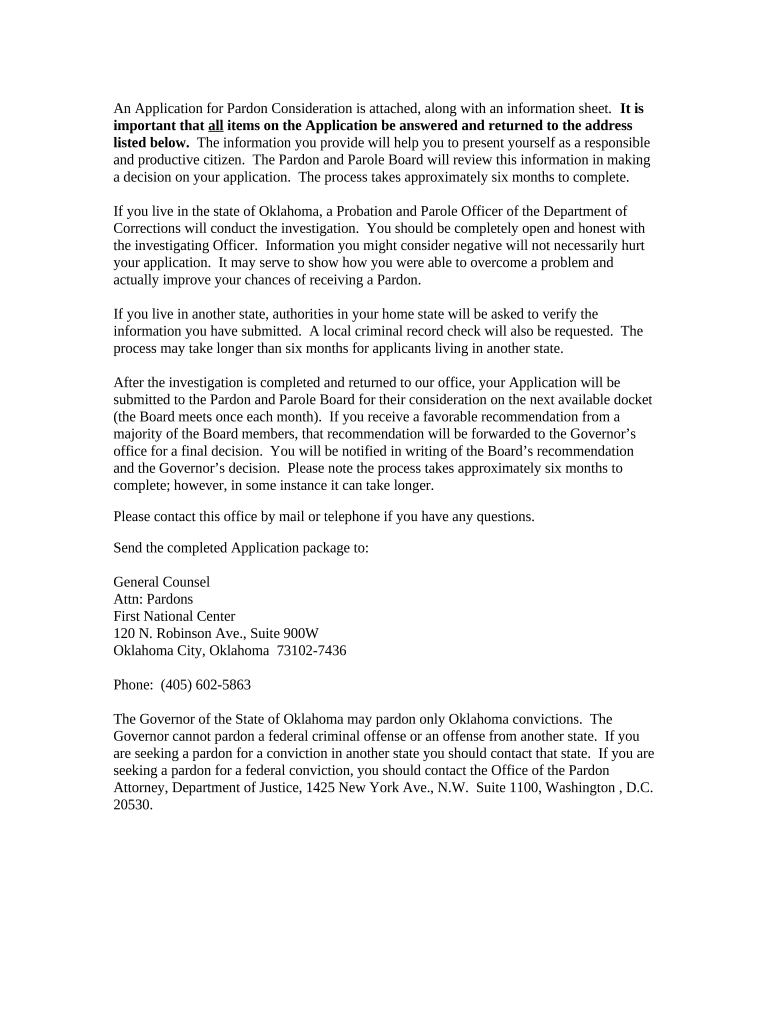
The Oklahoma Application for Pardon is a formal petition submitted to the state clemency or pardon authority requesting executive relief from collateral consequences of a conviction, restoration of civil rights, or record consideration. It typically collects identifying information, conviction details, a personal statement, and supporting documentation. Submission rules, review procedures, and available remedies vary by state; applicants may need background checks, certified court records, and notarized signatures. Decisions are discretionary and may involve board review, public notice, or a gubernatorial decision depending on Oklahoma's established process.

Why Completing the Application Matters

A completed pardon application documents your request for clemency and can address barriers such as employment, licensing, voting, and professional certification. Accurate, complete submissions improve reviewability and reduce administrative delays.

Why Completing the Application Matters

Who Typically Prepares or Submits This Form

Individuals seeking a pardon or restoration of rights prepare the form, often with assistance from counsel or advocates.

  • Applicants and petitioners who experienced a criminal conviction and seek relief or record consideration.
  • Attorneys and paralegals who prepare legal narratives, gather certified records, and advise on eligibility.
  • Advocacy groups and reentry services that help collect documents and submit complete applications.

Step-by-step: Completing the Oklahoma Application for Pardon

Follow these sequential steps to assemble a complete, review-ready submission to the pardon authority.

  • 01
    Gather Records: Obtain certified disposition, sentencing, and incarceration documents.
  • 02
    Complete Form: Enter personal, arrest, and case details accurately.
  • 03
    Support Materials: Attach letters, employment history, and evidence of rehabilitation.
  • 04
    Sign & Submit: Sign, notarize if required, and file per agency instructions.

Online Workflow Settings for a Digital Submission

Configure an electronic workflow that mirrors the paper process and preserves audit evidence for review.

Field Configuration
Document Type PDF — flattened for archival
Authentication Email plus optional SMS code
Notarization In-person or RON where allowed
Routing Applicant -> Agency intake -> Board reviewers

Overview of a Typical eSubmission Process

A clear digital sequence helps maintain evidence of consent and document integrity during remote submission.

  • Upload Document: Sender uploads the completed application and attachments as PDF files.
  • Place Fields: Add signature, date, and initial fields where required.
  • Sign & Notarize: Applicant authenticates and signs; notarization completed if mandated.
  • Submit to Agency: Deliver signed packet to the clemency office and retain audit trail.

Technical Requirements and File Compatibility

Ensure the chosen platform supports common government file formats and produces an auditable signing record.

  • File Formats: PDF, DOCX supported for upload and archival
  • Integrations: CRM and cloud storage integrations available
  • Security: TLS in transit; AES-256 at rest

Core Sections of a Professional Application Packet

A complete packet organizes identity, case detail, supporting evidence, and authorization elements so reviewers can evaluate suitability.

Applicant Details

Full contact and identifying information, including aliases and previous names, required to match records across courts and corrections databases.
Case History

Clear summary of charges, plea or verdict, sentence, and release dates so reviewers can quickly verify the underlying record.

Legal Representation

Contact details for counsel and any power-of-attorney documents authorizing third-party filing or representation.

Supporting Documents

Certified dispositions, parole reports, and rehabilitation evidence such as employment records or certificates.

Personal Statement

A concise narrative explaining rehabilitation, remorse, community ties, and reasons for requesting clemency, with dates and specifics.

Certification

Signature, date, and notarization block (if required) certifying the truthfulness of the submission and consent to agency processing.

Supporting Materials to Include with Your Petition

Assemble documents that corroborate rehabilitation and identity; organize them with a table of contents for reviewer convenience.

Certified Records

Court dispositions, sentencing orders, and parole records scanned as certified PDFs to verify the case history.

Character Letters

Two to five signed letters from employers, clergy, or community leaders describing the applicant's conduct and rehabilitation.

Proof of Stability

Employment history, educational certificates, housing verification, or treatment completion records that demonstrate stability.

Privacy Notice

Redact sensitive identification numbers as required and include any agency-mandated consent or release forms.

Common Preparation Pitfalls to Avoid

  • Incomplete or illegible entries that prevent accurate record matching and lead to administrative returns or delays.
  • Attaching uncertified copies rather than certified court documents, which often triggers requests for resubmission.
  • Mismatched names, dates, or case numbers between the application and official records, causing verification failures.
  • Failing to notarize when required or submitting the notarized document after the agency's deadline for that filing window.

Consequences of Errors or Misstatements

Application Rejection: Returned without review
Processing Delay: Extended review timelines
Perjury Risk: False statements may have legal consequences
Fee Forfeiture: Nonrefundable filing costs may be lost
Record Not Updated: Relief may not reflect in background checks
Legal Counsel Needed: Complex cases often require attorney input

Timing Considerations and Typical Review Stages

Processing timelines vary by jurisdiction; plan for document collection, agency intake, background checks, and possible hearing notices.

Filing Window:

No standard federal deadline; check agency for submission dates

Acknowledgment Receipt:

Agency typically issues a receipt within weeks of filing

Background Check Period:

Criminal and correctional checks may take 30–90 days

Board Review Schedule:

Applications may be scheduled for a hearing or placed on a review docket

Final Decision:

Time to decision varies widely; expect months to more than a year

eSignature Pricing and Feature Comparison

Compare common plan criteria relevant to filing and notarizing applications. signNow is listed first for consistency; vendor features and prices vary by plan.

signNow DocuSign Adobe Sign PandaDoc HelloSign
Starting Price $8/user/mo $15/user/mo $14/user/mo $19/user/mo $15/user/mo
Free Trial 7-day free trial Varies by vendor Varies by vendor Varies by vendor Varies by vendor
Bulk Send Yes Yes Yes Yes No
Audit Trail Yes Yes Yes Yes Yes
HIPAA Compliant Yes Yes Yes No No
Envelope Cap No cap 100 envelopes/user/year Varies Varies Varies

Frequently Asked Questions and Troubleshooting

Common questions about completing, signing, and submitting the Oklahoma Application for Pardon, and practical fixes for typical issues.


Need help? Contact support

be ready to get more
Join over 28 million airSlate SignNow users