Establishing secure connection…Loading editor…Preparing document…

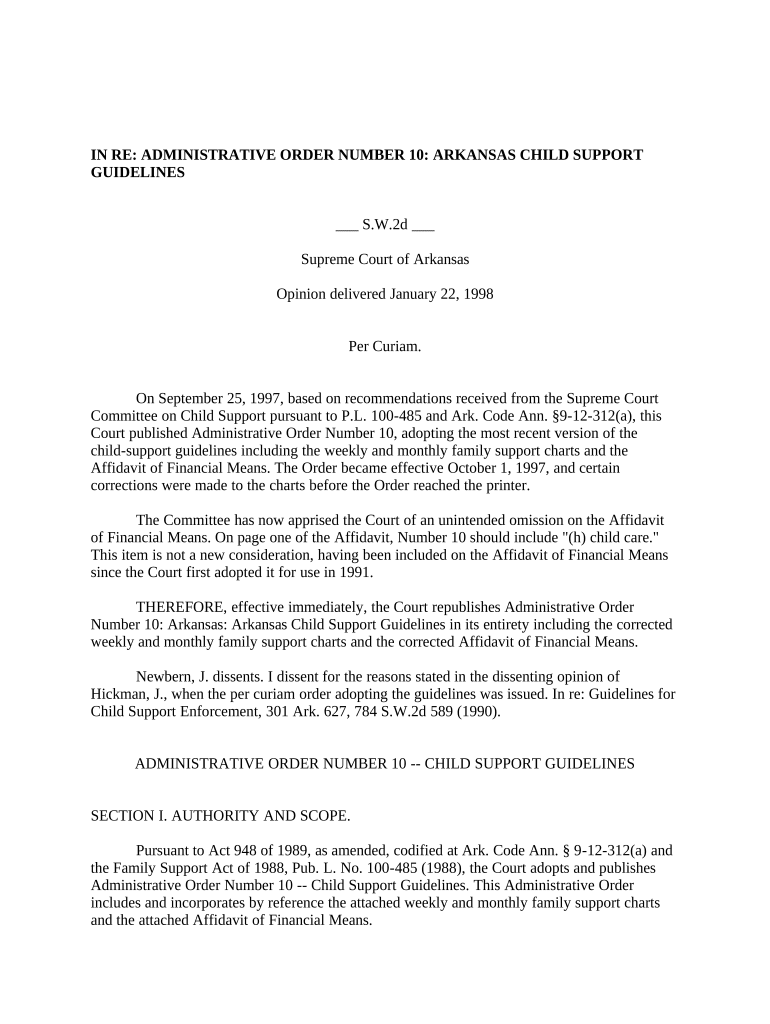
Arkansas Child Support Guidelines

This template is fully customizable. Edit the text, fill out the fields, and send it for signature. Give it a try!
Arkansas Child Support Guidelines

What the Arkansas Child Support Guidelines Are and why they matter

The Arkansas Child Support Guidelines are the state-specific rules used by Arkansas courts to calculate child support obligations based on parental income, custody arrangements, childcare and medical expenses, and other factors. They provide a uniform formula intended to promote consistency, clarity, and predictability in support orders. Courts apply the Guidelines when establishing initial support, considering deviations when appropriate, and when reviewing modifications. Parties and practitioners use the Guidelines to prepare financial worksheets, gather supporting documentation, and present calculations during hearings so judges can issue enforceable child support orders.

Why the Guidelines matter for parents and practitioners

Using the Arkansas Child Support Guidelines ensures calculations align with the court’s expected methodology, reduces dispute over basic inputs, and frames allowable deviations. Proper application helps produce defensible orders and reduces later modification or enforcement disputes.

Why the Guidelines matter for parents and practitioners

Who commonly prepares and relies on the Guidelines

Parents, family law attorneys, child support enforcement staff, and court clerks all interact with Arkansas child support worksheets and related filings.

  • Custodial and noncustodial parents preparing financial disclosure and income worksheets for a hearing or agreement.
  • Family law attorneys and mediators who draft proposed orders and advise clients on allowable deviations.
  • County clerks, child support enforcement officers, and judges who review worksheets and evidence during hearings.

Core components included in a professional child support worksheet

A complete Arkansas child support filing pairs the statutory worksheet with supporting documents and a clear explanation of deviations; each part supports the judge’s decision and provides a record for future modification or enforcement.

Income Calculation

Itemize gross income sources, pre-tax deductions, and adjustments to determine each parent’s monthly net available income for computation.
Allocation of Expenses

Document childcare, health insurance premiums, and extraordinary medical or educational costs and show each parent’s share per the Guidelines.

Percentages & Shares

Apply the guideline table or formula to split parental obligation according to combined income and parenting time proportions.

Deviation Rationale

Provide a concise, evidence-backed explanation when seeking a departure from the presumptive amount, referencing relevant factors.

Supporting Evidence

Attach pay stubs, tax returns, benefit statements, and receipts so the court can verify reported income and expenses.

Order Language

Draft precise order text for monthly amount, payment method, medical support, arrears handling, and modification triggers.

Step-by-step: preparing and filing a child support worksheet

Follow these sequential steps to prepare, verify, and submit the Arkansas child support worksheet so it’s ready for court review.

  • 01
    Gather documents: Collect pay stubs, tax returns, and proof of expenses.
  • 02
    Complete worksheet: Enter income, deductions, and childcare in prescribed fields.
  • 03
    Attach evidence: Scan and append supporting documents in chronological order.
  • 04
    File with court: Submit to the county clerk and serve the other party as required.

Configuring an online worksheet workflow for accurate submission

Set up a consistent digital workflow to collect inputs, enforce required fields, and generate a printable filing packet for the court.

Field Configuration
Required Fields Mark income and signature fields as mandatory to prevent incomplete submissions.
Authentication Use email or SMS code verification for signer attribution before acceptance.
Conditional Fields Show deviation justification only when a nonstandard amount is entered.
Notifications Auto-send confirmation and PDF to filer and opposing party after completion.

Typical filing and review flow for a child support worksheet

The typical process moves from document preparation to filing, service, and court review; each step creates records used for orders and future enforcement.

  • Prepare: Complete worksheet with supporting documents attached.
  • File: Submit to the appropriate county court or child support office.
  • Serve: Provide the other party with filed copies per local rules.
  • Hearing: Present calculations and evidence at the court date.

Digital signing and file format considerations

Use platforms that support secure PDF/X compatible exports, strong signer authentication, and an auditable completion certificate.

  • File formats: PDF and DOCX supported
  • Authentication: Email, SMS, or multi-factor
  • Integrations: Works with Google Workspace

Common supporting documents and export options

Attach verifiable evidence when submitting the worksheet and export a consolidated packet in a court-acceptable format for filing and service.

Income Proof

Attach recent pay stubs, W-2s, or 1099s that show gross earnings; provide a year-to-date stub when income varies.

Tax Returns

Include the most recent federal tax return (Form 1040) and schedules to substantiate self-employment income.

Health & Care Evidence

Attach insurance premium statements, invoices for daycare, or receipts for extraordinary medical expenses claimed.

Signed Worksheet

Export the completed worksheet and attachments as a single PDF for filing; retain a digital audit trail for the signature.

Practical tips to reduce errors and processing time

Small procedural choices improve acceptance rates and reduce return requests; adopt consistent documentation and clear order language.

Use precise, consistent calculations
Show math steps and conversion methods (weekly to monthly) so the court can reproduce totals without contacting you for clarification.
Attach source documents in order
Organize and label attachments (paystub 1, paystub 2, tax return) to streamline judicial review and reduce discovery requests.
Be transparent about irregular income
List bonuses, commissions, and overtime separately and state whether amounts are recurring to justify averaging methods used.
Confirm local filing rules
Check the county clerk’s requirements for copies, number of attachments, and service methods to avoid rejected filings or hearing delays.

Key milestones from filing to order entry

A typical timeline moves from filing and service to review and final order entry; timelines vary by county workload and court scheduling.

01

File Petition

Filing initiates the case and schedules preliminary events.

02

Serve Opposing Party

Service must occur per local rules before the hearing.

03

Financial Disclosure

Exchange documents prior to the hearing to support calculations.

04

Court Hearing

Judge reviews evidence and issues or modifies the order.

Timing considerations and typical deadlines to watch

Deadlines vary by county and whether the filing is an initial petition, temporary order, or modification; confirm specific timeframes locally.

Initial filing notice:

Scheduling depends on clerk backlog; expect 2–8 weeks in many counties.

Temporary order requests:

Courts may hear urgent temporary relief within days to weeks.

Financial exchange window:

Provide disclosure typically at least 7–14 days before hearing.

Post-order modification:

Modification petitions require proof of material change in circumstances.

Enforcement actions:

Processing times vary; administrative remedies run in parallel with court options.

Common preparation and submission pitfalls

  • Relying on gross versus net figures without explaining adjustments creates confusion and may prompt requests for clarification.
  • Failing to include recent paystubs or tax returns forces the court to rely on estimates or request continuances.
  • Not noting nonrecurring income, such as one-time bonuses, can produce inflated or misleading monthly averages.
  • Submitting unsigned or incompletely dated worksheets increases the chance of rejection or a request for re-service.

Consequences of incorrect or incomplete filings

Order delay: Hearing postponement
Rejection: Clerk may return filing
Adverse findings: Judicial credibility impact
Enforcement action: Contempt or arrears
Financial penalty: Possible sanctions
Revision costs: Additional attorney fees

Sample eSignature vendor comparison for child support worksheet workflows

Basic vendor differences include starting price, trial availability, bulk send, audit trail presence, HIPAA support, and envelope limits — choose based on compliance and volume needs.

signNow DocuSign Adobe Sign PandaDoc HelloSign
Starting Price $8/user/mo $15/user/mo $14/user/mo $19/user/mo $15/user/mo
Free Trial 7-day trial Varies by plan Varies by plan Yes, limited Yes, limited
Bulk Send Yes Yes Yes Yes No
Audit Trail Yes Yes Yes Yes Yes
HIPAA Compliant Yes Yes Yes No No

Real-world scenarios showing common worksheet uses

These examples illustrate typical situations where accurate worksheet completion changes outcomes during hearings or modifications.

Initial Support Calculation

A parent compiles two years of paystubs to average fluctuating income and obtains a stable monthly base

  • The court uses the averaged income to calculate a guideline amount
  • The resulting order reflects predictable monthly payments and includes provisions for future income-based modification.

Modification After Job Loss

A noncustodial parent loses full-time employment and files a modification with updated income documentation

  • The petitioner attaches unemployment records and a recent paystub showing reduced earnings
  • The court revises the support amount temporarily while reserving ability to adjust again when employment stabilizes.

Frequently asked questions about completing and filing the Arkansas Child Support Guidelines

Answers below address common procedural, evidentiary, and eSignature questions when preparing and submitting Arkansas child support worksheets.


Need help? Contact support

be ready to get more
Join over 28 million airSlate SignNow users