Establishing secure connection…Loading editor…Preparing document…

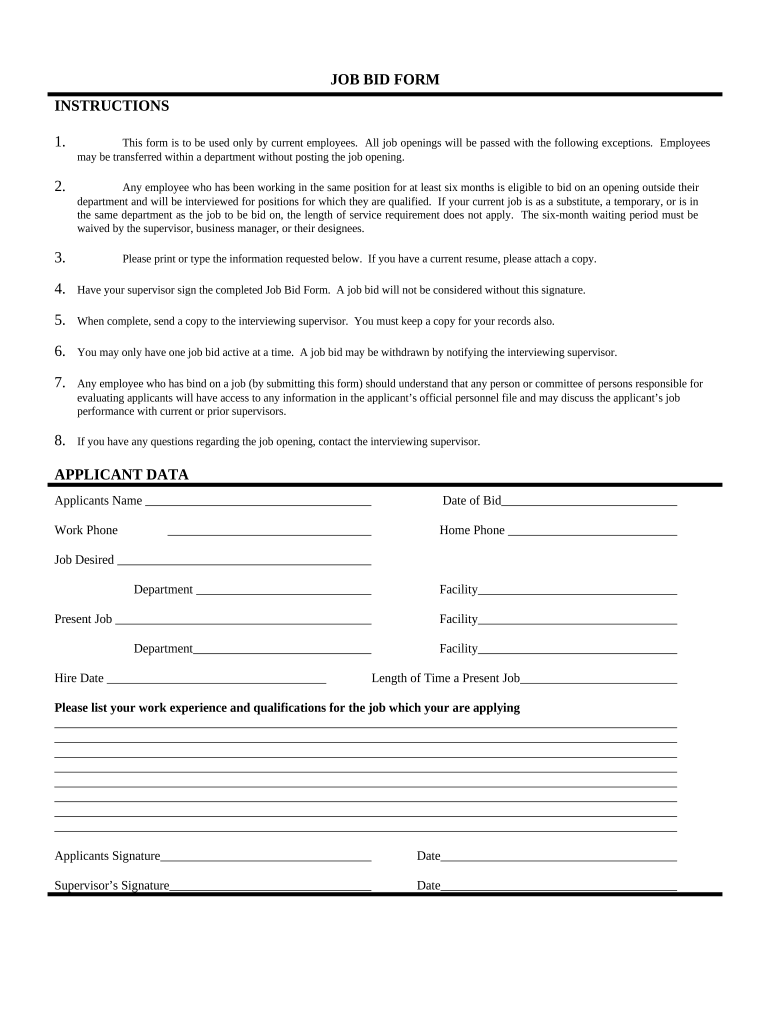
Bid Form

This template is fully customizable. Edit the text, fill out the fields, and send it for signature. Give it a try!
Bid Form

What a Bid Form Is and when it matters

A Bid Form is a standardized document that suppliers, contractors, or vendors submit in response to a solicitation to propose pricing, delivery, timelines, and contract terms. It summarizes the offer, identifies the bidder, and often attaches specifications, qualifications, and exclusions. In public procurement a bid form may be the bidder’s binding offer until acceptance; in private contracting it is frequently incorporated into the final agreement. Electronic platforms such as signNow enable secure online completion, signature capture, and an audit trail to preserve execution history and document integrity.

Why using a clear Bid Form reduces risk

A well-prepared Bid Form standardizes offers, speeds evaluation, minimizes ambiguity in pricing and scope, and creates a clear record of the bidder’s commitments for procurement officials and contract managers.

Why using a clear Bid Form reduces risk

Who prepares and relies on Bid Forms

Correct completion helps avoid bid rejection, pricing disputes, and administrative penalties during procurement and post-award performance.

  • Procurement teams who need comparable pricing and scope to score and award contracts efficiently.
  • Contractors and vendors submitting formal offers that may become part of the binding contract on acceptance.
  • Project managers and estimators who translate bid line items into budgets and schedules.

Core sections to include in a professional Bid Form

Include standardized sections so evaluators can compare submissions consistently and bidders provide the same information in the same format.

Bid Summary

Concise total price and high-level scope description. Use separate line items for material, labor, taxes, and allowances so evaluators can compare costs accurately.
Scope and Exclusions

Clearly define included work, specific exclusions, assumptions, and any contingencies. Ambiguity here commonly causes post-award disputes and change orders.

Schedule and Delivery

State firm delivery dates, milestones, lead times, and penalties for delay. Tie schedule items to payment milestones when applicable for clarity.

Payment Terms

Specify currency, invoicing cadence, retainage (if any), progress payment terms, and accepted payment methods to avoid cash-flow conflicts.

Qualifications and Certifications

List licenses, insurance limits, bonding, safety records, and any regulatory qualifications required to perform the work.

Signatures and Acceptance

Provide signatory block for authorized representatives and a clear acceptance clause that states when the bid becomes a binding offer if accepted.

Step-by-step: completing a Bid Form correctly

Follow these sequential steps to prepare and submit a compliant Bid Form for evaluation.

  • 01
    Review solicitation: Read instructions, attachments, and evaluation criteria before filling fields.
  • 02
    Complete fields: Enter each required field precisely, using requested formats and units.
  • 03
    Attach support: Include requested certificates, schedules, and financial documents as separate attachments.
  • 04
    Sign and submit: Execute the signature block and deliver by the specified method before the deadline.

Typical flow from bid submission to award

This flow describes common stages after you submit a Bid Form until contract award and execution.

  • Submission: Bidder sends the completed Bid Form and attachments via the prescribed channel.
  • Administrative review: Buyer checks completeness, compliance, and required certifications.
  • Technical and price evaluation: Evaluators score bids against criteria and compare line-item pricing.
  • Award and contract: Accepted bid is confirmed and converted into a contract or purchase order.

Configuring an online Bid Form workflow

Key settings to configure for electronic submission and automated routing when using a digital platform.

Field Configuration
Required fields Mark bidder name, price, and signature as required to prevent incomplete submissions.
Conditional fields Showcertificate or insurance fields only when a checkbox is selected to simplify the form.
Authentication Use email or SMS codes for signer verification to balance security and ease of access.
Routing Auto-route completed bids to evaluation teams and procurement supervisors for review.

Digital and platform requirements for eSubmission

Platforms that meet these requirements, including integrations with common systems, help enforce submission rules and preserve evidence of execution.

  • Document formats: PDF or DOCX preferred for preservation and compatibility.
  • Authentication: Email verification or SMS OTP ensures signer attribution.
  • Audit trail: Timestamp, IP, and action history must be captured for evidentiary value.

Typical deadlines and time expectations for Bid Forms

Procurement deadlines are strict; verify the solicitation for exact dates and time zones to avoid disqualification.

Submission deadline:

Exact date and time listed in the solicitation; late bids are usually rejected.

Questions cutoff:

Last date to submit clarifying questions before addenda are issued.

Bid opening:

Public openings may occur; bidders should confirm whether results are posted.

Evaluation period:

Timeframe for scoring and clarifications varies by project size and complexity.

Award notice:

Buyer issues notice of intent to award, followed by final contract execution.

Key milestones from bid release to contract execution

Track these milestones to coordinate submissions, responses, and post-award steps efficiently.

01

Solicitation release

Buyer publishes requirements and timeline for interested bidders.

02

Question window

Bidders submit clarifications; addenda may alter requirements.

03

Submission deadline

Final delivery of Bid Forms and required attachments; no exceptions unless stated.

04

Award and contracting

Selected bidder negotiates final contract terms and signs agreement.

Common mistakes that cause bid rejection or delays

  • Missing or incorrectly formatted pricing schedules that prevent apples-to-apples comparison and lead to disqualification during administrative review.
  • Failing to include mandatory attachments such as certificates of insurance, bonds, or licenses required by the solicitation.
  • Using a trade or DBA name instead of the legal registered entity name which can block award or payment until corrected.
  • Submitting after the deadline or to the wrong email/portal, which is one of the most common and fatal errors in procurement.

Penalties and risks from incomplete or incorrect Bid Forms

Disqualification: Immediate rejection of the bid from consideration.
Bid bond forfeiture: Loss of bond if bidder refuses contract after award.
Delay penalties: Late delivery may trigger liquidated damages in awarded contracts.
Payment holds: Incomplete vendor registration can block invoice processing.
Legal disputes: Ambiguous terms increase litigation risk post-award.
Compliance fines: Violations of solicitation procurement rules can incur administrative penalties.

eSignature provider comparison for Bid Form workflows

Compare typical plan characteristics relevant to Bid Form preparation and execution. signNow is listed first for direct feature comparison with commonly used competitors.

signNow DocuSign Adobe Sign PandaDoc HelloSign
Starting Price $8/user/mo $15/user/mo $14/user/mo $19/user/mo $15/user/mo
Free Trial 7-day free trial, no credit card Varies by plan Varies by plan Varies by plan Varies by plan
Bulk Send Yes (Business Premium) Yes Yes Yes No
Audit Trail Yes Yes Yes Yes Yes
HIPAA Compliant Yes (BAA available) Yes Yes No No

Frequently asked questions about Bid Forms and eSubmission

Answers to common questions on eSignature validity, notarization, signing authority, corrections, revocation, and recordkeeping for Bid Forms.


Need help? Contact support

be ready to get more
Join over 28 million airSlate SignNow users