Establishing secure connection…Loading editor…Preparing document…

Blocked Account Agreement

This template is fully customizable. Edit the text, fill out the fields, and send it for signature. Give it a try!
Blocked Account Agreement

What a Blocked Account Agreement Covers

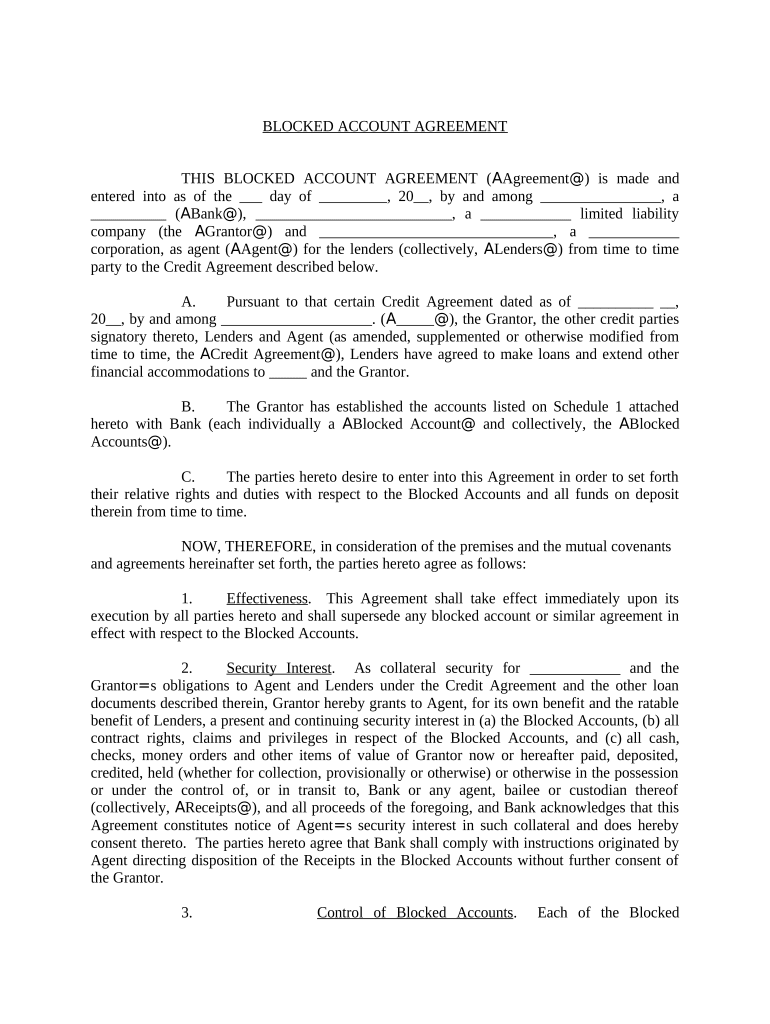
A Blocked Account Agreement defines the legal and operational terms under which funds or an account are restricted from normal withdrawal or transfer until specified conditions are satisfied. Typical provisions identify the parties, the precise blocked amount and currency, permitted account activity while blocked, release triggers, required supporting documentation, fees and costs, dispute resolution, and the governing law. The document is often executed with bank account forms, escrow instructions, or regulatory filings so that the holder, depositary, or escrow agent can reliably enforce the hold and process releases when conditions are met.

Why use a Blocked Account Agreement

Use a Blocked Account Agreement to protect stakeholders when funds must remain immobilized until contractual, regulatory, or legal conditions are satisfied. It clarifies release criteria, reduces disputes, documents fees and controls, and establishes the law that governs enforcement.

Why use a Blocked Account Agreement

Who typically prepares and signs this agreement

Typical users include corporate treasury, escrow agents, banks, and legal counsel managing restricted funds for transactions.

  • Banks and depositaries handling conditional releases and compliance under regulatory or contractual holds.
  • Escrow agents administering release upon document or performance triggers per instruction.
  • Corporate finance teams, law firms, and sponsors monitoring blocked collateral or grant distributions.

Knowing who is involved speeds negotiations, clarifies responsibilities, and reduces later litigation risk and administrative costs.

Essential sections to include in a professional agreement

A complete Blocked Account Agreement organizes clauses for the blocked amount, release conditions, permitted account activity, fees, dispute resolution, and signatory authority, including notice procedures and required document attachments.

Blocked Amount

Specify the exact principal or balance to be frozen, currency, permitted deductions, whether interest accrues, and calculation and rounding rules to avoid later accounting disputes.
Release Conditions

List precise events that trigger full or partial release (court order, regulatory clearance, completion certificate), required proof, approval thresholds, and staged release mechanics.

Permitted Activity

Define allowed account actions while blocked, such as interest posting or specific withdrawals, identify permitted signers, and state restrictions on transfers and encumbrances.

Fees & Costs

Allocate banking, escrow, notary, and administrative fees; give calculation methods, timing for deductions, and remedies for insufficient funds or chargebacks.

Dispute Resolution

Specify governing law and venue, arbitration versus court options, interim relief for urgent releases, and steps for notification and escalation on contested releases.

Signatory Authority

Identify authorized signers, required corporate resolutions or power of attorney, witness or notary requirements, and whether electronic signatures are accepted under ESIGN or UETA.

Step-by-step completion checklist

Follow these steps to prepare, execute, and process a Blocked Account Agreement to minimize delays and compliance issues.

  • 01
    Draft Agreement: Assemble clauses, amounts, release conditions.
  • 02
    Provide Documentation: Attach IDs, account statements, corporate resolutions.
  • 03
    Execute Signatures: Collect signatures, notarization, or e-consent.
  • 04
    Register or File: Deliver to bank, escrow agent, or regulator.

Common routing and acceptance checks

Delivery and verification vary by recipient; this outline shows typical acceptance checks used by banks and escrow agents.

  • Upload to Bank Portal: Bank verifies identity and account hold eligibility.
  • Send to Escrow Agent: Agent reviews instructions, records hold, and logs audit trail.
  • File with Regulator: Certain transactions require regulatory clearance before release.
  • Provide to Counterparty: Counterparty confirms performance documents before release.

Typical online workflow settings for e-completion

Configure your online workflow to capture authentication, conditional logic, and a retained audit trail for each signed agreement.

Field Configuration
Signer Authentication Email link with optional SMS code or KBA verification
Conditional Fields Show release date or attachments only when specific checkboxes are true
Notarization Allow in-person notarization or RON with recorded session retained
Audit Trail Capture IP address, timestamp, and signer email for each action

Platform capabilities to support processing

Choose a platform that supports integrations with financial systems, robust authentication, and long-term retention of signed records.

  • Integrations: Salesforce, NetSuite, Microsoft 365, Google Workspace
  • File Formats: PDF, DOCX, and editable form exports
  • Authentication: Email, SMS code, KBA, SSO options

Integration with banking or ERP systems reduces manual entry and reconciliation; ensure the platform meets required encryption and retention standards before uploading sensitive financial records.

Penalties and risks of incorrect or incomplete agreements

Tax Reporting Penalties: IRC §6721: $60–$660+ per form
Delayed Release: Payment delays cause interest loss
Contract Breach: Exposure to damages and litigation
Regulatory Fines: Agencies may assess penalties for noncompliance
Notary Errors: Invalid notarization can void release
Fraud Allegations: Intentional misstatements can trigger criminal liability

Common mistakes to avoid when preparing the agreement

  • Using inconsistent party names or abbreviations that do not match government ID or corporate records, which often causes banks to suspend processing and request re-execution.
  • Omitting required supporting documents such as current account statements, corporate resolutions, or valid government IDs, which delays verification and release.
  • Drafting vague release triggers (for example, 'upon satisfactory performance') without objective proof or certification criteria, resulting in disputes over entitlement to funds.
  • Relying on unsupported e-signature methods without obtaining consent or recording attribution, which may be rejected by banks or regulators under ESIGN/UETA frameworks.

eSignature provider comparison for signing and processing

Compare core pricing and capability attributes when choosing an eSignature provider to execute and archive Blocked Account Agreements.

signNow DocuSign Adobe Sign PandaDoc HelloSign
Starting Price $8/user/mo $15/user/mo $14/user/mo $19/user/mo $15/user/mo
Free Trial 7-day free trial Varies by promo Varies by promo Varies by plan Varies by plan
Bulk Send Yes (premium tier) Yes Yes Yes No
Audit Trail Yes Yes Yes Yes Yes
HIPAA Compliant Yes Yes Yes No No
Envelope Cap No envelope cap 100 envelopes/user/year Varies by plan Varies by plan Varies by plan

Frequently asked questions about Blocked Account Agreements

Answers to common practical and legal questions encountered when preparing, signing, and enforcing blocked-account instruments.


Need help? Contact support

be ready to get more
Join over 28 million airSlate SignNow users