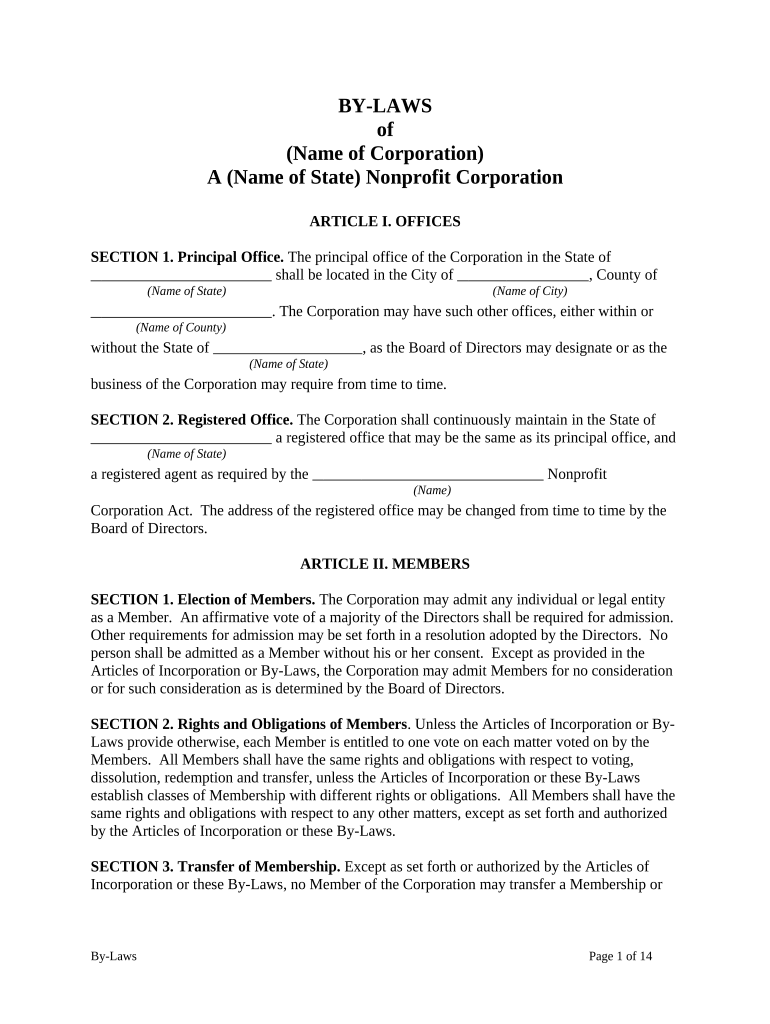
BY-LAWS
of
(Name of Corporation)
A (Name of State) Nonprofit Corporation
ARTICLE I. OFFICES
SECTION 1. Principal Office. The principal office of the Corporation in the State of
shall be located in the City of , County of
(Name of State) (Name of City)
. The Corporation may have such other offices, either within or
(Name of County)
without the State of , as the Board of Directors may designate or as the
(Name of State)
business of the Corporation may require from time to time.
SECTION 2. Registered Office. The Corporation shall continuously maintain in the State of
a registered office that may be the same as its principal office, and
(Name of State)
a registered agent as required by the Nonprofit
(Name)
Corporation Act. The address of the registered office may be changed from time to time by the
Board of Directors.
ARTICLE II. MEMBERS
SECTION 1. Election of Members. The Corporation may admit any individual or legal entity
as a Member. An affirmative vote of a majority of the Directors shall be required for admission.
Other requirements for admission may be set forth in a resolution adopted by the Directors. No
person shall be admitted as a Member without his or her consent. Except as provided in the
Articles of Incorporation or By-Laws, the Corporation may admit Members for no consideration
or for such consideration as is determined by the Board of Directors.
SECTION 2. Rights and Obligations of Members . Unless the Articles of Incorporation or By-
Laws provide otherwise, each Member is entitled to one vote on each matter voted on by the
Members. All Members shall have the same rights and obligations with respect to voting,
dissolution, redemption and transfer, unless the Articles of Incorporation or these By-Laws
establish classes of Membership with different rights or obligations. All Members shall have the
same rights and obligations with respect to any other matters, except as set forth and authorized
by the Articles of Incorporation or these By-Laws.
SECTION 3. Transfer of Membership. Except as set forth or authorized by the Articles of
Incorporation or these By-Laws, no Member of the Corporation may transfer a Membership or
By-Laws Page 1 of 14
any right arising therefrom. Where transfer rights have been provided, no restriction on them
shall be binding with respect to a Member holding a Membership issued prior to the adoption of
the restriction unless the restriction is approved by the Members and the affected Member.
SECTION 4. Dues, Assessments or Fees . A Member may become liable to the Corporation for
dues, assessments or fees; provided, however, that an Article or By-Law provision or a
resolution adopted by the Board authorizing or imposing dues, assessments or fees does not, of
itself, create liability.
SECTION 5. Resignation of Member. A Member may resign at any time by filing a written
resignation with any corporate officer. The resignation of a Member does not relieve the
Member from any obligations the Member may have to the Corporation.
SECTION 6. Termination of Membership. No Member may be expelled or suspended, and no
Membership or Memberships may be terminated or suspended except pursuant to the procedure
provided herein carried out in good faith. The affected Member must receive not less than 15
days' prior written notice of the expulsion, suspension or termination and the reasons therefore
and an opportunity to be heard, orally or in writing, not less than five days before the effective
date of the expulsion, suspension or termination by the Board or a person or persons authorized
by the Board to decide that the proposed expulsion, termination or suspension not take place.
Any written notice given by mail must be given by first-class or certified mail sent to the last
address of the Member shown on the Corporation's records. Any proceeding challenging an
expulsion, suspension or termination, including a proceeding in which defective notice is
alleged, must be commenced within one year after the effective date of the expulsion, suspension
or termination. A Member who has been expelled or suspended may be liable to the Corporation
for dues, assessments or fees.
ARTICLE III. MEETINGS OF MEMBERS
SECTION 1. Annual Meeting. The annual meeting of the Members shall be held on the first
Monday in the month of February, in each year, beginning with the year 20 , at the hour
of 6:00 p.m., or such other time and date as may be determined by the Directors, for the purpose
of electing Directors and for the transaction of such other business as may properly come before
the meeting. At the annual meeting, the president and chief financial officer shall report on the
activities and financial condition of the Corporation and the Members shall consider and act
upon such other matters as may be raised consistent with these By-Laws. If the day fixed for the
annual meeting shall be a legal holiday in the State of , such
(Name of State)
meeting shall be held on the next succeeding business day.
If the election of Directors shall not be held on the day designated herein for any annual meeting
of the Members, or at any adjournment thereof, the Board of Directors shall cause the election to
be held at a special meeting of the Members as soon thereafter as conveniently may be. The
failure to hold an annual meeting at the time stated in or fixed in accordance with the
Corporation's By-Laws does not affect the validity of any corporate action.
By-Laws Page 2 of 14
SECTION 2. Special Meetings. Special meetings of Members may be called by the President,
the Board of Directors, or not less than of such Members as may be qualified to
(Percentage)
vote.
SECTION 3. Place of Meeting. The Board of Directors may designate any place, either within
or without the State of , as the place of meeting for any annual or
(Name of State)
special meeting of the Members. If no designation is made, the place of meeting shall be
. However, if all Members shall meet at any time
(Street Address, City, County, State, Zip Code)
and place, either within or without the State of , and consent to the
(Name of State)
holding of a meeting, such meeting shall be valid without call or notice, and at such meeting any
corporate action may be taken.
SECTION 4. Notice of Meetings. Written or printed notice stating the place, day, and hour of
any meeting of Members shall be delivered personally or by mail, to each Member entitled to
vote at such meeting, not less than nor more than days before the date
(Number) (Number)
of such meeting, by or at the direction of the President, Secretary, or such officers or persons as
are calling the meeting. In the case of special meetings, or when required by these Bylaws or by
law, the purpose or purposes for which the meeting is called shall be stated in the notice. If sent
by mail, a notice of meeting shall be deemed delivered when deposited in the United States mail,
postage prepaid, addressed to the Member at the Member's address as it appears on the records of
the Corporation at the time of mailing.
SECTION 5. Informal Action by Members . Any action required or permitted to be taken at
any meeting of Members, may be taken without such meeting if a consent in writing, setting
forth the action to be taken, shall be signed by all Members entitled to vote with respect to such
action. Such a consent has the effect of a meeting vote and may be described as such in any
document
SECTION 6. Quorum. Members holding % of the total votes which may be cast at
any meeting shall constitute a quorum at such meeting. If a quorum is not present at any meeting
of Members, a majority of those present may adjourn the meeting from time to time without
further notice.
SECTION 7. Proxies. At any meeting of Members, a Member entitled to vote may vote by
proxy executed in writing by the Member or by the Member's duly authorized attorney-in-fact.
No proxy shall be valid after months from its date of execution unless otherwise
(Number)
provided in the proxy.
By-Laws Page 3 of 14
SECTION 8. Voting by Mail. Where officers are to be elected by Members, such election may
be conducted by mail in such manner as the Board of Directors shall determine. The Corporation
is entitled to reject a vote, consent, waiver or proxy appointment if the Secretary or other officer
or agent authorized to tabulate votes, acting in good faith, has reasonable basis for doubt about
the validity of the signature on it or about the signatory's authority to sign for the Member.
SECTION 9. Voting Rights. Each Member shall be entitled to one vote. If an organization is a
Member, the organization shall designate one person who shall have the right to exercise the
organization's voting rights.
SECTION 10. Closing of Transfer Books or Fixing of Record Date. The Board of Directors
of the Corporation may fix a date as the record date for determining the Members entitled to
notice of a Members' meeting, to vote at a Members' meeting, or to exercise any rights in respect
of any other lawful action. A record date may not be more than 70 days before the meeting or
action requiring a determination of Members occurs. If no such record date is fixed, Members at
the close of business on the business day preceding the day on which the meeting is held, are
entitled to notice of the meeting; Members on the date of the meeting who are otherwise eligible
to vote are entitled to vote at the meeting; and Members at the close of business on the day on
which the Board adopts the resolution to the exercise of any rights in respect of any other lawful
action, or the 60th day prior to the date of such other action, whichever is later, are entitled to
exercise such rights. A determination of Members entitled to notice of or to vote at a
Membership meeting is effective for any adjournment of the meeting unless the Board of
Directors fixes a new date for determining the right to notice or the right to vote, which it must
do if the meeting is adjourned to a date more than 70 days after the record date for determining
Members entitled to notice of the original meeting.
SECTION 11. Voting Lists. After fixing a record date for a notice of a meeting, the Corporation
shall prepare an alphabetical list of the names of all its Members who are entitled to notice of the
meeting. The list must show the address and number of votes each Member is entitled to vote at
the meeting.
The list of Members must be available for inspection by any Member for the purpose of
communication with other Members concerning the meeting, beginning two business days after
notice is given of the meeting for which the list was prepared and continuing through the
meeting, at the Corporation's principal office or at a reasonable place identified in the meeting
notice in the city where the meeting will be held. A Member, a Member's agent, or his attorney
is entitled, on written demand, to inspect and, subject to the requirements of applicable law, to
copy the list at a reasonable time and at the Member's expense, during the period it is available
for inspection. The Corporation shall make the list of Members available at the meeting, and any
Member, a Member's agent, or his attorney is entitled to inspect the list at any time during the
meeting or any adjournment.
By-Laws Page 4 of 14
ARTICLE IV. BOARD OF DIRECTORS
SECTION 1. General Powers . Except as provided by applicable law or in the Articles of
Incorporation, all corporate powers shall be exercised by or under the authority of, and the affairs
of the Corporation managed under the direction of, its Board of Directors.
SECTION 2. Number, Election, Tenure and Qualifications. The number of Directors of the
Corporation shall be not less than three (3) nor more than ten (10). All the Directors (except the
initial Directors) shall be elected at the first annual meeting of Members, and at each annual
meeting thereafter, unless the Articles of Incorporation or By-Laws provide some other time or
method of election or provide that some of the Directors are appointed by some other person or
designated. The terms of the initial Directors of the Corporation expire at the first annual
Members' meeting at which Directors are elected. In the absence of any term specified in the
Articles, the term of each Director shall be five years. A decrease in the number of Directors or
term of offices does not shorten an incumbent Director's term. Except as otherwise provided in
the Articles of Incorporation or these By-Laws, the term of a Director filling a vacancy in the
office of a Director elected by the Members expires at the next election of Directors by
Members, and the term of a Director filling any other vacancy expires at the end of the unexpired
term which such Director is filling. Despite the expiration of a Director's term, the Director
continues to serve until the Director's successor is elected, designated or appointed and qualifies,
or until there is a decrease in the number of Directors. A Director must be an individual.
SECTION 3. Resignation of Directors; Removal of Directors by Members. A Director may
resign at any time by delivering written notice to the Board of Directors, its presiding officer or
to the President or Secretary. A resignation is effective when the notice is delivered unless the
notice specifies a later effective date. If a resignation is made effective at a later date, the Board
of Directors may fill the pending vacancy before the effective date if the Board of Directors
provides that the successor does not take office until the effective date.
The Members may remove one or more Directors elected by them without cause. A Director may
be removed as provided above only if the number of votes cast to remove the Director would be
sufficient to elect the Director at a meeting to elect Directors. A Director elected by Members
may be removed by the Members only at a meeting called for the purpose of removing the
Director, and the meeting notice must state that the purpose, or one of the purposes, of the
meeting is removal of the Director. An entire Board of Directors may be removed under this
Section.
Any Director may be removed, with or without cause, by the vote of % of the
members of the Board of Directors at a special meeting called for that purpose. At any such
meeting, any vacancy caused by the removal may be filled as stated herein.
SECTION 4. Regular Meeting. Unless the Articles of Incorporation or these Bylaws provide
otherwise, a regular meeting of the Board of Directors shall be held without other notice than this
Bylaw immediately after, and at the same place as, the annual meeting of Members.
By-Laws Page 5 of 14
SECTION 5. Special Meetings. Special meetings of the Board of Director may be called by or
at the request of the president or any two Directors. Unless the Articles of incorporation or these
By-Laws provide for a longer or shorter period, special meetings of the Board of Directors must
be preceded by at least two days' notice of the date, time and place of the meeting. If no place for
the meeting has been designated in the notice, the meeting shall be held at the principal office of
the Corporation. The notice need not describe the purpose of the special meeting unless required
by the Articles of Incorporation or these By-Laws.
SECTION 6. Place of Meetings. The Board of Directors may hold regular or special meetings
in or out of this state.
SECTION 7. Quorum. Except as otherwise provided by applicable law, the Articles of
Incorporation or these By-Laws, a quorum of the Board of Directors consists of a majority of the
Directors in office immediately before the meeting begins. If less than such number necessary
for a quorum is present at a meeting, a majority of the Directors present may adjourn the meeting
from time to time without further notice.
SECTION 8. Manner of Acting. If a quorum is present when a vote is taken, the affirmative
vote of a majority of Directors present is the act of the Board of Directors unless applicable law,
the Articles of incorporation or these By-Laws require the vote of a greater number of Directors.
SECTION 9. Action Without a Meeting. Unless the Articles of incorporation or these By-
Laws provide otherwise, action required or permitted to be taken at a Board of Directors' meeting
may be taken without a meeting if the action is taken by all Members of the Board. The action
must be evidenced by one or more written consents describing the action taken, signed by each
Director, and included in the minutes or filed with the corporate records reflecting the action
taken. Action taken under this section is effective when the last Director signs the consent, unless
the consent specifies a different effective date. Such a consent has the effect of a meeting vote
and may be described as such in any document.
SECTION 10. Vacancies. Unless the Articles of Incorporation or these By-Laws provide
otherwise, and except as provided below, if a vacancy occurs on the Board of Directors,
including a vacancy resulting from an increase in the number of Directors, (i) the Members, if
any, may fill the vacancy, (ii) the Board of Directors may fill the vacancy, or (iii) if the Directors
remaining in office constitute fewer than a quorum of the Board, they may fill the vacancy by the
affirmative vote of a majority of all the Directors remaining in office. Unless the Articles of
Incorporation or these By-Laws provide otherwise, if the vacant office was held by an appointed
Director, only the person who appointed the Director may fill the vacancy. A vacancy that will
occur at a specific later date (by reason of a resignation effective at a later date or otherwise) may
be filled before the vacancy occurs, but the new Director may not take office until the vacancy
occurs.
SECTION 11. Compensation. Unless the Articles of Incorporation or these By-Laws provide
otherwise, the Board of Directors may fix the compensation of Directors. By resolution of the
Board of Directors, each Director may be paid his expenses, if any, of attendance at each
By-Laws Page 6 of 14
meeting of the Board of Directors, and may be paid a stated salary as a Director or a fixed sum
for attendance at each meeting of the Board of Directors or both. No such payment shall preclude
any Director from serving the Corporation in any other capacity and receiving compensation
therefore.
SECTION 12. Participation by Telephonic or Other Means. Unless the Articles of
Incorporation or these By-Laws provide otherwise, the Board of Directors may permit any or all
Directors to participate in a regular or special meeting by, or conduct the meeting through the use
of, any means of communication by which all Directors participating may simultaneously hear
each other during the meeting. A Director participating in a meeting by this means is deemed to
be present in person at the meeting.
ARTICLE V. OFFICERS
SECTION 1. Number. The officers of the Corporation shall be a president, a vice president, a
secretary and a treasurer, each of whom shall be elected by the Board of Directors. Such other
officers, assistant officers and agents as may be deemed necessary may be elected or appointed
by the Board of Directors. Any two or more offices may be held by the same person.
SECTION 2. Election and Term of Officers. The Officers of the Corporation to be elected by
the Board of Directors shall be elected annually by the Board of Directors at the regular meeting
of the Board of Directors. If the election of officers shall not be held at such meeting, such
election shall be held as soon thereafter as conveniently may be. Each officer shall continue to
serve until his successor is elected and qualifies or until his death or until he shall resign or shall
have been removed in the manner hereinafter provided.
SECTION 3. President. The President shall be the chief executive officer of the Corporation,
and shall exercise general supervision and control over all activities of the Corporation. The
President:
A. Shall preside at all meetings of Members and of Directors;
B. May sign, with the secretary or other officer duly authorized by the Board of
Directors, any deeds, mortgages, bonds, contracts, or other instruments the execution of
which has been authorized by the Board of Directors, except in cases where the signing
and execution or such instruments has been expressly delegated by the Board of Directors
by these bylaws, or to some other officer or agent of the Corporation by law; and
C. Shall perform all other duties generally incident to the office of President and
such other duties as may be prescribed by the Board of Directors.
SECTION 4 . Vice-President. In the absence of the President or in the event of the President's
inability or refusal to act, the Vice-President shall perform the duties of the President, and when
so acting, shall have all the powers of, and be subject to all the restrictions upon, the President.
By-Laws Page 7 of 14
Any Vice-President shall perform such additional duties as may from time to time be assigned to
him by the President or by the Board of Directors.
SECTION 5. Treasurer. If so required by the Board of Directors, the treasurer shall:
A. Give a bond for the faithful discharge of the treasurer's duties in such sum and
with such surety or sureties as the Board of Directors may deem appropriate;
B. Have charge and custody of, and be responsible for, all funds and securities of the
Corporation;
C. Receive and give receipts for moneys due and payable to the Corporation from
any source and deposit all such moneys in the name of the Corporation in such banks,
trust companies, or other depositaries as shall be selected by the Board of Directors; and
D. Perform all duties generally incidental to the office of treasurer and such other
duties as may from time to time be assigned to the Treasurer by the President or by the
Board of Directors.
SECTION 6. Secretary. The Secretary shall:
A. Keep the minutes of meetings of Members and of the Board of Directors, in one
or more books provided for that purpose;
B. See that all notices are duly given in accordance with these Bylaws or as required
by law;
C. Be custodian of the corporate records of the Corporation;
D. keep a Membership book containing the names and addresses of all Members and
Directors of the Corporation, and with respect to any Membership that has been
terminated, record that fact together with the date of termination; and
E. Exhibit to any Director of the Corporation, or to a Director's agent, or to any
person or agency authorized by law to inspect them, at all reasonable times and on
demand, these Bylaws, the Articles of Incorporation, the Membership book, the minutes
of any meeting, and the other records of the Corporation.
SECTION 7. Resignation or Removal of Officers and Agents.
A. An officer may resign at any time by delivering notice to the Corporation. A
resignation is effective when the notice is delivered unless the notice specifies a later
effective date.
By-Laws Page 8 of 14
B. The Board of Directors may remove any officer at any time with or without cause.
An officer's removal does not affect the officer's contract rights, if any, with the
Corporation. An officer's resignation does not affect the Corporation's contract rights, if
any, with the officer. The appointment of an officer does not of itself create contract
rights between the officer and the Corporation.
C. Vacancies. A vacancy in any office because of death, resignation, removal,
disqualification, or otherwise, may be filled by the Board of Directors for the unexpired
portion of the term. If a resignation is made effective at a later date and the Corporation
accepts the future effective date, the Board of Directors may fill the pending vacancy
before the effective date if the Board of Directors provides that the successor does not
take office until the effective date.
SECTION 8. Compensation. The Board of Directors may fix the compensation of the
officers. No such payment shall preclude any officer from serving the Corporation in any
other capacity and receiving compensation therefore.
ARTICLE VI. CONTRACTS, LOANS, CHECKS AND DEPOSITS
SECTION 1. Contracts . The Board of Directors may authorize any officer or officers, or agent
or agents, to enter into any contract or execute and deliver any instrument in the name of and on
behalf of the Corporation, and such authority may be general or confined to specific instances.
SECTION 2. Loans of the Corporation; Loans to Officers and Directors.
A. No loans shall be contracted on behalf of the Corporation and no evidences of
indebtedness shall be issued in its name unless authorized by a resolution of the Board of
Directors. Such authority may be general or confined to specific instances.
B. The Corporation may not lend money to or guarantee the obligation of a Director
or officer of the Corporation.
SECTION 3. Checks, Drafts Etc. All checks, drafts or other orders for the payment of money,
notes or other evidences of indebtedness issued in the name of the Corporation, shall be signed
by such officer or officers, or agent or agents of the Corporation and in such manner as shall
from time to time be determined by resolution of the Board of Directors.
SECTION 4. Deposits . All funds of the Corporation not otherwise employed shall be deposited
from time to time to the credit of the Corporation in such banks, companies or other depositories
as the Board of Directors may select.
By-Laws Page 9 of 14
ARTICLE VII. CERTIFICATES OF MEMBERSHIP
SECTION 1. Certificates of Membership. The Board of Directors may provide for the
issuance of certificates evidencing Membership in the Corporation, which shall be in such form
as may be determined by the Board of Directors. Such certificates shall be signed (either
manually or in facsimile) by the President or Vice president and by the Secretary or by such
other officers designated in the By-Laws or by the Board of Directors so to do, and may be
sealed with the corporate seal. If the person who signed (either manually or in facsimile) a share
certificate no longer holds office when the certificate is issued, the certificate is nevertheless
valid.
All certificates evidencing Membership shall be consecutively numbered or otherwise identified.
The name and address of each Member and the date of issuance of the certificate shall be entered
on the records of the Corporation. In the case of a lost, destroyed, or mutilated certificate, a new
one may be issued therefore upon such terms and conditions as the Board of Directors may
prescribe.
SECTION 2. Issuance of Certificates. When a Member has been elected to Membership and
has paid any initiation fee and dues that may then be required, a certificate of Membership shall
be issued in his name and delivered to him by the secretary, if the Board of Directors shall have
provided for the issuance of certificates of Membership under the provisions of Section 1 of
Article VII.
ARTICLE VIII. INDEMNIFICATION
SECTION 1. Right of Indemnity. The Corporation may indemnify its officers and Directors to
the fullest extent permitted under applicable law.
SECTION 2. Right of Corporation to Insure. The Corporation may purchase and maintain
insurance on behalf of an individual who is or was a Director, officer, employee or agent of the
Corporation, or who, while a Director, officer, employee or agent of the Corporation, is or was
serving at the request of the Corporation as a Director, officer, partner, Director, employee or
agent of another foreign or domestic Corporation, partnership, joint venture, trust, employee
benefit plan or other enterprise, against liability asserted against or incurred by him in that
capacity or arising from his status as a Director, officer, employee or agent, whether or not the
Corporation would have power to indemnify him against such liability under applicable law.
ARTICLE IX. NOTICE
Notice may be oral or written. Notice may be communicated in person, by telephone, telegraph,
telefax, or other form of wire or wireless communication, or by mail or private carrier. If these
forms of personal notice are impracticable, notice may be communicated by a newspaper of
general circulation in the area where published, or by radio, television or other form of public
broadcast communication.
By-Laws Page 10 of 14
Written notice, if in a comprehensible form, is effective at the earliest of the following:
A. When received;
B. Five days after its deposit in the United States mail, as evidenced by the postmark,
if mailed correctly addressed and with first-class postage affixed;
C. On the date shown on the return receipt, if sent by registered or certified mail,
return receipt requested, and the receipt is signed by or on behalf of the addressee;
D. Thirty (30) days after its deposit in the United States mail, as evidenced by the
postmark, if mailed correctly addressed and with other than first-class, registered
or certified postage affixed.
Written notice is correctly addressed to a Member of a domestic or foreign Corporation if
addressed to the Member's address shown in the Corporation's current list of Members. Oral
notice is effective when communicated if communicated in a comprehensible manner.
A written notice or report delivered as part of a newsletter, magazine, or other publication
regularly sent to Members shall constitute a written notice or report if addressed or delivered to
the Member's address shown in the Corporation's current list of Members, or in the case of
Members who are residents of the same household and who have the same address in the
Corporation's current list of Members, if addressed or delivered to one of such Members, at the
address appearing on the current list of Members.
Written notice is correctly addressed to a domestic or foreign Corporation (authorized to transact
business in this state), other than in its capacity as a Member, if addressed to its registered agent
or to its secretary at its principal office shown in its most recent status report or, in the case of a
foreign Corporation that has not yet delivered a status report, in its application for a certificate of
authority.
If applicable law prescribes notice requirements for particular circumstances, those requirements
govern. If the Articles of Incorporation or these By-Laws prescribe notice requirements not
inconsistent with this section or other provisions of applicable law, those requirements govern.
ARTICLE X. WAIVER OF NOTICE; ASSENT TO ACTIONS
SECTION 1. A Member or Director of the Corporation may waive any notice required by
applicable law, the Articles of Incorporation or these By-Laws, before or after the date and time
stated in the notice. Except as provided below, the waiver must be in writing, be signed by the
Member or Director entitled to the notice, and delivered to the Corporation for inclusion in the
minutes or filing with the corporate records.
SECTION 2. A Director's attendance at or participation in a meeting waives any required notice
to him of the meeting unless the Director at the beginning of the meeting (or promptly upon his
By-Laws Page 11 of 14
arrival) objects to holding the meeting or transacting business at the meeting and does not
thereafter vote for or assent to action taken at the meeting. A Member's attendance at a meeting
(i) waives objection to lack of notice or defective notice of the meeting unless the Member at the
beginning of the meeting objects to holding the meeting or transacting business at the meeting,
and (ii) waives objection to consideration of a particular matter at the meeting that is not within
the purpose or purposes described in the meeting notice, unless the Member objects to
considering the matter when it is presented.
SECTION 3. A Director who is present at a meeting of the Board of Directors or a committee
of the Board of Directors when corporate action is taken is deemed to have assented to the action
taken unless (1) he objects at the beginning of the meeting, or promptly upon his arrival, to
holding it or transacting business at the meeting; (2) his dissent or abstention from the action
taken is entered in the minutes of the meeting; or (3) he delivers written notice of his dissent or
abstention to the presiding officer of the meeting before its adjournment or to the Corporation
immediately after adjournment of the meeting. The right of dissent or abstention shall not be
available to a Director who votes in favor of the action taken.
ARTICLE XI. FISCAL YEAR
The fiscal year of the Corporation shall begin on the 1st day of January and end on the thirty-first
day of December in each year.
ARTICLE XII. FEES AND DUES
SECTION 1. Initiation Fees and Annual Dues. The Board of Directors may determine from
time to time the amount of the initiation fee, if any, and the annual dues payable to the
Corporation by Members of each class.
SECTION 2. Payment of Dues . Dues shall be payable in advance on the tenth day of January in
each fiscal year. Dues of a new Member shall be prorated from the first day of the month in
which such new Member is elected to Membership, for the remainder of the fiscal year of the
Corporation.
SECTION 3. Default and Termination of Membership. When any Member of any class shall
be in default in the payment of dues for a period of three months from the beginning of the fiscal
year or period for which such dues became payable, his Membership may thereupon be
terminated by the Board of Directors in the manner provided in these By-Laws.
ARTICLE XIII. CORPORATE SEAL
The Board of Directors may provide a corporate seal which, if provided, shall be circular in form
and shall have inscribed thereon the name of the Corporation, the state of incorporation, and the
words "Corporate Seal."
By-Laws Page 12 of 14
ARTICLE XIV. AMENDMENTS
SECTION 1. Unless applicable law, the Articles of Incorporation, these By-Laws, the Members
(acting pursuant to subsection (b) of this section), or the Board of Directors (acting pursuant to
subsection (c) of this section) requires a greater vote, an amendment to this Corporation's By-
Laws, to be adopted, must be approved:
A. By the Board if the amendment does not relate to the number of Directors, the
composition of the Board, the term of office of Directors, or the method or way in which
Directors are elected or selected; and
B. By the Members of two-thirds of the votes cast or a majority of the voting power,
whichever is less.
The Members may condition the amendment's adoption on its receipt of a higher percentage of
affirmative votes or on any other basis.
SECTION 2. If the Board initiates an amendment to the By-Laws or Board approval is required
by Subsection A of this Section to adopt an amendment to the By-Laws, the Board may
condition the amendments' adoption on receipt of a higher percentage of affirmative votes or on
any other basis.
SECTION 3. If the Board or the Members seek to have the amendment approved by the
Members at a Membership meeting, the Corporation shall give notice to its Members of the
proposed Membership meeting in writing in accordance with Section 4 of Article III. The notice
must also state that the purpose, or one of the purposes, of the meeting is to consider the
proposed amendment, and contain or be accompanied by a copy or summary of the amendment.
SECTION 4. If the Board or the Members seek to have the amendment approved by the
Members by written consent or written ballot, the material soliciting the approval shall contain or
be accompanied by a copy or summary of the amendment.
Article XV. SECTION 501(c)(3) STATUS
SECTION 1. Notwithstanding any other provision of these Bylaws, the purposes for which the
Corporation is organized are exclusively for charitable, religious, and educational purposes
within the meaning of Section 501(c)(3) of the Internal Revenue Code of 1986, or the
corresponding provision of any future United States Internal Revenue Law.
SECTION 2. This Corporation is organized exclusively for charitable, religious, and educational
purposes, including, for such purposes, the making of distributions to organizations that qualify
as exempt organizations under Section 501(c)(3) of the Internal Revenue Code of 1986, or the
corresponding provision of any future United States Internal Revenue Law
By-Laws Page 13 of 14
SECTION 3. No part of the net earnings of the Corporation shall inure to the benefit of or be
distributable to its Members, Directors, Directors, officers, or other private persons, except that
the Corporation shall be authorized and empowered to pay reasonable compensation for services
rendered and to make payments and distributions in furtherance of the purposes set forth in this
Article and Article II. No substantial part of the activities of the Corporation shall be the carrying
on of propaganda, or otherwise attempting to influence legislation, and the Corporation shall not
participate in, or intervene in (including the publishing or distribution of statements) any political
campaign on behalf of any candidate for public office. Notwithstanding any other provision of
these Articles, the Corporation shall not carry on any other activities not permitted to be carried
on (a) by a Corporation exempt from federal income tax under Section 501(c)(3) of the Internal
Revenue Code of 1986 (or the corresponding provision of any future United States Internal
Revenue Law) or (b) by a Corporation, contributions to which are deductible under Section
170(c)(2) of the Internal Revenue Code of 1986 (or the corresponding provision of any future
United States Internal Revenue Law).
SECTION 4. Upon the dissolution of the Corporation, the Board of Directors shall, after paying
or making provision for the payment of all of the liabilities of the Corporation, dispose of all the
assets of the Corporation exclusively for the purposes of the Corporation in such manner as the
Board of Directors shall determine, or to such organization or organizations organized and
operated exclusively for charitable, religious, or educational as shall at the time qualify as an
exempt organization or organizations under Section 501(c)(3) of the Internal Revenue Code of
1986 (or the corresponding provision of any future United State Internal Revenue Law). Any
such assets not so disposed of shall be disposed of by the chancery court of the county in which
the domicile of the Corporation is then located, exclusively for such purposes to such
organization or organizations, as said court shall determine, which are organized and operated
exclusively for such purposes.
The foregoing By-Laws Articles I through XV, are
(Name of Corporation)
hereby certified to be a true copy of the By-Laws adopted by the Directors of
and effective as of the .
(Name of Corporation) (Date)
SEAL
(Signature of Director)
(Printed Name of Director, Director)
(Signature of Director)
(Printed Name of Director, Director)
(Signature of Director)
(Printed Name of Director, Director)
By-Laws Page 14 of 14