Establishing secure connection…Loading editor…Preparing document…

Agreement to Incorporate Close Corporation

This template is fully customizable. Edit the text, fill out the fields, and send it for signature. Give it a try!
Agreement to Incorporate Close Corporation

What the Agreement to Incorporate Close Corporation Is and When It Applies

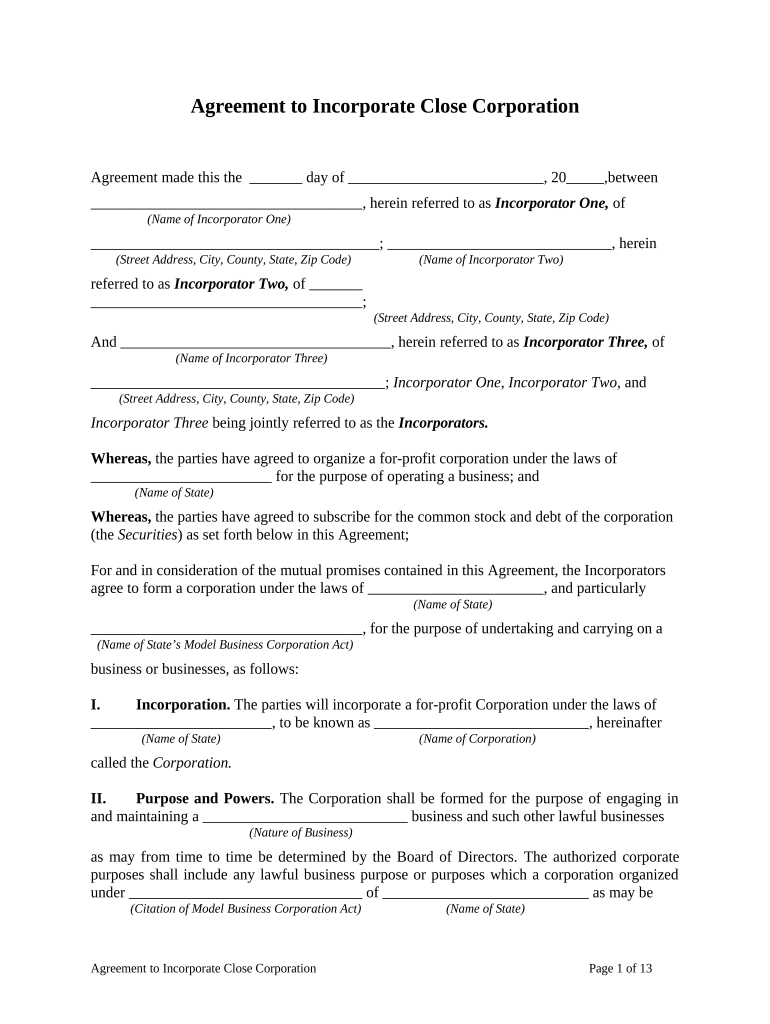
An Agreement to Incorporate Close Corporation is a written contract used when founders or existing owners agree to form a close corporation, a business entity with a limited number of shareholders and restricted transferability. The document records initial capital contributions, management and voting arrangements, share classes, restrictions on transfer, and buy-sell or redemption mechanisms. It also sets dispute-resolution and dissolution procedures, assigns responsibilities for pre-incorporation liabilities, and creates a framework for preparing and filing state incorporation documents and maintaining consistent internal corporate records.

Why a Clear Agreement Matters Before Incorporation

A written Agreement to Incorporate Close Corporation clarifies ownership, preserves control, and sets enforceable rules for transfers and buyouts. Early agreement reduces litigation risk, supports consistent governance, and helps ensure state filings, tax treatment, and investor expectations align with the parties’ intent.

Why a Clear Agreement Matters Before Incorporation

Who Typically Prepares and Signs This Agreement

Founders, small business owners, and advisors commonly prepare and review this agreement when organizing a close corporation.

  • Founders and sole proprietors establishing shareholder rules, capital obligations, and voting thresholds.
  • Family-owned businesses limiting transfers and protecting continuity across owners and generations.
  • Attorneys and CPAs reviewing governance, tax consequences, and enforceable buy-sell mechanisms prior to filing.

Primary Roles Involved

Founder

Founder — An individual or group forming the close corporation who needs to document capital contributions, voting rights, and transfer restrictions to preserve control and reduce future disputes among a small shareholder group.

Advisor

Advisor — Attorneys, accountants, and formation specialists who draft, review, and certify that the agreement aligns with state incorporation rules, tax planning, and enforceable corporate governance provisions.

Core Provisions You Should Expect

A professional Agreement to Incorporate Close Corporation organizes essential governance, financial, and dispute-resolution provisions into a single document for consistent application after incorporation.

Capital Contributions

Describes cash, property, or services each party contributes, timing of contributions, and capital account treatment to avoid ambiguity over ownership percentages and tax reporting.
Management Structure

Specifies whether management is board-driven or shareholder-managed, appointment procedures, officer roles, and decision thresholds for ordinary and extraordinary actions.

Share Transfer Rules

Includes restrictions on transfers, right-of-first-refusal, buyback obligations, and permitted transferees to preserve close-corporation character and limit outside investors.

Buy-Sell Provisions

Outlines events that trigger buyouts (death, disability, divorce, bankruptcy), valuation method, timing, and payment terms to ensure predictable ownership transitions.

Voting and Governance

Defines quorum, supermajority thresholds, special voting rights, and procedures for amending the agreement or adopting bylaws post-incorporation.

Dispute Resolution

Specifies mediation, arbitration, governing law, and venue to limit litigation costs and clarify how internal disputes will be resolved.

Step-by-Step: Prepare, Execute, and File

Follow these steps to complete the agreement, secure signatures, and file incorporation documents with the state.

  • 01
    Draft Agreement: Prepare terms, capital entries, and governance clauses.
  • 02
    Internal Review: Have legal and tax advisors verify terms and tax effects.
  • 03
    Signatures: Collect signatures, dates, and required initials from all parties.
  • 04
    State Filing: File articles of incorporation and retain executed agreement in corporate records.

Execution and Routing Overview

Typical routing includes review, signature collection, optional notarization, and final filing or storage steps.

  • Prepare Document: Upload final agreement and map signature fields.
  • Collect Signatures: Send to signers in defined order or via signing links.
  • Notarize If Required: Arrange in-person or RON when statutes require notarization.
  • File and Store: File incorporation forms and retain executed agreement securely.

Recommended Digital Workflow Settings

Configure these settings to reduce signer friction and preserve an audit trail for corporate records.

Field Configuration
Authentication Method Email plus SMS code for signer verification
Signature Order Sequential order for founding signers and officers
Notification Recipients CC legal counsel and corporate secretary for final copies
Storage Location Encrypted cloud storage with version-control audit trail

Platform and Technical Considerations

Confirm that your eSigning platform supports legal-quality audit trails, common file formats, and required authentication methods before initiating signatures.

  • File Formats: PDF and DOCX support
  • Integrations: CRM and storage connectors
  • Authentication: Email, SMS code, or stronger

Key Timing and Filing Deadlines to Track

Be mindful of effective dates, state filing windows, and any conditional deadlines that trigger buyouts or reporting obligations once the agreement executes.

Effective Date:

Establishes when obligations begin; use MM/DD/YYYY format.

State Filing Window:

File articles per state processing timelines to activate corporate status.

Tax Reporting Start:

Confirm start of tax year treatment with your CPA.

Buyout Trigger Deadlines:

Observe time limits for valuations and payment schedules.

Record Retention Start:

Retention periods run from execution and filing dates.

Milestone Timeline from Draft to Corporate Records

These sequential milestones show typical timeframes and actions from initial draft through final recordkeeping.

01

Drafting and Negotiation

Parties agree on terms and resolve open items.

02

Legal and Tax Review

Advisors confirm compliance and tax treatment.

03

Execution and Notarization

Signers execute; notarize if the state or document requires it.

04

Filing and Archival

File articles and store executed agreement in corporate records.

Common Preparation Pitfalls to Avoid

  • Using inconsistent party names across documents, which can delay bank and state registrations and create tax reporting issues.
  • Failing to define valuation methods in buy-sell provisions, producing disputes and litigation when a triggering event occurs.
  • Overlooking required notarization or witness rules that vary by state, which can render executions legally vulnerable.
  • Not coordinating tax and entity treatment with advisors, leading to unintended tax consequences after formation.

Short Risks and Consequences to Note

Invalid Signatures: May lead to unenforceability
Incorrect Entity Name: Can delay filings
Missing Notarization: Could require re-execution
TIN Errors: May trigger 24% backup withholding
Late Filing: Potential state penalties
Ambiguous Terms: Increase litigation risk

Security and Compliance Standards to Expect

Encryption: TLS 1.2/1.3 in transit
At-Rest Protection: AES-256 encryption
Audit Trail: IP, timestamp, action history
Certifications: SOC 2 Type II and ISO 27001
Regulatory Coverage: ESIGN, UETA, 21 CFR Part 11
HIPAA Support: BAA available for healthcare use

eSignature Vendor Pricing and Feature Snapshot

Comparison of starting price and key enterprise features relevant to executing and storing incorporation agreements; signNow listed first per vendor conventions.

signNow DocuSign Adobe Sign PandaDoc HelloSign
Starting Price $8/user/mo $15/user/mo $14/user/mo $19/user/mo $15/user/mo
Free Trial 7-day free trial Varies by plan Varies by plan Varies by plan Varies by plan
Bulk Send Yes (Business Premium) Varies by plan Varies by plan Varies by plan Varies by plan
Audit Trail Yes Yes Yes Yes Yes
HIPAA Compliant Yes (BAA available) Varies by plan Varies by plan Varies by plan Varies by plan
Envelope Cap No cap 100 envelopes/user/year Varies Varies Varies

Frequently Asked Questions About Execution and Validity

Answers to common questions about enforceability, notarization, electronic signatures, and post-execution changes for this agreement.


Need help? Contact support

be ready to get more
Join over 28 million airSlate SignNow users