Establishing secure connection…Loading editor…Preparing document…

Complaint Form

This template is fully customizable. Edit the text, fill out the fields, and send it for signature. Give it a try!
Complaint Form

What a Complaint Form Is and when it’s used

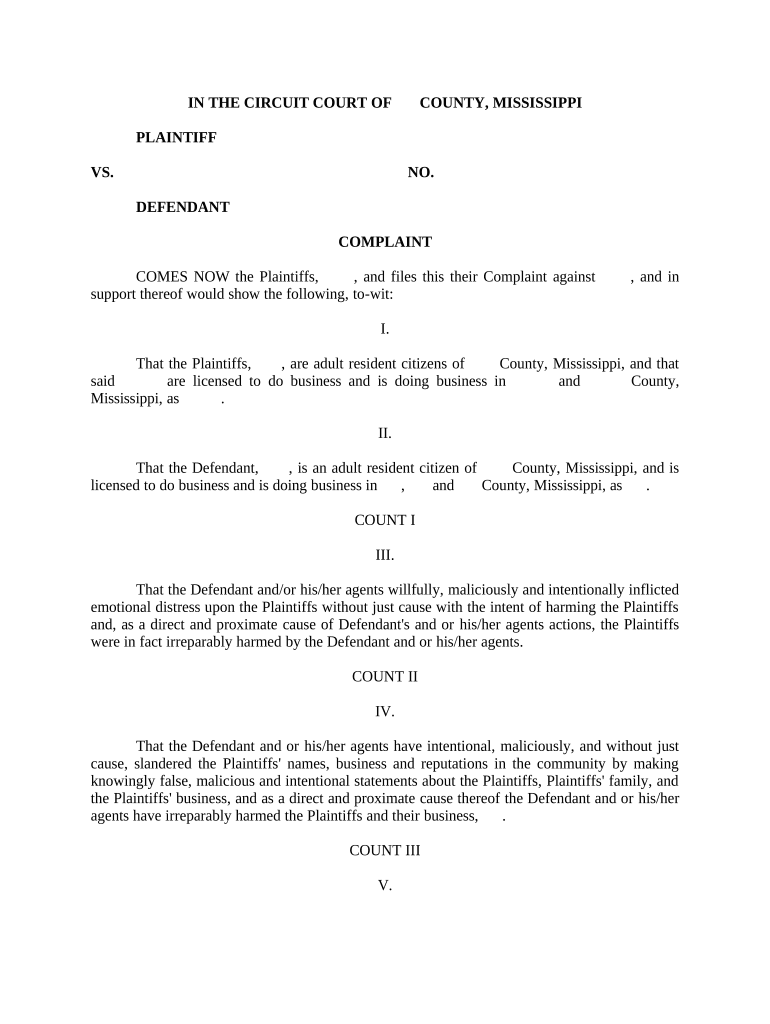
The Complaint Form is a standardized document used to record a formal grievance, allegation, or service failure and to initiate an organized response. It captures the complainant and respondent identities, incident dates, a factual narrative, witnesses, and supporting evidence. Completed forms create an auditable record that triggers intake triage, investigation, remediation, and retention actions. In regulated contexts the form must meet signature, privacy, and recordkeeping requirements to ensure admissibility and compliance with applicable U.S. laws.

Why a structured Complaint Form matters

A formal Complaint Form standardizes intake, preserves evidence, timestamps allegations, and clarifies responsibilities so organizations can investigate, document outcomes, and meet regulatory obligations such as ESIGN retention and sector-specific rules.

Why a structured Complaint Form matters

Who completes and receives Complaint Forms

Organizations and individuals use Complaint Forms to document grievances for internal review, HR, compliance, or external regulators.

  • Employees reporting workplace misconduct, discrimination, or safety concerns to HR or compliance.
  • Customers submitting service complaints, billing disputes, or product defect allegations to support resolution.
  • Regulated parties filing formal notices with agencies or third-party reviewers for investigation.

Common roles involved in a Complaint Form

Employee Complainant

An individual who files an internal complaint should provide precise dates, locations, witness names, and documentation. Accurate identification helps HR validate the claim, triggers internal investigation procedures, and determines whether statutory notifications or external reporting are required under employment or safety laws.

Agency Recipient

A compliance officer or regulator evaluates jurisdiction, severity, and mandatory reporting. The recipient logs the complaint, assigns an investigator, preserves chain-of-custody for evidence, and enforces timelines required by agency rules or statute.

Essential fields every Complaint Form should capture

Complainant Name: Full legal name as on ID
Contact Information: Phone, email, address for follow-up
Incident Date: Enter date as MM/DD/YYYY format
Description of Complaint: Concise factual narrative of events
Witnesses: Names and contact details if available
Supporting Documents: Attach copies: photos, emails, receipts

Risks and consequences of incorrect or incomplete forms

Delayed Investigation: Missed statutory deadlines
Evidence Loss: Insufficient documentation retention
Regulatory Penalties: Fines or mandatory corrective orders
Legal Exposure: Increased litigation risk
Data Privacy Breach: HIPAA or state privacy violation
Invalid Complaint: Incomplete signatures or dates

Common preparation mistakes that slow or invalidate complaints

  • Incomplete dates, vague descriptions, or missing witness details commonly delay investigations and may result in requests for supplemental information from the investigator.
  • Using informal language, emotional statements, or unverifiable assertions weakens credibility; focus on objective facts, observable actions, and direct evidence.
  • Failing to redact sensitive personal data or to obtain consent for medical records can create HIPAA compliance issues during review.
  • Submitting multiple inconsistent versions or unsigned attachments causes processing errors and can invalidate time-sensitive filings.

Step-by-step: complete and submit a Complaint Form

Follow these steps to complete and submit a Complaint Form accurately and efficiently to ensure timely review.

  • 01
    Gather Facts: Collect dates, locations, witnesses, and supporting evidence.
  • 02
    Fill Fields: Enter names, contact info, and precise incident details.
  • 03
    Attach Proof: Upload photos, emails, receipts, and relevant documents.
  • 04
    Sign & Submit: Sign, date, and send to the designated recipient.

How the submission and review flow typically works

The submission flow routes the Complaint Form from intake through review, investigation, and closure with audit logging at every step.

  • Intake: Record basic complaint details and attach documents.
  • Triage: Assess severity and assign investigation priority.
  • Investigate: Collect statements, review evidence, and document findings.
  • Resolution: Close with outcome, corrective actions, and notifications.

Recommended online workflow settings for eSubmission

Configure an online workflow to collect, authenticate, route, and store Complaint Forms electronically with traceable audit data.

Field Configuration
Authentication Method Email link, SMS code, or KBA
Signature Type Simple e-signature or digital certificate
Routing Rules Sequential approvers or role-based auto-assignment
Storage Location Encrypted cloud repository with audit trail

Platform capabilities to support secure Complaint Forms

Ensure the eSubmission platform supports secure authentication, AES-256 encryption at rest, TLS 1.2/1.3 in transit, and integrates with existing systems.

  • Authentication: Email, SMS, or stronger MFA
  • Encryption: AES-256 at rest; TLS 1.2/1.3 in transit
  • Integrations: Salesforce, NetSuite, Google Workspace, Box

Typical deadlines and response time expectations

Key deadlines and timeframes for filing, investigating, and responding to Complaint Forms vary by sector and applicable law.

Acknowledge receipt to complainant within timeframe:

Typically within 48 business hours of receipt

Begin investigation and assign investigator:

Start within 7 calendar days or as policy requires

Provide interim updates to complainant status:

Every 10 to 30 days depending on case complexity

Issue final report and corrective actions:

Issue final findings within 30 to 90 days in most cases

Regulatory reporting deadlines may apply:

Follow agency rules; some require immediate reporting or 30-day notices

Key lifecycle milestones for a Complaint Form

Major milestones show the end-to-end lifecycle from intake through closure with estimated timeframes for each stage.

01

Intake and Logging

Complaint recorded and initial triage completed within 48 hours.

02

Investigation Phase

Evidence collection, interviews, and analysis typically take 2 to 6 weeks.

03

Decision & Remediation

Outcome documented, remedies assigned, and notifications issued within 30 days.

04

Closure & Record Retention

Archive complaint, evidence, and audit trail according to retention policy.

Core components of a professional Complaint Form

A professional Complaint Form balances structured fields with space for narrative, attachments, and metadata to support reliable investigations and defensible records.

Header

Includes unique complaint ID, intake date, receiving department, and preferred contact method; these metadata points enable tracking, auditability, and linkage to case files and external reference numbers.
Parties

Lists complainant, respondent, witnesses, and their roles, plus accurate contact details; discrepancies here are a primary cause of invalid filings and delayed outreach during investigations.

Incident Details

Structured fields for date, time, location, and a concise factual description supported by checkboxes or dropdowns to standardize categorization for reporting and analytics across cases.

Evidence

Designated attachments section for documents, photos, audio, or video with clear file naming conventions and guidance on acceptable formats and maximum file sizes to preserve chain-of-custody.

Remedy Requested

A space to specify desired outcomes or remedies, whether corrective action, refund, apology, or policy change; helps triage and set reasonable expectations for resolution.

Signatures

Signature block with signer name, title, signature, date, and optional witness or notary fields; include consent to electronic records and reference to consumer disclosure where required by law.

Practical examples that illustrate effective Complaint Forms

These examples show how structured Complaint Forms support prompt investigation, defensible records, and compliant outcomes.

HR Incident

A mid-sized employer used a structured Complaint Form to log allegations of workplace harassment with dates, witnesses, and attachments for HR review.

  • Immediate intake reduced follow-up queries and preserved evidence.
  • HR investigators accessed attachments, conducted prompt interviews, and produced a written report documenting findings and corrective actions, enabling defensible decisions while reducing legal exposure and ensuring policy compliance.

Healthcare Privacy

A clinic received a patient complaint alleging improper disclosure; the Complaint Form captured PHI controls, consent status, and exact records requested for review.

  • Form included consent fields and BAA information.
  • The clinic invoked HIPAA incident response, retained logs for six years per 45 CFR §164.530(j), coordinated with counsel, and updated staff training to prevent recurrence.

Best practices to improve accuracy and reduce processing time

Adopt these practical practices to improve complaint quality, reduce processing time, and strengthen investigatory outcomes.

Keep narratives factual, concise, and chronological
Describe events in order, include timestamps, identify actions and outcomes, and avoid subjective commentary. Objective narratives reduce dispute over facts and help investigators determine next steps without repeated clarification requests.
Attach original documents and preserve metadata
Upload originals whenever possible; maintain file names, timestamps, and sender metadata. Preserving original formats and metadata helps prove authenticity during audits or legal proceedings and prevents challenges to the evidentiary chain.
Document your investigative steps and communications
Keep an investigation log noting interviews, evidence requests, analysis, and outcomes. Record dates, participants, methods, and decisions to create an auditable trail that supports findings and demonstrates adherence to policy and regulatory obligations.
Protect sensitive data and comply with privacy law
Limit PHI and other sensitive data to authorized personnel, use redaction where appropriate, and ensure any vendor handling health or financial data has a BAA or suitable data protection agreement in place.

Compare eSignature plans and features relevant to Complaint Forms

Compare common eSignature plan features and pricing to evaluate options for processing Complaint Forms electronically.

signNow DocuSign Adobe Sign PandaDoc HelloSign
Starting Price $8/user/mo $15/user/mo $14/user/mo $19/user/mo $15/user/mo
Free Trial Yes, 7-day trial Varies Varies Varies Varies
Bulk Send Yes Yes Yes Yes No
Audit Trail Yes Yes Yes Yes Yes
HIPAA Compliant Yes Yes Yes No No
Envelope Cap No envelope cap 100 envelopes/user/year Varies Varies Varies

Frequently asked questions about Complaint Forms

Answers to common questions about filling, signing, submitting, and preserving Complaint Forms, focusing on U.S. legal and eSignature considerations.


Need help? Contact support

be ready to get more
Join over 28 million airSlate SignNow users