Establishing secure connection…Loading editor…Preparing document…

Delaware Series G Convertible Preferred Stock Subscription Agreement

This template is fully customizable. Edit the text, fill out the fields, and send it for signature. Give it a try!
Delaware Series G Convertible Preferred Stock Subscription Agreement

What this Delaware Series G Convertible Preferred Stock Subscription Agreement is

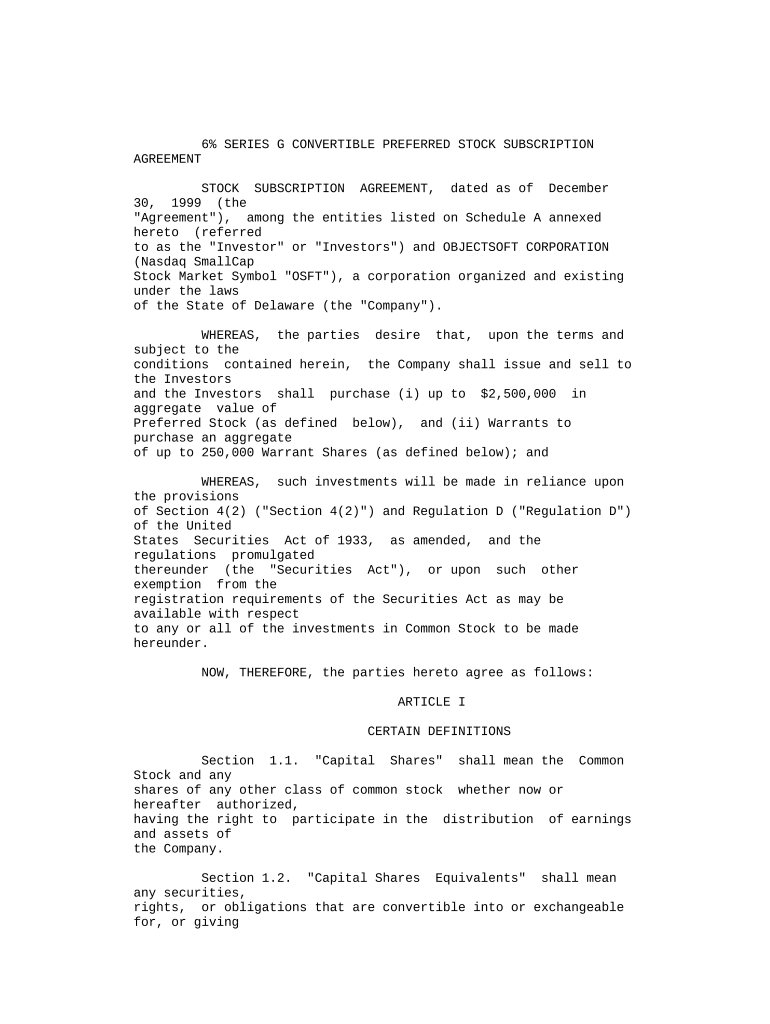
A Delaware Series G Convertible Preferred Stock Subscription Agreement is a legally binding contract used when investors agree to purchase convertible preferred shares issued by a Delaware corporation. The agreement documents the number of shares, purchase price, conversion mechanics, liquidation preferences, voting and dividend rights, transfer restrictions, representations and warranties, and closing conditions. It governs the investor’s obligations to pay and the company’s obligations to issue shares, and it often references the corporation’s certificate of incorporation and any investor rights agreement or stockholders agreement that affect conversion or transfer.

Why this agreement matters to issuers and investors

The subscription agreement creates a clear record of the investment terms, protects parties through reps and warranties, and sets conversion and exit mechanics. It reduces ambiguity at closing, ties into corporate governance documents, and helps demonstrate compliance with securities laws and internal corporate approvals.

Why this agreement matters to issuers and investors

Who typically prepares and signs these subscription agreements

Documents typically require coordinated review by counsel, finance, and company officers prior to execution and funding.

  • Founders and management completing capital raises and ensuring corporate approvals are documented.
  • General counsels and outside corporate counsel preparing tailored terms and securities compliance language.
  • Accredited individual and institutional investors confirming purchase terms, conversion rights, and transfer restrictions.

Primary signers and their roles

Company Officer

Chief Financial Officer or Chief Executive Officer executes on behalf of the issuer after board approval; responsible for confirming share issuance, updating the stock ledger, and coordinating closing deliverables with legal counsel and transfer agent.

Investor Representative

Named purchaser or authorized signatory signs for the investor entity; responsible for delivering payment, TIN/W9 information, and any required investor representations for securities law safe harbors.

Key clauses you will find in a professional subscription agreement

A complete agreement covers purchase mechanics, investor representations, company representations, conversion and liquidation terms, closing conditions, and transfer restrictions to ensure enforceability and alignment with governing corporate documents.

Subscription Terms

Specifies shares subscribed, purchase price per share, aggregate payment, and method and timing of funding including wire instructions and conditions for acceptance.
Representations

Investor and company representations include authority, accuracy of disclosed information, absence of conflicts, and investor status for applicable exemptions from registration.

Conversion Mechanics

Describes conversion ratio, events triggering conversion, adjustments for stock splits and dividends, and whether conversion is automatic or optional.

Liquidation Preference

Defines seniority on liquidation, payout multiple, participation terms, and allocation of proceeds among series and common shareholders.

Transfer Restrictions

Includes lockups, right of first refusal, piggyback rights, and legend requirements to preserve exemptions under federal and state securities laws.

Closing Conditions

Lists actions required at closing: board resolutions, officer certificates, legal opinions (if any), delivery of funds, and updated shareholder registers.

Step-by-step sequence for completing and closing a subscription

Follow these ordered steps to move from offer to issuance with minimal friction.

  • 01
    Prepare: Draft the subscription form and confirm certificate of incorporation provisions.
  • 02
    Review: Counsel reviews securities exemptions and investor reps.
  • 03
    Execute: Parties sign and deliver payment per wire instructions.
  • 04
    Issue: Company records issuance, updates the stock ledger, and delivers share certificates or electronic evidence.

Operational checklist for administrative and legal tasks

Use this grid to coordinate legal, financial, and corporate record updates at each stage of the transaction.

01

Board Approval:

Obtain board resolution authorizing issuance and approving terms.
02

Due Diligence:

Complete investor KYC and legal due diligence where required.
03

Wire Funds:

Confirm cleared funds per bank instructions.
04

Stock Ledger:

Record share issuance and update capitalization table.
05

Securities Filings:

Prepare any required Form D or state notices.
06

Deliverables:

Provide confirmation, share certificates, and executed agreements to parties.

Typical online workflow settings for digital completion

Configure your e-signing workflow to capture signatures, dates, and supporting documents in correct order.

Field Configuration
Signature Field Assign to investor and company signers; required
Date Field Auto-fill with signer-entered MM/DD/YYYY
Supporting Docs Require W-9 or entity formation documents upload
Authentication Use email + access code or stronger MFA when needed

How digital execution and routing typically operate

A clear routing flow reduces signer friction and creates an auditable trail for regulators and internal records.

  • Upload: Issuer uploads the fully negotiated document to the e-sign platform.
  • Assign: Place signature, date, and attachment fields for each party.
  • Authenticate: Signers receive link and complete authentication step.
  • Complete: Signed copies and audit trail are generated and stored.

Digital signing and format considerations

Ensure the provider meets compliance needs (ESIGN, UETA, and industry-specific rules) and can produce a reproducible record of the transaction.

  • File Formats: PDF and DOCX supported for template fidelity
  • Integrations: Connectors for NetSuite, Salesforce, and Google Workspace
  • Authentication: Email code, SMS, or advanced signer verification

Download, supporting documents, and export options to include

Provide signed agreements and supporting exhibits in multiple formats for legal records, accounting, and investor relations.

Signed Agreement

Deliver a final signed PDF with embedded audit trail and timestamps to each party for their records and corporate minutes.

Exhibits

Include investor certifications, W-9 or W-8BEN as applicable, board resolutions, and legal opinions if required.

Cap Table Update

Export cap table changes to CSV or Excel and circulate to relevant internal stakeholders for reconciliation.

Retention Copy

Store a long-term archival copy in PDF/A format and retain accessible backups for compliance review.

Practical tips for accurate and efficient completion

Applying these practices reduces closing delays and avoids common post-closing disputes.

Pre-validate investor status
Confirm accredited investor status and obtain required certifications in advance to rely on private placement exemptions and avoid securities law violations.
Standardize wiring instructions
Publish consistent wire instructions and verification procedures to prevent fraud, and require dual verification for large transfers.
Coordinate corporate approvals
Obtain board resolutions and authorized signatory confirmations before sending subscriptions for signature to ensure the company can legally issue shares.
Keep a single source of truth
Use one master document and track changes; reconcile the executed version with certificate of incorporation and investor rights agreements to avoid conflicting provisions.

Key milestones in the subscription and issuance timeline

Track these numbered stages to ensure timely performance and accurate recordkeeping.

01

Offer Date

Investor signs subscription and delivers executed document prior to funding.

02

Funding Deadline

Investor must wire funds by specified date or the offer expires.

03

Closing Date

Company accepts subscription, issues shares, and records issuance.

04

Post-Closing Compliance

File Form D and applicable state notices if relying on Regulation D exemptions.

Time-sensitive dates and typical processing expectations

Monitor these deadlines to avoid tax or regulatory penalties and to ensure a clean closing.

Effective Date:

The formal MM/DD/YYYY when rights and obligations commence.

Acceptance Period:

Company often sets a limited window (for example, 5–10 business days) to accept a subscription.

Wire Settlement:

Funds typically must clear by the closing date; same-day or next-business-day settlement is common.

Form D Filing:

File Form D within 15 days of first sale for Regulation D reliance (SEC rule practice).

Tax Reporting:

Provide investor data needed for tax forms (e.g., year-end statements) in time for reporting deadlines.

Pricing snapshot for common eSignature vendors (signNow first)

Compare starting prices and key availability items across vendors. Verify vendor plans for enterprise features or volume pricing specific to your use case.

signNow DocuSign Adobe Sign PandaDoc HelloSign
Starting Price $8/user/mo $15/user/mo $14/user/mo $19/user/mo $15/user/mo
Free Trial 7-day free trial Varies Varies Varies Varies
Bulk Send Yes Yes Yes Yes Varies
Audit Trail Yes Yes Yes Yes Yes
HIPAA Compliant Yes Yes Yes Varies Varies
Envelope Cap No cap 100 envelopes/user/year Varies Varies Varies

Security, encryption, and compliance posture for electronic execution

Encryption: TLS 1.2/1.3 in transit; AES-256 at rest
SOC2: SOC 2 Type II available on request
HIPAA: HIPAA-compliant with BAA available
21 CFR Part 11: Supports 21 CFR Part 11 controls
ESIGN / UETA: Compliant with ESIGN and UETA rules
ISO: ISO 27001 certified

Penalties and risks of errors or noncompliance

Securities Violations: Civil and regulatory penalties
Tax Consequences: Incorrect reporting or missing forms
Contract Invalidity: Missing signature may void transaction
Wire Fraud: Financial loss without verification
Delays: Funding or issuance postponement
Investor Disputes: Potential litigation or arbitration

Common mistakes to avoid when preparing subscriptions

  • Using inconsistent entity names between subscription and formation documents, which can prevent issuance and require corrective amendments.
  • Failing to confirm investor accreditation or exemptions, risking violation of federal or state securities laws.
  • Missing board resolutions or corporate approvals before acceptance, leaving the company unable to legally issue shares.
  • Relying on unsecured payment verification procedures, which can expose parties to wire fraud or payment disputes.

Real-world examples of subscription agreement use

Two anonymized summaries show how companies and investors commonly use these agreements during financing rounds.

Early-Stage Fundraise

A startup executed Series G pre-money negotiation online to accelerate close.

  • Investor wired funds within the required window.
  • The company updated its stock ledger and issued electronic evidence, reducing administrative lag and ensuring accurate cap table reconciliation.

Institutional Placement

An institutional investor required customized conversion terms and legal reps.

  • Parties exchanged redlines over counsel and used digital signatures for final execution.
  • The issuer recorded the transaction, filed Form D where applicable, and delivered closing materials to the investor promptly.

Frequently asked questions about subscriptions and execution

Answers address practical signing, enforceability, and recordkeeping questions commonly raised by issuers and investors.


Need help? Contact support

be ready to get more
Join over 28 million airSlate SignNow users