Claimant
Name, business entity type, mailing and service addresses, and a contact person with phone and email for follow‑up and proof of service.
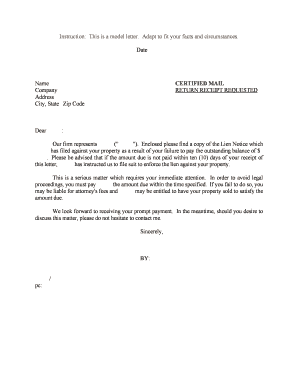
A well‑prepared Demand Letter Lien creates a clear record of the claim and gives the debtor formal notice required by many lien statutes. It can trigger statutory deadlines, improve prospects for voluntary payment, and strengthen evidentiary support for later lien recording or litigation.

Several professional roles prepare and send these notices; recipients include private and commercial debtors and title holders.
Proper preparation reduces procedural risk and supports downstream filing or enforcement steps when statutory timelines apply.
Name, business entity type, mailing and service addresses, and a contact person with phone and email for follow‑up and proof of service.
Full legal name of the debtor, any trade names, and the property owner or contract counterparty that holds title or payment responsibility.
Specific dollar amount claimed, itemized if possible, with invoice numbers, dates, and a short calculation of how the total was reached.
Legal or contractual grounds for the lien claim (for example, unpaid construction work, materials supplied, or contract breach) and citation to the controlling statute if known.
Sufficient description to identify the encumbered property: street address, parcel number, legal description, or contract identifying information.
Clear demand language specifying a cure period, the action to be taken if not cured, and instructions for payment or dispute submission.
| Field | Configuration |
|---|---|
| Delivery Method | Email + certified mail where statute requires proof |
| Authentication | Email link or SMS code for signer verification |
| Retention | Store signed PDF and audit trail for retention period |
| Notifications | Automatic reminders before cure deadline |
Use an eSignature platform that supports secure signing, a tamper-evident audit trail, and PDF exports acceptable to recorders or courts.
Verify that the chosen platform provides retention, audit logs (IP, timestamp), and any industry compliance (for example, HIPAA BAA when health data is involved) required for evidentiary use.
Some states require notice days before filing; confirm local law
Mechanics/liens typically have a months-long filing window post-completion
Set a clear cure deadline in the demand letter (commonly 10–30 days)
After filing, pursue enforcement timelines per state statute
Preserve claims within the applicable limitations period
| Document Type | Demand Letter Lien | Mechanics Lien |
|---|---|---|
| Purpose | notice and demand | create a public encumbrance |
| Timing | often pre‑filing | filed within statutory window |
| Filing Required | usually not recorded | recording required |
| Typical Remedy | payment or negotiation | foreclosure or judgment |
| signNow | DocuSign | Adobe Sign | PandaDoc | HelloSign | |
|---|---|---|---|---|---|
| Starting Price | $8/user/mo | $15/user/mo | $14/user/mo | $19/user/mo | $15/user/mo |
| Free Trial | 7-day free trial | Varies by plan | Varies by plan | Varies by plan | Varies by plan |
| Bulk Send | Yes (Premium/above) | Yes | Yes | Yes | Yes |
| Audit Trail | Yes | Yes | Yes | Yes | Yes |
| HIPAA Compliant | Yes | Yes | Yes | No | No |
A subcontractor sent a detailed demand letter with invoices and delivery receipts
A landlord issued a demand letter for unpaid rent listing lease defaults and cure options
A project manager or authorized company officer signs to attest to amounts claimed and service details; their signature ties internal records to the public notice and supports later enforcement.
An attorney signs or prepares the demand to reflect legal review, often including statutory citations and a formalized cure period to demonstrate readiness to enforce rights.
Prepare and serve the demand with proof of delivery.
Allow the statutory or contractual cure window to elapse.
Record the lien within the state filing deadline when unpaid.
Initiate foreclosure or suit if necessary after filing.