Establishing secure connection…Loading editor…Preparing document…

Minutes of Organizational Meeting of Directors

This template is fully customizable. Edit the text, fill out the fields, and send it for signature. Give it a try!
Minutes of Organizational Meeting of Directors

What the Minutes of Organizational Meeting of Directors Are

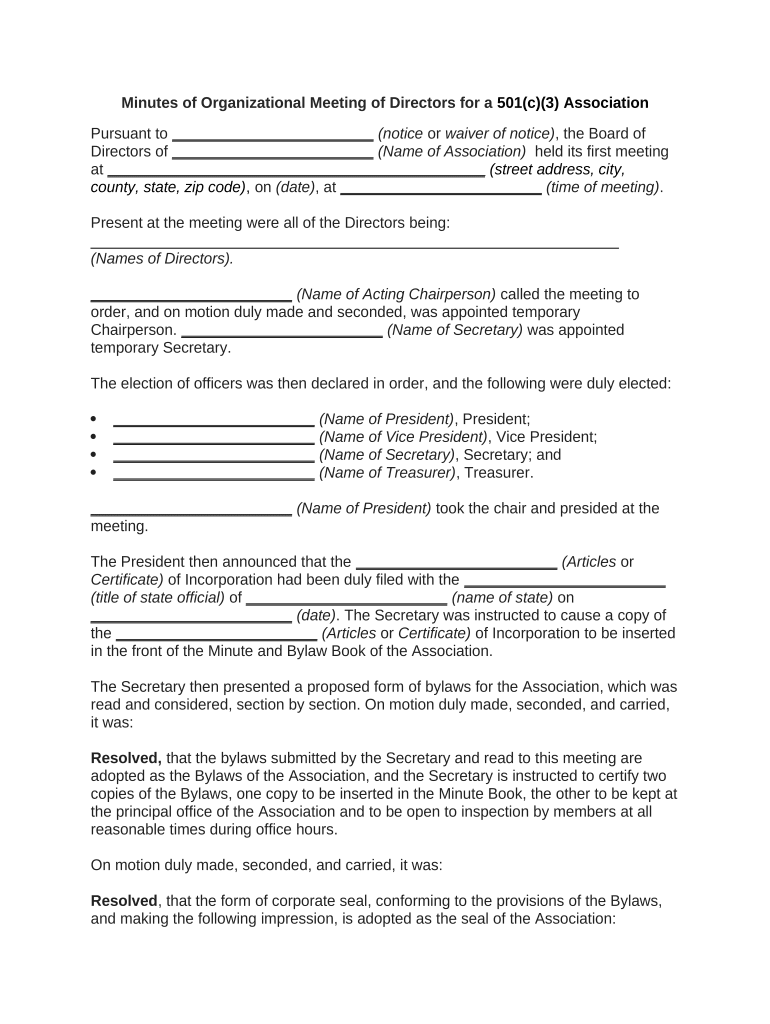
The Minutes of Organizational Meeting of Directors is a formal corporate record that documents the initial board meeting held after incorporation or formation. It captures the agenda, resolutions adopted (for example, approval of bylaws, election of officers, authorization to open bank accounts, and stock or membership issuances), names of directors and attendees, and any delegated powers. These minutes establish corporate action taken at organization, support later filings, and serve as evidence of authority for third parties. The document is retained in the corporate minute book and should be signed and dated by the meeting chair or secretary.
Why Complete Clear Organizational Minutes

Well-drafted organizational minutes provide legal proof of board action, clarify authority for officers, and support compliance with corporate formalities required by state law and investors. They reduce future disputes by preserving contemporaneous decisions and provide third parties with documented evidence of corporate powers.

Why Complete Clear Organizational Minutes

Who Prepares and Relies on Organizational Minutes

Corporate secretaries, newly elected officers, founders, and outside counsel commonly prepare or review organizational meeting minutes for recordkeeping and legal compliance.

  • Startups and small corporations: record bylaws adoption, officer elections, initial resolutions, and capitalization actions for legal evidence.
  • Corporate secretaries and legal teams: maintain minute books, prepare signatures, and coordinate formal filings with state agencies and banks.
  • Investors, lenders, and title agents: rely on minutes to confirm authority for banking, security agreements, and closing transactions.

Typical Roles Involved

Corporate Secretary

Typically responsible for drafting and maintaining the corporate minute book, the corporate secretary records all organizational actions, circulates signed copies to directors and officers, and ensures minutes meet statutory requirements and internal governance policies. They coordinate with counsel for legal accuracy.

Outside Counsel

Outside counsel often reviews minutes for legal sufficiency, drafts resolution language, advises on state-specific corporate formalities, and prepares attestations when necessary. Counsel's review reduces risks of defective corporate acts and supports due diligence during investment or financing transactions.

Core Sections That Make Minutes Effective

Essential sections ensure minutes are complete, legally defensible, and useful for governance, financing, and third-party verification purposes over the corporation's lifecycle.

Meeting Information

Include meeting date, start and end times, exact location, method (in-person or remote), and notice details. Recording these elements supports statutory notice requirements and provides context for corporate actions taken during the session.

Attendance

List directors, officer attendees, and any guests or advisers present. Note absences and proxies. Accurate attendance records are critical for quorums, vote validity, and later verification in corporate governance or due diligence reviews.

Resolutions

Record each resolution verbatim or in clear concise language, including who moved and seconded, the exact voting results, and any conditions or effective dates. Attach exhibits or drafts referenced during motion.

Officer Elections

Document elections of officers with titles, names, and effective dates. Note any term lengths or interim appointments. Such records prove authority for signing contracts, opening accounts, and executing obligations on behalf of the corporation.

Financial Authorizations

Include formal resolutions to open bank accounts, authorize signatories, approve initial capital contributions, and set accounting policies. Banks and auditors frequently require documentary evidence of these authorizations.

Adjournment & Signatures

Record the time of adjournment and any follow-up actions assigned. Provide signature blocks for the meeting chair and corporate secretary, with printed names, titles, and dates to authenticate the record.

Step-by-Step: Prepare and Finalize the Minutes

Follow these steps to prepare, approve, and store minutes of the organizational board meeting effectively.

  • 01
    Prepare Agenda: List items: bylaws, officers, banking, capitalization
  • 02
    Record Meeting: Note motions, seconds, votes, and material discussion
  • 03
    Adopt Resolutions: Record exact resolution language and vote tallies
  • 04
    Sign & File: Chair and secretary sign; file in minute book

How Minutes Move from Draft to Permanent Record

Organizational minutes move from drafter to board approval, signature, and permanent minute book retention with copies provided to stakeholders.

  • Draft: Secretary prepares minutes immediately after meeting
  • Review: Directors review text for accuracy and completeness
  • Approve: Board formally adopts minutes by motion and vote
  • Store: Signed originals returned to corporate minute book

Online Workflow Settings for Minutes Preparation

Suggested online configuration options for creating, routing, and authenticating organizational minutes before signature and archival.

Field Configuration
Authentication Email link; SMS code; KBA for higher assurance
Signature Type Simple e-signature or PKI-based digital signature
Routing Order Sequential signer order or parallel routing
Storage PDF archival with audit trail and access controls

Technical Requirements for Delivery and Storage

For eSubmission and distribution, consider authentication, format compatibility, integration with corporate systems, and retention policies.

  • Formats Supported: PDF, DOCX, and editable fields
  • Integrations: Salesforce, NetSuite, Google Workspace, Microsoft 365
  • Security: AES-256 at rest; TLS 1.2/1.3 in transit

Timing Best Practices for Minutes and Related Actions

Key timing considerations for preparing and distributing organizational minutes and related filings. Prepare promptly after the meeting to preserve accuracy and support immediate banking or compliance actions.

Draft within 7 days:

Draft minutes within one week of meeting

Provide copies within 14 days:

Distribute approved copies to officers and counsel within two weeks

File corporate records:

File originals in minute book and retain electronic backups

Banking evidence ready:

Provide certified copies to banks when opening accounts

Retain for audits:

Keep minutes for statutory retention and audits

Key Milestones from Meeting to Archival

A typical milestone sequence shows how minutes progress from the initial meeting record to final archival and long-term retention.

01

Record Meeting

Prepare accurate draft immediately after the meeting

02

Board Review

Directors review and request edits within days

03

Formal Adoption

Board adopts minutes by recorded vote

04

Archive

Signed originals stored in minute book and backups

Common Pitfalls When Preparing Minutes

  • Using vague language for resolutions, such as 'approved generally,' which complicates enforcement and third-party reliance.
  • Failing to record votes and roll call results, leaving ambiguity about director support and individual dissent later.
  • Not documenting conflicts of interest or recusal decisions, increasing exposure to fiduciary breach claims later.
  • Retaining unsigned or undated minutes, which weakens evidentiary value and undermines formal adoption by board.

Risks of Incomplete or Missing Minutes

Loss of Liability Shield: Failure to record corporate acts risks piercing corporate veil
Third-Party Rejection: Banks or title agents may refuse authority proof
Investor Disputes: Unclear records increase litigation and fiduciary claims
Regulatory Noncompliance: State law may impose fines or corrective actions
Contractual Invalidity: Undocumented decisions can void agreements
Audit Issues: Incomplete minutes cause reconstruction challenges during audits

Required Information to Include in the Minutes

Meeting Date: MM/DD/YYYY format, include start and end times
Location: Street address, city, state, and ZIP
Directors Present: Full legal names and roles (attendee list)
Officers Elected: Titles and incumbents with effective dates
Resolutions Adopted: Brief resolution text and vote result
Signatures & Dates: Chair and secretary print, sign, and date

eSignature Pricing and Feature Snapshot for Minutes

Pricing and feature overview for common eSignature vendors relevant to signing, approving, and storing organizational minutes.

signNow DocuSign Adobe Sign PandaDoc HelloSign
Starting Price $8/user/mo $15/user/mo $14/user/mo $19/user/mo $15/user/mo
Free Trial 7-day free trial Varies by vendor Varies by vendor Varies by vendor Varies by vendor
Bulk Send Yes Yes Yes Yes No
Audit Trail Yes Yes Yes Yes Yes
HIPAA Compliant Yes Yes Yes No No

Representative Use Cases

Real-world examples show how minutes support transactions, compliance, and third-party reliance across organizations.

Startup Formation

A newly formed LLC recorded officer elections and capitalization terms

  • Quick adoption of bylaws allowed bank account opening
  • Certified minutes provided to investors and banking partners during initial funding and compliance checks.

Real Estate Closing

An LLC board authorized a manager to sign a deed and mortgage

  • Resolution included exact signing authority and vote tally
  • Title company required a certified copy and secretary certificate to complete the closing.

Minutes vs. Written Consent: Key Differences

Compare organizational minutes to written consents to understand differences in formality, evidentiary use, and third-party reliance.

Criteria Minutes Written Consent
Authenticity recorded at meeting signed record without meeting
Witness/Notary usually not notarized notarization rare
Use Case perpetual record of decisions rapid board action without meeting
Filing not filed with state not typically filed

FAQs: Drafting, Signing, and Storing Minutes

Answers to frequent questions about drafting, signing, and maintaining organizational meeting minutes for U.S. corporations.


Need help? Contact support

be ready to get more
Join over 28 million airSlate SignNow users