Establishing secure connection…Loading editor…Preparing document…

Mississippi Motion to Dismiss for Lack of Jurisdiction

This template is fully customizable. Edit the text, fill out the fields, and send it for signature. Give it a try!
Mississippi Motion to Dismiss for Lack of Jurisdiction

What the Mississippi Motion to Dismiss for Lack of Jurisdiction Is

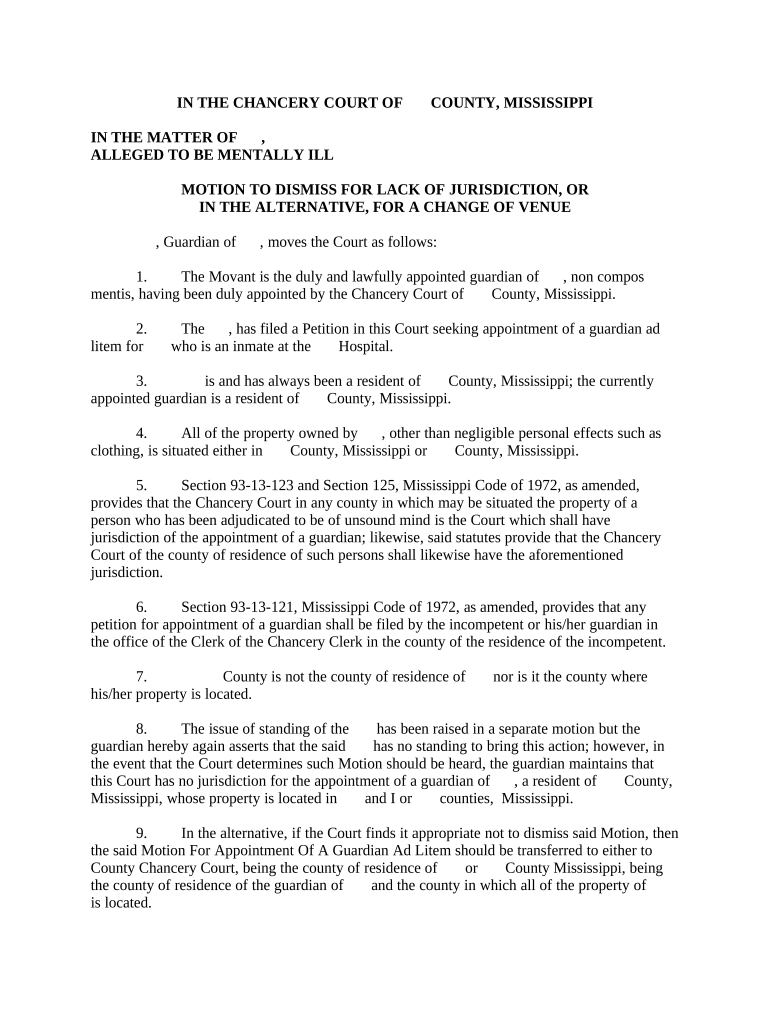
A Mississippi Motion to Dismiss for Lack of Jurisdiction is a formal pleading filed in state or federal court asking the judge to dismiss a case because the court lacks authority over the person, subject matter, or venue. The motion explains legal and factual grounds showing jurisdiction is absent, cites governing procedural rules, and requests dismissal without reaching the case merits. In federal court this defense typically arises under Federal Rule of Civil Procedure 12(b)(2); in state court similar timed objections must be raised promptly or they may be waived.

Why this motion matters in Mississippi litigation

A timely, well-supported jurisdictional motion can end a case early, avoid discovery costs, and preserve appellate rights. It focuses the court on whether the forum is legally appropriate before parties invest in full litigation, protecting defendants from being forced to litigate in an improper forum.

Why this motion matters in Mississippi litigation

Who commonly prepares or files this motion

Preparation usually requires factual investigation, jurisdictional research, and precise pleading to avoid waiver of the defense.

  • Defense attorneys representing individuals or entities facing out-of-state claims in Mississippi.
  • In-house counsel for businesses served with litigation outside their principal place of business.
  • Pro se defendants served in Mississippi who seek early dismissal on jurisdictional grounds.

Who signs and files the motion

Defense Attorney

A licensed attorney admitted to practice in the relevant Mississippi court or federal district signs the motion, certifies legal research and service, and typically files via the court's electronic filing system or by hand at the clerk's office.

Corporate Representative

Authorized in-house counsel or an officer with litigation authority may approve and direct filing; an attorney usually files and enters an appearance to preserve procedural defenses.

Essential parts of a professional motion

A complete Motion to Dismiss for Lack of Jurisdiction combines procedural headings, factual support, and legal argument to persuade the court to decline adjudication.

Caption

Court name, case number, parties, and title clearly identifying the pleading as a Motion to Dismiss for Lack of Jurisdiction with proper party designations.
Statement of Facts

Concise factual summary setting out service details, contacts with Mississippi, and facts relevant to personal or subject-matter jurisdiction.

Legal Grounds

Specific grounds asserted (lack of personal jurisdiction, subject-matter jurisdiction, improper venue) with citations to controlling authority.

Affidavit or Declaration

Sworn or sworn-equivalent statements from witnesses or corporate officers supporting factual assertions about contacts and jurisdictional facts.

Authorities and Argument

Organized legal analysis applying jurisdictional law to the facts, addressing plaintiff's allegations and distinguishing contrary cases.

Prayer for Relief

Clear request that the court dismiss the action (with or without prejudice) and for any appropriate costs or sanctions.

Step-by-step: prepare and file the motion

Follow these sequential steps to draft, support, and file a jurisdictional motion with attention to timing and proof.

  • 01
    Review Complaint: Confirm service date and jurisdictional allegations in the complaint.
  • 02
    Legal Research: Identify controlling personal and subject-matter jurisdiction law.
  • 03
    Draft Motion: State facts, legal argument, and request for dismissal.
  • 04
    File and Serve: File with clerk and serve opposing counsel per rules.

How to adapt the motion to an online workflow

Configure e-filing and e-signature steps so filings meet court format and authentication expectations.

Setting | Value Field or step | Recommended configuration
Document Format PDF/A, text-searchable, single file for exhibits
Signature Method Typed or digital signature with audit trail
Service Method Email plus certified mail if required
Filing Portal Use court CM/ECF or state e-filing system

Where to file and how documents move through the system

Filing paths vary by court; follow the clerk's e-filing rules and state procedure for proof of service.

  • Court Clerk: Primary recipient via e-filing portal or in-person submission.
  • Opposing Counsel: Serve counsel by agreed method and document service on the record.
  • Electronic Record: Court docket entry and attached PDF accessible to parties.
  • Certificate of Service: Filed to demonstrate proper delivery and timing.

Technical and security requirements for electronic submission

Integrations with common platforms (for example, ECF, Google Drive, NetSuite) and secure storage reduce friction while maintaining an audit trail.

  • File Format: PDF/A preferred
  • Transport Security: TLS encryption in transit
  • Authentication: Audit trail and signer attribution

Common timing considerations and response windows

Timing for filing a jurisdictional motion affects waiver and subsequent briefing deadlines; verify the applicable local and federal rules.

Initial Response Window:

File the motion by the deadline to answer or before filing an answer.

Federal Rule Timing:

A pre-answer Rule 12 motion usually precedes the 21-day answer deadline.

Briefing Schedule:

Courts set service, response, and reply deadlines after filing.

Hearing Date:

Judge may schedule oral argument weeks after briefing closes.

Appeal Timing:

Dismissal for lack of jurisdiction is immediately appealable in many instances.

Key milestones after filing the motion

Track these numbered stages so filings, service, and hearings proceed without procedural lapses.

01

Motion Filed

Court receives and docket entry is created; service must follow local rules.

02

Response Due

Opposing party files response per court or scheduling order.

03

Reply Filed

Movant may file a reply brief if permitted by rules.

04

Oral Argument

Court may decide on briefs or set a hearing for argument.

Consequences of getting the motion wrong

Waiver Risk: Failure to timely assert jurisdictional defenses may waive them.
Default Exposure: Mistimed motions can disrupt defensive strategy and lead to default judgments.
Sanctions: Frivolous or dilatory motions risk fee shifting or sanctions.
Appeal Limitations: Incorrect claims may limit appellate remedies.
Increased Costs: Additional briefing and discovery raise litigation expenses.
Loss of Forum: Dismissal without prejudice can require refiling in a different forum.

Common drafting and filing errors to avoid

  • Relying on conclusory jurisdictional assertions rather than specific facts demonstrating lack of contacts with Mississippi.
  • Failing to attach supporting affidavits or declarations that state facts under penalty of perjury.
  • Missing procedural deadlines or filing the motion after filing an answer, which can waive the defense.
  • Improper service or failure to file a certificate of service as required by local rules.

Two real-world scenarios illustrating use

These examples show typical fact patterns where a motion to dismiss for lack of jurisdiction succeeds or requires careful proof.

Out-of-State Contractor

A contractor with minimal Mississippi contacts was sued in a Mississippi county court.

  • The defendant submitted affidavits showing no purposeful activities in Mississippi.
  • The court granted dismissal after finding plaintiff failed to establish minimum contacts sufficient for personal jurisdiction, avoiding costly discovery and preserving defendant's right to litigate elsewhere.

Forum Non Conveniens

A multinational corporation was sued in Mississippi despite central operations abroad.

  • The motion argued convenience and available alternative forum.
  • The court dismissed on jurisdictional and forum non conveniens grounds, allowing plaintiff to refile in the proper jurisdiction and protecting defendant from unfair forum selection.

eSignature vendor comparison for preparing and executing filings

Comparison of common plan features useful when choosing an eSignature provider to prepare affidavits, certificates of service, and exhibits. signNow is listed first per platform comparison standards.

signNow DocuSign Adobe Sign PandaDoc HelloSign
Starting Price $8/user/mo $15/user/mo $14/user/mo $19/user/mo $15/user/mo
Free Trial 7-day free trial Varies Varies Varies Varies
Bulk Send Yes Yes Yes Yes No
Audit Trail Yes Yes Yes Yes Yes
HIPAA Compliant Yes Varies Varies No No

FAQs and common procedural questions

Answers to frequent questions about timing, evidence, and electronic submission for a Mississippi Motion to Dismiss for Lack of Jurisdiction.


Need help? Contact support

be ready to get more
Join over 28 million airSlate SignNow users