Establishing secure connection…Loading editor…Preparing document…

Dress Code and Uniform Policy

This template is fully customizable. Edit the text, fill out the fields, and send it for signature. Give it a try!
Dress Code and Uniform Policy

What the Dress Code and Uniform Policy Is

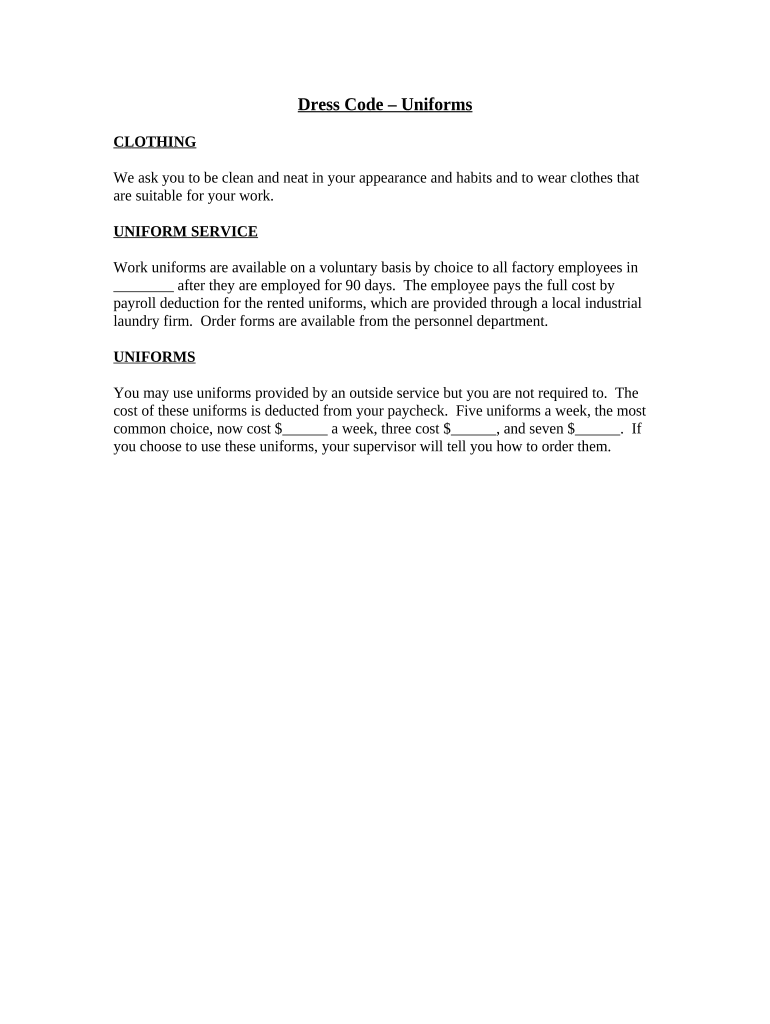
A Dress Code and Uniform Policy is a written company rule that defines acceptable workplace attire, uniform requirements, and grooming standards. It explains who must wear uniforms, when and where they apply, permitted variations for different job functions or shifts, and any employer-provided uniform items. The policy also covers accommodations for religious practices and medical needs, guidance on branded insignia, laundering or replacement procedures, and disciplinary steps for noncompliance. Clear definitions and examples reduce disputes, support consistent enforcement, and help protect employers against claims of unfair or discriminatory treatment.

Why a Clear Dress Code and Uniform Policy Matters

A concise policy promotes workplace safety, consistent branding, and nondiscriminatory enforcement while reducing confusion among staff. It also documents employer expectations and the process for exceptions and accommodations, which supports compliance with federal law such as ESIGN for records and nondiscrimination standards under Title VII.

Why a Clear Dress Code and Uniform Policy Matters

Who Typically Issues and Follows This Policy

Employers, HR teams, operations managers, and supervisors use this policy to set uniform expectations and manage compliance.

  • Human Resources and People Operations: draft, update, and track acknowledgements.
  • Site Managers and Supervisors: enforce daily compliance and log exceptions.
  • Employees and Contractors: read, acknowledge, and request accommodations when needed.

Essential Elements to Include in the Policy

A professional Dress Code and Uniform Policy should be structured, specific, and easy to apply across roles and locations.

Scope

Define who the policy covers (employees, contractors, interns) and which locations, shifts, or events are subject to the rules.
Uniform Items

List employer-provided items, descriptions, acceptable brands/colors, care instructions, and replacement procedures.

Permitted Attire

Describe acceptable business, business casual, and casual options with concrete examples (e.g., collared shirt, closed-toe shoes).

Prohibited Items

Identify clearly prohibited clothing and accessories (e.g., offensive logos, unsafe footwear, ripped clothing).

Accommodations

Explain the process for religious or medical accommodations, required documentation, and reasonable modification procedures.

Enforcement

State progressive discipline steps, who documents violations, and how employees can appeal or request exceptions.

Required Information and Administrative Fields

Policy Title: Dress Code and Uniform Policy
Effective Date: MM/DD/YYYY
Policy Owner: Human Resources or People Ops contact
Scope: Employee groups covered
Accommodation Process: How to request exceptions
Acknowledgement: Employee signature and date

Step-by-Step: Creating and Implementing the Policy

Follow these sequential steps to draft, approve, distribute, and enforce the Dress Code and Uniform Policy.

  • 01
    Draft: Define scope, items, and accommodation process with legal review.
  • 02
    Review: HR and legal review for compliance with Title VII and state law.
  • 03
    Approve: Obtain executive sign-off and set effective date.
  • 04
    Distribute: Publish to employees and collect written acknowledgements.

How Policy Acknowledgement and Exceptions Flow

This describes the operational routing from distribution through accommodation or enforcement actions.

  • Publish Policy: HR uploads the policy and notifies employees via internal channels.
  • Acknowledgement: Employees sign and return the acknowledgement form; HR logs the response.
  • Accommodation Request: Employee submits request; HR evaluates with documentation.
  • Resolution: HR documents approved modifications or initiates corrective actions.

Configuring Online Distribution and Tracking

Set up a simple digital workflow to send, sign, and store acknowledgements for easy tracking and audits.

Field Configuration
Sender HR or delegated manager email
Recipient Employee email or group list
Authentication Email link or SMS code
Storage Central HR document repository

Digital Sharing and eSubmission Considerations

Use a platform that supports secure delivery, audit trails, and easy retrieval for HR records.

  • Supported Formats: PDF, DOCX
  • Authentication Options: Email, SMS, KBA
  • Integrations: HRIS, cloud storage

Typical Timelines and Key Dates

Track rollout and renewal dates to ensure employees have adequate notice and the policy remains current with legal changes.

Policy Effective Date:

Set at adoption (MM/DD/YYYY) and communicated 30 days in advance

Acknowledgement Deadline:

Typically 14–30 days from distribution

Accommodation Response Time:

HR decision expected within 14 business days

Periodic Review:

At least annually or when laws change

Revision Notice:

Provide 30 days' notice before substantive changes

Common Mistakes to Avoid

  • Vague language that leaves interpretation to individual managers and increases inconsistent enforcement.
  • Failing to document accommodations or exceptions, which can lead to discrimination claims.
  • Not tracking employee acknowledgements centrally, complicating audits and dispute resolution.
  • Overly prescriptive rules that conflict with religious or medical accommodation obligations.

Risks and Consequences of a Poor Policy

Discrimination Claims: Potential legal exposure under Title VII for failure to accommodate religious practices
OSHA/Safety Issues: Noncompliant attire may violate workplace safety regulations
Reputational Risk: Public disputes over enforcement can harm employer brand
Inconsistent Enforcement: Leads to morale problems and unequal treatment claims
Recordkeeping Gaps: Missing acknowledgements complicate defenses in litigation
Regulatory Penalties: Fines or corrective orders if safety standards are breached

Real-World Examples of Policy Use

Two anonymized examples show how employers apply the policy to common scenarios.

Retail Chain Example

A regional retail chain required branded polo shirts for sales staff to improve brand uniformity.

  • The policy included laundering guidance and replacement scheduling.
  • After rollout, the chain tracked acknowledgements electronically and reduced uniform-related disputes by documenting exception approvals and return procedures in HR records.

Healthcare Clinic Example

A clinic enforced color-coded scrubs by role to aid patient navigation.

  • It added PPE and laundering requirements per OSHA guidance.
  • The clinic documented accommodation requests for religious head coverings and retained approval records to support compliance during audits.

eSignature Vendor Comparison for Policy Distribution and Acknowledgements

Core features to support Dress Code and Uniform Policy distribution include starting price, free trial availability, bulk send, audit trail, HIPAA compliance, and envelope or session caps.

signNow DocuSign Adobe Sign PandaDoc HelloSign
Starting Price $8/user/mo $15/user/mo $14/user/mo $19/user/mo $15/user/mo
Free Trial 7-day free trial Varies by plan Varies by plan Varies by plan Varies by plan
Bulk Send Yes (Business Premium) Varies by plan Varies by plan Varies by plan Varies by plan
Audit Trail Yes Yes Yes Yes Yes
HIPAA Compliant Yes Yes Yes No No
Envelope Cap No cap 100 envelopes/user/year Varies by plan Varies by plan Varies by plan

Frequently Asked Questions and Troubleshooting

Answers to common questions about drafting, distributing, and enforcing a Dress Code and Uniform Policy.


Need help? Contact support

be ready to get more
Join over 28 million airSlate SignNow users