Establishing secure connection…Loading editor…Preparing document…

Equipment Maintenance Agreement

This template is fully customizable. Edit the text, fill out the fields, and send it for signature. Give it a try!
Equipment Maintenance Agreement

What an Equipment Maintenance Agreement Covers

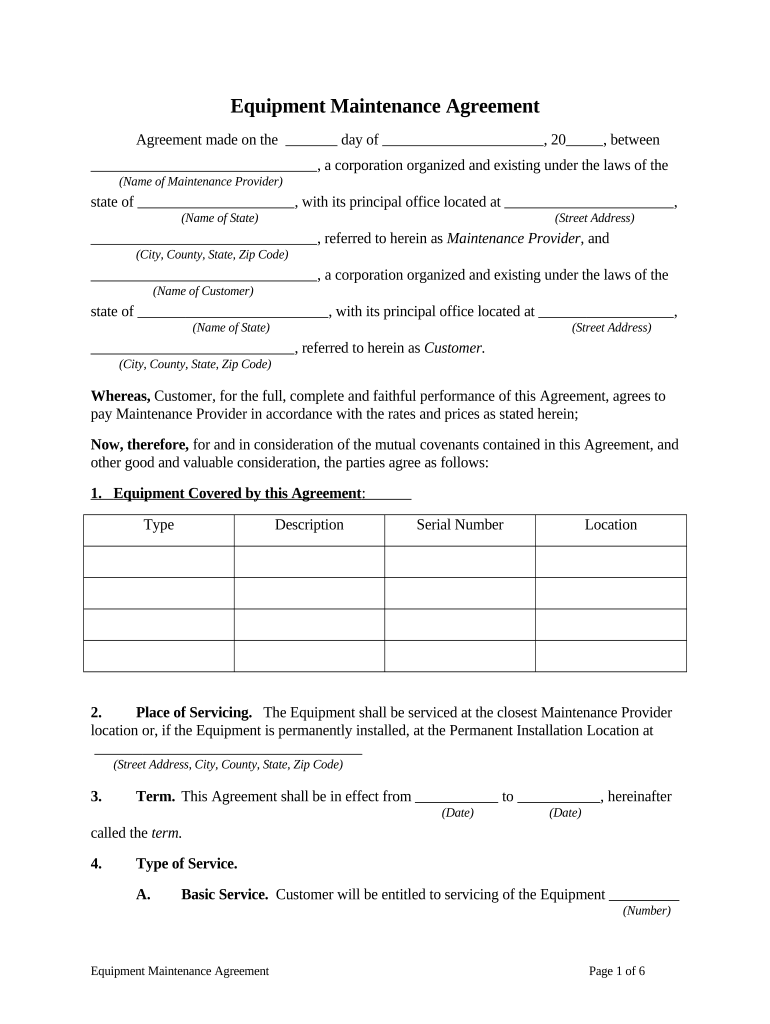
An Equipment Maintenance Agreement is a written contract that defines service obligations, response times, payment terms, liability limits, and inspection or testing responsibilities for the upkeep of machinery, fixtures, or systems. It sets the duration of coverage, whether preventive or corrective maintenance is included, and any spare-parts or consumables policies. These agreements allocate risk between owner and service provider, establish performance metrics and remedies for breach, and provide the administrative details needed to invoice, audit, and enforce obligations over the contract term.

Why a Clear Maintenance Agreement Matters

A well‑drafted Equipment Maintenance Agreement reduces downtime, clarifies payment and warranty terms, and limits liability by documenting expectations and remedies. It also supports regulatory and tax recordkeeping requirements and creates an auditable trail for service history and contract compliance.

Why a Clear Maintenance Agreement Matters

Who Typically Prepares and Signs These Agreements

Parties usually document roles, invoicing contacts, and authorized signatories within the agreement to prevent confusion during service delivery.

  • Facility managers and operations directors responsible for asset uptime and vendor selection
  • Service providers and independent contractors that supply technicians, parts, and scheduled maintenance
  • Procurement and legal teams who negotiate terms, SLAs, and indemnity provisions

Step-by-step: Completing an Equipment Maintenance Agreement

Follow these steps to assemble and finalize the agreement; complete each field accurately to avoid disputes and ensure enforceability.

  • 01
    Prepare details: List equipment IDs, serial numbers, and locations.
  • 02
    Define scope: Specify preventive vs corrective services and exclusions.
  • 03
    Set SLAs: Add response times, uptime targets, and remedies.
  • 04
    Sign and retain: Obtain authorized signatures and store executed copies.

Core clauses to include in a professional maintenance agreement

Include clear, enforceable clauses that assign responsibilities, define performance expectations, and describe remedies for noncompliance.

Scope of Work

Detailed description of services, frequency, and exclusions to avoid ambiguity and scope creep.
Service Levels

Response times, uptime targets, and measurable KPIs tied to remedies or credits for failures.

Payment and Invoicing

Pricing structure, invoicing schedule, late-payment penalties, and any pass-through costs.

Term and Renewal

Contract length, renewal mechanism, and termination notice periods to manage expectations.

Liability and Insurance

Limits of liability, indemnities, and required insurance certificates for service providers.

Data and Access

Onsite access, remote diagnostics, data sharing, and confidentiality protections for operational information.

Security and compliance controls to specify

Encryption: TLS 1.2/1.3 in transit; AES-256 at rest
Audit Trail: Record timestamps, IPs, and action history
Certifications: SOC 2 Type II; ISO 27001
HIPAA Support: BAA available where PHI involved
Regulatory Fit: ESIGN and UETA compliance
Accessibility: WCAG 2.0 Level AA

Typical workflow for issuing and signing the agreement

A consistent workflow reduces friction and captures necessary evidence for enforceability.

  • Draft: Owner or vendor prepares the agreement
  • Review: Legal and procurement review terms
  • Send for signature: Send to authorized signers via eSignature or print
  • Execution: Collect signatures and distribute executed copies

How to configure a digital workflow for maintenance contracts

Map key fields and automation points to speed execution and ensure completeness.

Field Configuration
Assigning Party Owner or vendor contact mapped to signature field
Maintenance Type Select preventive or corrective with conditional fields
Service Window Specify hours and blackout periods for scheduling
Response SLA Auto-notify when response times exceed threshold

Technical requirements for eSubmission and storage

Confirm the platform meets regulatory controls relevant to your industry and preserves a tamper-evident audit trail for executed agreements.

  • File Formats: PDF, DOCX, and Excel supported
  • Integrations: Salesforce, NetSuite, Google Workspace
  • Authentication: Email, SMS, or advanced methods

Key dates and timing obligations to track

Record and monitor critical dates to manage renewals, notice periods, and warranty timelines effectively.

Effective Date:

Date obligations begin; determines warranty windows

Service Commencement:

When first visit or monitoring starts

Renewal Notice:

Typically 30–90 days before contract end

Invoice Due Date:

Payment terms (for example, Net 30)

Warranty Claim Window:

Follow manufacturer warranty timelines

Key milestones from negotiation to service start

Track these sequential milestones to ensure timely approval, signature, and mobilization of service resources.

01

Draft Complete

Agreement language finalized and versioned

02

Internal Approval

Procurement and legal sign off

03

Execution

Authorized parties sign the agreement

04

Mobilization

Technicians scheduled and service begins

eSignature vendor comparison for executing maintenance agreements

Core pricing and capability differences across common eSignature providers. signNow is listed first as the primary vendor column.

signNow DocuSign Adobe Sign PandaDoc HelloSign
Starting Price $8/user/mo $15/user/mo $14/user/mo $19/user/mo $15/user/mo
Free Trial 7-day free trial Varies by plan Varies by plan Varies by plan Varies by plan
Bulk Send Yes (premium) Yes Yes Yes Varies
Audit Trail Yes Yes Yes Yes Yes
HIPAA Compliant Yes Yes Yes No No
Envelope Cap No envelope cap 100 envelopes/user/year Varies by plan Varies by plan Varies by plan

Real-world examples of digital agreement use

Organizations use electronic execution and standardized templates to reduce delays and centralize records.

Martin Properties — Founder

Tim Martin uses online execution to process compliance documents quickly.

  • Digital signing allowed mobile and offline completion for field teams.
  • He reported being able to execute inspection and service agreements without in-person meetings while maintaining required security and audit records.

Tech Data — CEO

Tech Data centralized contract workflows to accelerate vendor onboarding and revenue recognition.

  • Standardized templates reduced review cycles.
  • The result was improved internal coordination and faster deployment of maintenance vendors across facilities.

Practical tips for accurate and efficient completion

Adopt these practices to reduce disputes and speed execution while preserving evidence for enforcement or audits.

Use a standardized template
Maintain a single approved template with modular exhibits for equipment lists and SLAs. Centralized templates reduce negotiation time, ensure consistent liability and insurance language, and simplify regulatory review if multiple sites or states are involved.
Record equipment details precisely
Include serial numbers, model numbers, and physical locations. Accurate equipment identification prevents billing errors, enables targeted preventive maintenance, and supports warranty claims or parts ordering when repairs are needed.
Specify measurable SLAs and remedies
Define response windows, uptime targets, and service credits or termination rights for persistent failure. Measurable SLAs reduce disputes and provide objective bases for remedies or contract termination.
Keep an auditable signature record
Capture signer identity, timestamp, and access logs. Maintain executed copies and an audit trail to support enforceability under ESIGN and UETA and for regulatory audits.

Common mistakes to avoid

  • Vague scope language that omits component or parts exclusions and creates billing disputes
  • Missing equipment identifiers that make it hard to match service visits to the contract
  • No defined SLAs or remedies, leaving parties to rely on informal expectations
  • Failure to store executed copies and audit trails, complicating enforcement or claims

Potential legal and financial risks of errors

Incorrect Dates: May void warranty
Missing Signatures: Undermines enforceability
Tax Penalties: $60–$330 per incorrect 1099
I-9 Violations: $281–$2,789 per violation
Data Breach: Regulatory fines and remediation costs
Unauthorized Access: Contract and liability exposure

Who typically has authority to sign

Company Officer — CEO

A chief executive or other officer with delegated contracting authority often signs for the business. Confirm internal delegation (board resolution or procurement policy) and ensure the signer has authority to bind the company for the agreement term and potential renewals.

Operations Manager — Facility

Facility or operations managers may sign for routine maintenance within preset financial limits. When signing, require confirmation of delegated authority and cross-reference procurement thresholds to avoid unauthorized commitments.

Vendor pricing and capability snapshot

Compare core pricing and capability dimensions relevant to executing and managing maintenance contracts; signNow appears first in the vendor list.

signNow DocuSign Adobe Sign PandaDoc HelloSign
Starting Price $8/user/mo $15/user/mo $14/user/mo $19/user/mo $15/user/mo
Free Trial 7-day free trial Varies by plan Varies by plan Varies by plan Varies by plan
Bulk Send Yes Yes Yes Yes Varies
Audit Trail Yes Yes Yes Yes Yes
HIPAA Compliant Yes Yes Yes No No

Frequently asked questions about Equipment Maintenance Agreements

Answers to common procedural and legal questions when preparing, signing, and storing maintenance agreements.


Need help? Contact support

be ready to get more
Join over 28 million airSlate SignNow users